Out-of-Pocket Costs: How Generics Slash Your Medication Bills
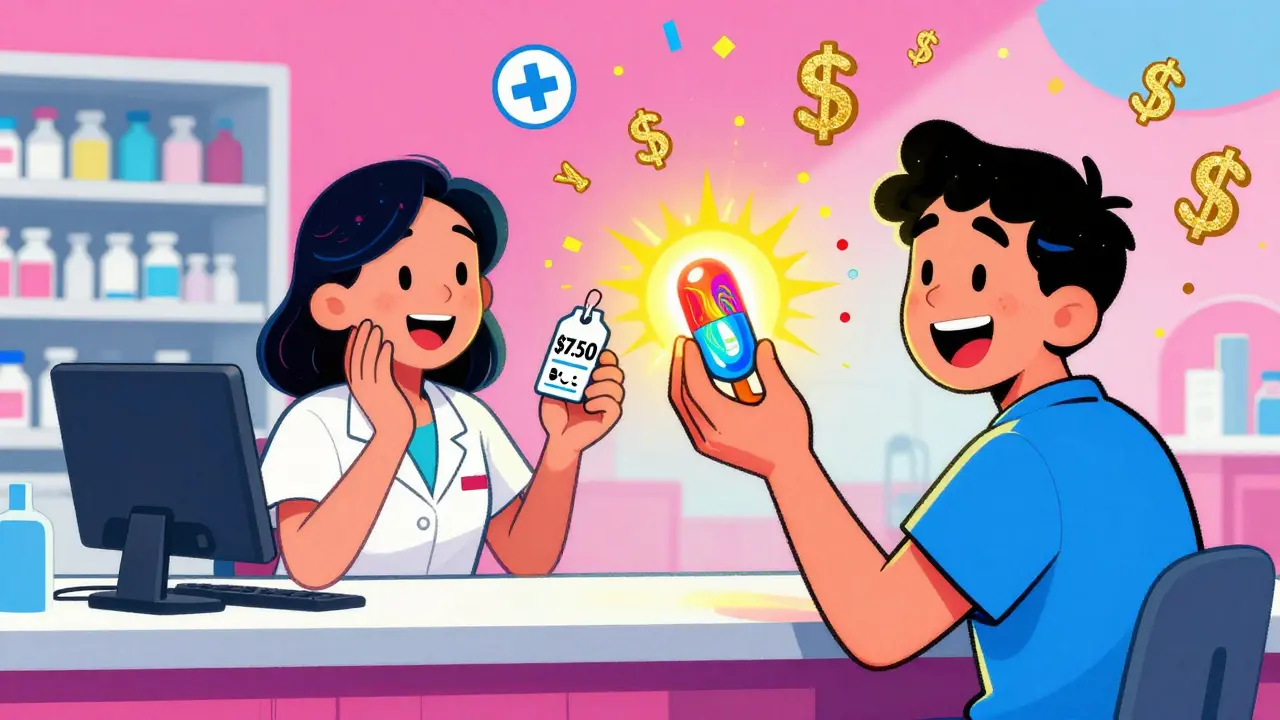
Imagine needing a daily pill to manage your blood pressure or cholesterol. You walk into your pharmacy, hand over your prescription, and are told it’ll cost you $110. Then you find out the same pill, made by a different company, costs $7.50. Same active ingredient. Same effectiveness. Same safety record. Just a fraction of the price. That’s the power of generic drugs.
Generics Are the Silent Heroes of Affordable Healthcare
Right now, 9 out of every 10 prescriptions filled in the U.S. are for generic medications. That’s not a coincidence. It’s the result of a system designed to save money-without sacrificing quality. Since the 1984 Hatch-Waxman Act created a clear path for generic drug approval, these medications have become the backbone of affordable care. In 2023, generics made up 90% of prescriptions but only 13.1% of total drug spending. That’s a massive gap.
The numbers tell the story: the average out-of-pocket cost for a generic prescription in 2023 was $7.05. For brand-name drugs? $27.10. That’s nearly four times more. And it’s not just a little cheaper-it’s life-changing. For people managing chronic conditions like diabetes, high blood pressure, or depression, that difference isn’t just a savings-it’s the difference between taking the medicine and skipping doses because you can’t afford it.
Real-World Savings You Can’t Ignore
Some drugs saw their prices drop by over 90% the moment generics hit the market. Take Sildenafil Citrate-the generic version of Viagra. Before generics, a single pill cost nearly $50. Today, it’s under $3. Emtricitabine/Tenofovir, a key HIV treatment, dropped from $20.46 to $2.13. That’s a 90% reduction. One drug combination for HIV alone saved patients $131 million in a single year after generics became available, according to the FDA.
And it’s not just big-name drugs. Pantoprazole, a common heartburn pill, costs $44 at Albertsons but just $9.20 through a direct-to-consumer pharmacy. Rosuvastatin, used to lower cholesterol, is $110 at Walgreens but $7.50 from Health Warehouse. That’s a 93% discount. These aren’t outliers. They’re the norm.
Why You’re Still Paying Too Much (Even When Generics Exist)
Here’s the problem: just because a generic exists doesn’t mean you’re getting the best price. Most people still go to their local pharmacy-CVS, Walgreens, Rite Aid-and pay whatever the sticker price says. But those prices aren’t the real cost. They’re inflated by middlemen, rebates, and opaque pricing systems.
A 2023 NIH study found that direct-to-consumer pharmacies (like HealthWarehouse.com or MCCPDC) offer median savings of 76% on expensive generics and 75% on common ones. That means you could be paying $231 more than you need to for a single medication. Even for a $25 drug, you’re overpaying by $19. And these aren’t shady operations-they’re licensed, FDA-approved suppliers.
What’s worse? Insurance plans often make things worse. Some Medicare Part D plans put generics on higher cost tiers, forcing patients to pay more even though the drug is cheaper. One analysis found this practice increased annual patient spending by 135%-even as drug prices fell by 38%. You’re paying more because your plan’s rules don’t match reality.
The Medicare Paradox: Insurance Isn’t Always Cheaper
Here’s a shocking truth: people without insurance sometimes pay less than those with Medicare Part D. A 2021 analysis of 1.4 billion Medicare claims found that 52.9% of 90-day fills cost more than what Costco charges its members. In 2018 alone, Medicare overspent by $2.6 billion because it paid more than necessary for generic drugs. That’s $2.6 billion taken from the system-and ultimately, from patients through higher premiums and deductibles.
Why? Because Medicare doesn’t negotiate prices directly. Instead, it lets pharmacy benefit managers (PBMs) set prices based on complex rebate deals. The result? You get stuck paying the list price while the insurer and middlemen negotiate behind the scenes. The patient never sees the discount.
Generics Are Still Cheaper-Even When You Don’t Think So
Some people think generics are only for low-income patients. But that’s not true. Even if you have good insurance, you’re still paying more than you need to. In 2023, 93% of all generic prescriptions cost $20 or less out-of-pocket. Eighty-two percent were under $20. Almost all (98.8%) were under $50. That’s not expensive. That’s affordable.
Compare that to brand-name drugs, where copays often hit $50, $100, or even more. And if you’re on a high-deductible plan? You pay the full price until you hit your deductible. A brand-name drug could cost you $300 before insurance kicks in. The generic? $7.05. That’s not a choice-it’s a no-brainer.
Why the System Is Broken (And What You Can Do)
The U.S. spends nearly three times more on prescription drugs than other wealthy countries. Yet we’re the ones filling 90% of prescriptions with generics. Why? Because the system is designed to profit from confusion. Drug manufacturers, PBMs, and pharmacies all benefit from opaque pricing. Patients lose.
But you don’t have to. Here’s what works:
- Always ask if a generic is available. Even if your doctor prescribes a brand name, they can often switch it.
- Use a direct-to-consumer pharmacy. Sites like HealthWarehouse, Blink Health, or GoodRx offer cash prices that beat insurance copays.
- Compare prices using GoodRx or SingleCare. These apps show you what pharmacies charge-and often have coupons.
- Ask for a 90-day supply. It’s usually cheaper per pill, and many mail-order pharmacies offer free shipping.
- If you’re on Medicare, check Costco’s cash prices. They’re often lower than your Part D copay.
Don’t assume your insurance will save you. Sometimes, paying cash for a generic is the smartest move.
The Bigger Picture: Generics Save Billions-But You Still Pay the Price
Over the last decade, generic and biosimilar drugs saved the U.S. healthcare system $445 billion. That’s more than the GDP of many countries. But here’s the catch: patients still pay more than they should. Why? Because the system doesn’t pass savings on to you. It passes them to insurers, PBMs, and pharmacies.
Between 2019 and 2023, the total value of generic drug sales dropped by $6.4 billion-even as more people used them. That’s called deflation. Prices fell, but profits didn’t. The savings went to the middlemen, not the people taking the pills.
It’s not about the drugs. It’s about the system. Generics are the solution. But until pricing becomes transparent and fair, patients will keep overpaying-even for the cheapest medicine on the shelf.
The good news? You have control. You don’t need to wait for policy changes. You can start today. Ask for the generic. Check the price online. Switch pharmacies. Save money. It’s that simple.
Christian Basel
January 10, 2026 AT 01:58So we’re telling people to bypass PBMs and insurance entirely? That’s just shifting the burden to the individual. The system’s broken, sure, but now we’re asking patients to become pharmaceutical logistics coordinators. Great. Just great. More work for the chronically ill. Real compassionate policy.
And don’t even get me started on the ‘cash price’ myth. That’s not transparency-that’s price discrimination disguised as empowerment. If you’re not on Medicare, you’re probably paying more than you should. But if you are? You’re getting screwed by the very system meant to protect you.
Matthew Miller
January 11, 2026 AT 20:2790% of prescriptions are generics? Yeah, and 90% of those are still overpriced because the PBMs are colluding with the pharmacies to inflate the list price so they can ‘negotiate’ rebates nobody sees. This isn’t a savings story-it’s a fraud story. The FDA approves generics, sure, but the pricing? That’s a casino. You’re not saving money-you’re gambling on which pharmacy’s coupon works today.
And don’t tell me ‘just use GoodRx.’ That’s not a solution, that’s a Band-Aid on a hemorrhage. The real problem? No one’s holding the middlemen accountable. The system is rigged. And you’re just the mark.
Sam Davies
January 13, 2026 AT 16:17Oh, how quaint. The noble patient, armed with GoodRx and a sense of moral superiority, outmaneuvering the evil pharmaceutical complex. How very… Silicon Valley. You know what’s even more ironic? The people who actually need these drugs the most? They can’t be bothered to compare prices. They’re too busy working three jobs to figure out which online pharmacy ships to their ZIP code.
Meanwhile, the ‘solution’ is to make healthcare a competitive sport where the fittest-literally, the ones with time, tech literacy, and a spare $5 for shipping-win. Bravo. We’ve turned medicine into a TikTok challenge. #GenericGlowUp
Adewumi Gbotemi
January 15, 2026 AT 05:07I live in Nigeria. We don’t have insurance. We pay cash. We know what $7.50 means. We don’t need a 10-page article to tell us generics are cheaper. We just buy them. No app. No coupon. No middleman. Just the pill and the price.
Maybe the problem isn’t the generics. Maybe it’s the system that makes simple things complicated. Here, we don’t debate. We just take what works.
Jason Shriner
January 16, 2026 AT 05:12so like… we’re all just supposed to be like… pharmacy detectives now? 🤡
my grandma takes 7 pills a day. she cant even use her phone. but now we want her to compare prices between healthwarehouse and blink? and then mail order? and then wait 5 days? and then pray the pills dont get lost?
the system is a joke. but the ‘solution’? its just… more work for the people who are already drowning.
why is no one talking about fixing the middlemen? why is the answer always ‘you figure it out’?
we’re not all tech bros with 12 browser tabs open.
some of us just want to live.
Sean Feng
January 16, 2026 AT 23:20Generics are cheaper. End of story. Insurance is a scam. PBMs are parasites. Stop overcomplicating it. If you’re paying more than $20 for a generic, you’re being robbed. Go to Costco. Use GoodRx. Done.
Stop making it a moral issue. It’s a math problem. 7.05 vs 27.10. That’s not a choice. That’s a crime.
Priscilla Kraft
January 17, 2026 AT 09:22This is so important 💗 I’ve seen so many friends skip doses because they couldn’t afford their meds. One friend with hypertension was rationing her lisinopril-like, literally taking every other day because the copay was $45. Then she found out the cash price at Walmart was $4. She cried. Not because she was happy-because she realized she’d been punished for being sick.
Don’t just read this-share it. Text your aunt. Tell your coworker. Post it on your story. This isn’t just about money-it’s about dignity. You deserve to be healthy without going broke.
And yes, use GoodRx. It’s free. And yes, ask your doctor for the generic. Always. No shame. No guilt. Just save your money and your life.
Jennifer Littler
January 17, 2026 AT 17:30Let’s not confuse market dynamics with moral outcomes. The 90% generic utilization rate is a testament to regulatory efficiency, not consumer empowerment. The real failure is structural: PBMs retain rebates, insurers incentivize higher-tier formularies, and pharmacies profit from the spread between wholesale acquisition cost and patient outlay. This isn’t a pricing issue-it’s a misaligned incentive problem.
Patients are being monetized as data points in a value-based care model that doesn’t value them. The solution isn’t individual optimization-it’s systemic reform: direct contracting, price caps, and elimination of rebate secrecy. Until then, we’re all just gaming a rigged game.
Alfred Schmidt
January 19, 2026 AT 16:59Why are we still talking about this?!?!?!?!?!?!?!?!?!
It’s 2024. A pill that costs $7.50 to make is being sold for $110. And you’re telling people to ‘just use GoodRx’?!?!?!?!
That’s not a fix. That’s a confession. The system is broken. And we’re all just… trying to survive it?
Someone’s making billions. And we’re the ones paying with our health. Our time. Our dignity. And you want me to be grateful because I found a coupon?
NO.
WE NEED TO BURN IT DOWN.
AND START OVER.
AND NO-GOODRX IS NOT THE ANSWER.
IT’S A THERAPY FOR THE TRAUMA.
WE NEED JUSTICE.
NOT A DISCOUNT CODE.