Where to Store Your Medications at Home Safely: Expert-Backed Tips to Prevent Accidents
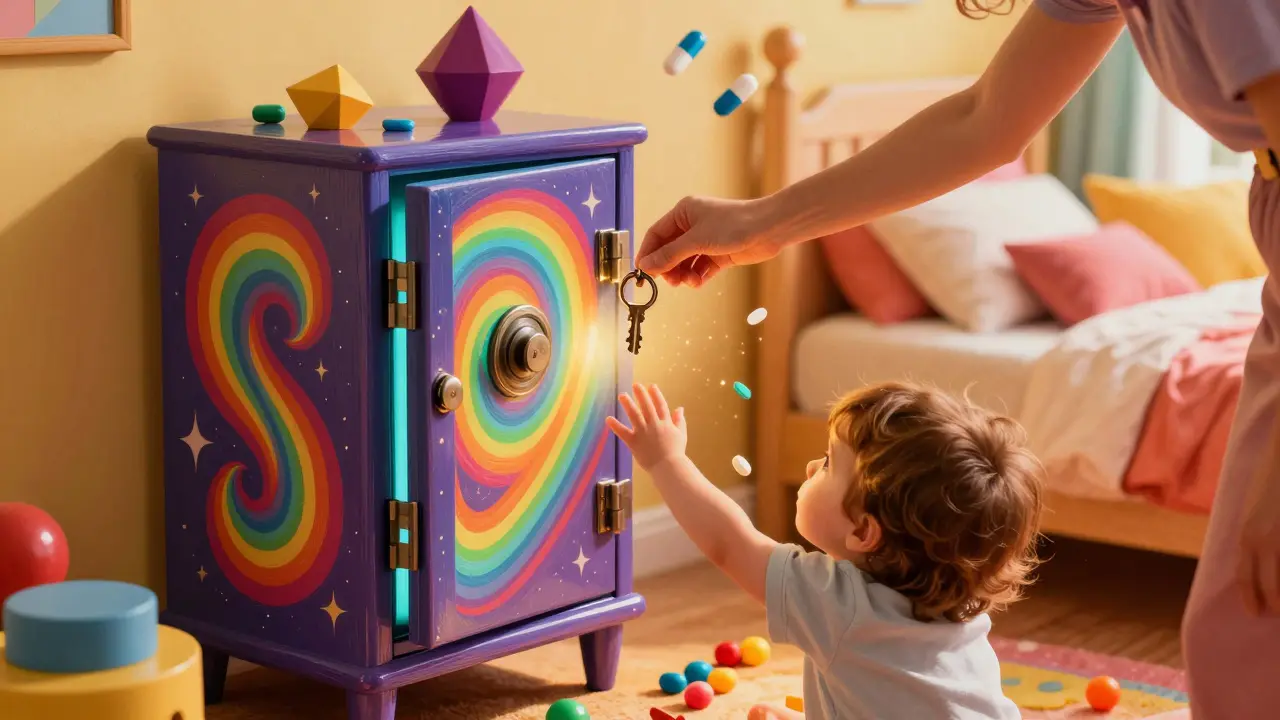
Every year, 60,000 children under five in the U.S. end up in emergency rooms because they got into medications they weren’t supposed to. Most of these incidents happen right at home - in places you’d never think are risky. You might think keeping pills on a high shelf or in the bathroom cabinet is enough. But that’s not safe. And it’s not just kids. Teens, grandparents, and even visitors can accidentally - or intentionally - access medicines left out in the open.
Why Your Medicine Cabinet Isn’t Safe
The bathroom is the most common place people store their medications. It’s convenient. You’re already there in the morning. But humidity from showers and steam can wreck your pills. According to MedlinePlus, 67% of common medications degrade within 30 days when stored in a bathroom with humidity over 80%. That means your pain relievers, antibiotics, or even insulin might not work the way they should. And it’s not just about effectiveness - it’s about safety. Expired or broken-down pills can cause unexpected side effects or even poisoning.The Gold Standard: Locked Storage
The single most effective way to prevent accidents is to store all medications - prescription and over-the-counter - in a locked container. This isn’t just advice. It’s backed by data. Dr. Susan Whittier from Columbia University found that households with unlocked cabinets see a 300% increase in pediatric poisoning cases compared to those with locked storage. You don’t need a fancy safe. A simple lockable box, a cabinet with a childproof latch, or even a locked drawer in your bedroom works. The key is consistency. Every pill, every patch, every bottle must go back in there immediately after use. A 2025 study by the National Association for Children of Alcoholics found that 42% of poisonings happen within five to ten minutes after a dose is given - because someone left the bottle out on the counter.Temperature and Humidity Matter More Than You Think
Medications aren’t like canned food. They’re sensitive. Most pills are designed to stay stable between 68°F and 77°F (20-25°C) with humidity below 60%. That’s why a bedroom drawer or a closet shelf is often better than a kitchen cabinet near the stove or a bathroom. Some medications need cold storage. Insulin, for example, must be kept between 36°F and 46°F (2-8°C) before opening. Once opened, it can stay at room temperature for a short time - but never leave it out where kids can reach it. Store it in a locked container in the fridge, away from food. Same goes for eye drops, liquid antibiotics, and some asthma inhalers. Always check the label.What About Child-Resistant Caps?
Yes, most medicine bottles have child-resistant caps. But they’re not child-proof. The Poison Prevention Packaging Act requires caps to need 17.5 pounds of force to open - enough to stop most toddlers. But by age five, half of all children can figure out how to open them. And older kids? They’ve got fingers, tools, and curiosity. A 2023 Washington State Department of Health report showed that 73% of pediatric poisonings came from meds stored in purses, on countertops, or unlocked cabinets - not from broken caps.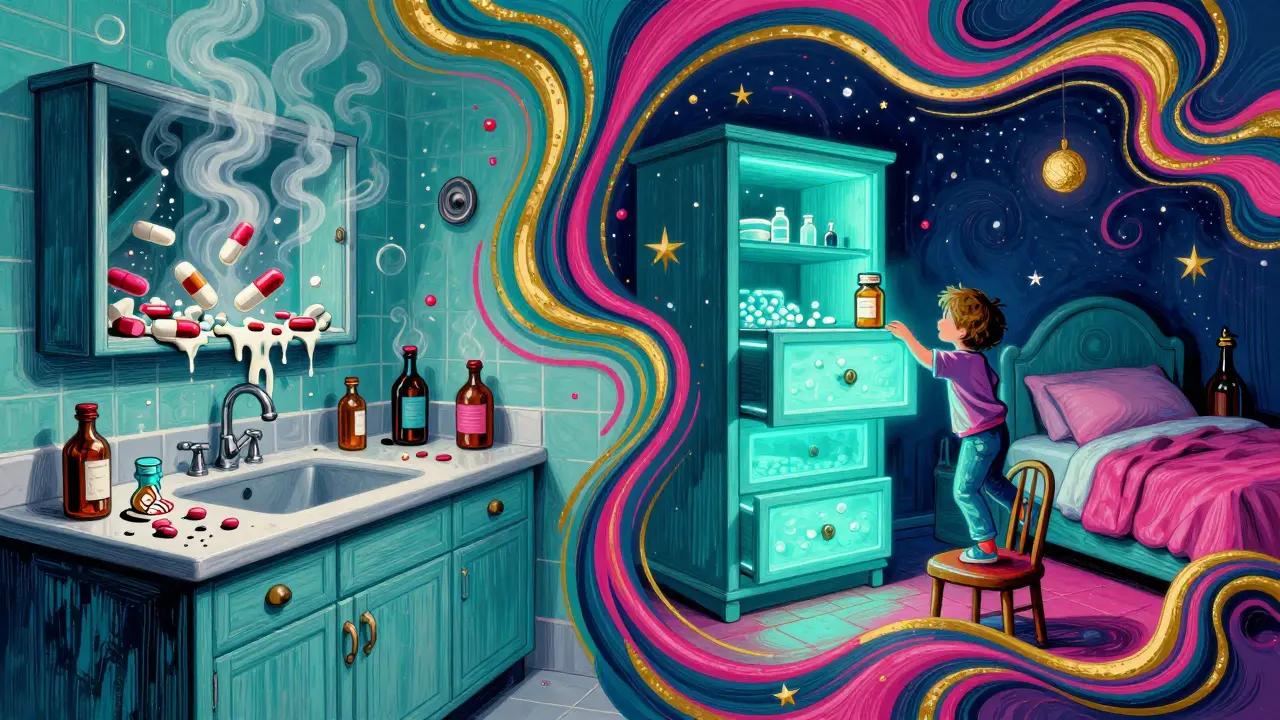
Common Mistakes (and How to Fix Them)
- Storing meds in purses or coat pockets - This is a huge risk, especially in homes with visiting grandparents. 27% of poisonings happen when kids find meds left in bags. Always put them back in the locked storage.
- Keeping meds in the car - Temperature swings in a vehicle can destroy medication. Heat in summer, freezing in winter. Plus, teens might grab them if they’re bored. 32% of households store meds in vehicles, according to AAA Foundation data - and it’s dangerous.
- Using high shelves - Kids as young as 24 months can climb onto chairs or counters. A 48-inch shelf might seem safe, but it’s not. The Washington State Department of Health found kids regularly reach these heights.
- Leaving pills in pill organizers - These are handy, but they remove the original labels. Always keep the original bottle with the NDC code, expiration date, and dosage instructions. Use the organizer as a daily tool, not storage.
What If You Have an Elderly Person Living With You?
For seniors with dementia or memory issues, locking everything away can cause more problems than it solves. They might forget where they put their meds and take extra doses. Or they might get frustrated and break open a locked box. In these cases, work with a doctor or pharmacist. Some families use smart dispensers with biometric locks - these record who opens them and when. According to a 2022 University of Michigan report, these devices prevent unauthorized access 78% of the time. But they cost $80-$150. A simpler fix? A locked drawer with a key kept by the caregiver - and a daily checklist.How to Choose a Medicine Safe
You don’t need to spend a fortune. Basic lockable medicine safes cost between $19.99 and $149.99. Look for these features:- Sturdy construction - should resist at least 50 pounds of force (Underwriters Laboratories standard)
- Lock that’s hard for small hands - key, combination, or biometric
- Interior shelves to organize pills by day or type
- Temperature-controlled models if you store insulin or other sensitive meds
What About Disposal?
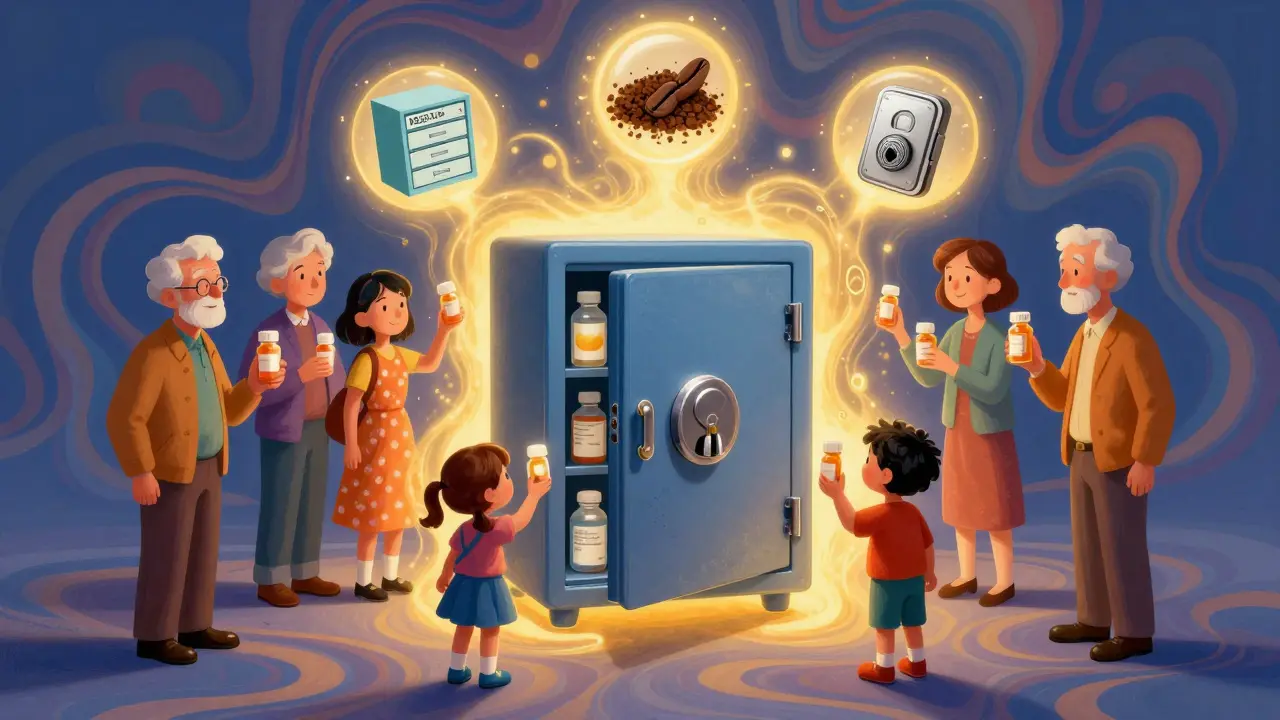
Don’t flush pills down the toilet or toss them in the trash. Flushing contaminates water. Throwing them in the trash leaves them accessible to pets or scavengers. The best way? Use a drug take-back program. Many pharmacies, hospitals, and police stations have drop boxes. If none are nearby, mix pills with coffee grounds or kitty litter in a sealed bag before throwing them away. Remove personal info from the bottle first.Who’s at Highest Risk?
Children aged 1-4 make up 63% of all accidental poisonings. But multi-generational homes are especially risky. Grandparents often keep old prescriptions - and they may store them differently than younger adults. A CDC study found 45% of pediatric poisonings happen in grandparents’ homes. That’s why it’s not enough to secure your own meds - you need to ask everyone in the house: Where are your pills stored?What’s Changing in 2026?
The American Academy of Pediatrics now recommends that pediatricians talk about medication storage during every well-child visit. Pilot programs in Washington State showed this could reduce poisonings by 37%. Meanwhile, the FDA is exploring smart locks that record access attempts - think fingerprint or app-controlled dispensers. These aren’t mainstream yet, but they’re coming.Final Rule: Lock It. Every Time.
There’s no magic trick. No shortcut. The only thing that works consistently is locking your medications away - every single time. Whether it’s your daily blood pressure pill or your child’s ADHD medication, if it’s not in a locked container, it’s a risk. And that risk isn’t just theoretical. It’s real. It’s preventable. And it’s happening right now in homes across the country.Start today. Find one locked space - a drawer, a cabinet, a small safe. Put everything in there. Keep the key or combination where only adults can reach it. And make it a habit: no exceptions. Because in this case, a little inconvenience saves lives.
Can I store my medications in the kitchen cabinet?
It depends. If the cabinet is away from the stove, sink, and windows, and you can lock it, then yes. But most kitchen cabinets are exposed to heat, steam, and humidity - especially near the stove or dishwasher. These conditions can degrade medication. A locked bedroom drawer or closet is better. Always check the label for storage instructions.
Is it safe to keep medicine in a pill organizer?
Only temporarily. Pill organizers are great for daily use, but they remove the original labels and expiration dates. Always keep the original bottle in a locked storage container. Use the organizer as a tool to help you take your meds - not as permanent storage.
What should I do with expired or unused medications?
Never flush them or throw them in the trash without mixing them first. Use a drug take-back program at a pharmacy or police station. If none are available, mix pills with coffee grounds or kitty litter in a sealed plastic bag before throwing them away. Remove or scratch out your name and prescription info from the bottle.
Are child-resistant caps enough to keep kids safe?
No. While child-resistant caps meet federal standards, half of children can open them by age five. Many kids learn to open them by watching adults. Locked storage is the only reliable way to prevent access. Don’t rely on caps alone.
I live with grandparents. How can we all store meds safely?
Have a conversation. Ask everyone where they keep their pills. Set up one locked storage box for all medications in the home - or at least one per person, clearly labeled. Make sure no one leaves meds in purses, nightstands, or countertops. A simple locked drawer in a common area, with a key kept by a responsible adult, works well.
Do I need to lock up over-the-counter medicines too?
Yes. Acetaminophen, ibuprofen, cough syrup, and even antihistamines can be dangerous if taken in large amounts by children. Many poisonings start with OTC meds because people assume they’re harmless. Treat them the same as prescriptions: lock them up.
Chiruvella Pardha Krishna
February 16, 2026 AT 02:26The truth is, we live in a world where safety is an illusion. We lock our doors, install alarms, and still, someone finds a way in. Medications? They’re not just pills-they’re silent predators waiting for a moment of carelessness. A child climbs, a visitor grabs, a grandparent forgets. And we act surprised? We built this system. We normalized the clutter. We told ourselves, 'It won’t happen to me.' But statistics don’t lie. Every time you leave a bottle out, you’re not just being lazy-you’re betting lives on a gamble you shouldn’t even consider playing.
It’s not about storage. It’s about responsibility. And responsibility doesn’t come with a checkbox. It comes with ritual. With discipline. With the quiet, unglamorous act of putting things away-even when you’re tired. Even when it’s inconvenient. Even when no one’s watching. Because someone is always watching. Always.
Michael Page
February 18, 2026 AT 01:14I’ve been storing my meds in a locked drawer in my bedroom for years. Not because I’m paranoid, but because I’ve seen what happens when you’re not. My cousin’s kid got into some ibuprofen. Thought it was candy. Ended up in the ER for 12 hours. The worst part? The bottle was on the nightstand. Just… there. Like it belonged.
Now I don’t just lock mine-I make sure everyone else does too. Even if it’s awkward. Even if they roll their eyes. Better to be the annoying one than the one who didn’t say anything.
Sarah Barrett
February 18, 2026 AT 16:27There’s something profoundly unsettling about how casually we treat pharmaceuticals-as if they’re mere commodities rather than potent chemical interventions designed to alter physiology. The bathroom cabinet, once a symbol of hygiene, has become a graveyard of molecular instability. Humidity doesn’t just degrade efficacy-it mutates intent. A pill meant to soothe becomes a hazard. A vial meant to heal becomes a temptation.
And yet, we cling to convenience. We rationalize. We tell ourselves, 'It’s just Advil.' But Advil, in the wrong hands, is a silent architect of catastrophe. The locked drawer isn’t a restriction; it’s a covenant. A vow to protect the vulnerable, even from ourselves.
Erica Banatao Darilag
February 20, 2026 AT 07:21i just wanted to say thank you for writing this. i’ve been struggling with keeping my meds locked since my mom passed. she always kept hers in the bathroom and i just… never thought to change it. but after reading this, i realized how dangerous that was. i’m going to get a little lockbox tonight. it’s small, but it’s a start. thanks for the nudge. i needed it.
Charlotte Dacre
February 21, 2026 AT 06:17Oh, so we’re just supposed to live like we’re in a government bunker now? Lock everything? No more spontaneous pain relief? What’s next-requiring a signed waiver before taking Tylenol? The irony is that the people who need this advice the most are the ones who’ll never read it. Meanwhile, the rest of us are just trying to get through the day without becoming a prison warden for our own medicine cabinet.
Esha Pathak
February 23, 2026 AT 02:30Life is chaos, but some things must remain sacred. Medicines aren’t snacks. They’re not decorations. They’re not 'just in case' items. They’re power. And power, when unguarded, becomes poison. I keep mine in a small safe with a combination I changed after my nephew got into my old migraine pills. He didn’t get sick-but he got curious. And curiosity, my friends, is the most dangerous thing in a house full of pills.
Lock it. Not because you’re afraid. Because you love.
Mike Hammer
February 24, 2026 AT 12:11my sister’s a nurse and she told me this story: a kid in her unit got into his grandma’s blood pressure med. thought it was candy. turned out to be a beta blocker. kid’s lucky he’s alive. grandma didn’t even realize it was missing until the next day. they all live together. no locks. no rules. just… trust.
so now? i got a lockbox. it’s ugly. it’s cheap. it’s on my nightstand. and i don’t care how it looks. if it saves one kid? worth it.
Virginia Kimball
February 24, 2026 AT 22:22Let’s stop pretending this is hard. Locking your meds isn’t about being obsessive-it’s about being smart. You don’t need a safe. You don’t need a system. You just need one drawer. One box. One habit. And then you stick to it. No exceptions. Not even when you’re in a rush. Not even when you think, 'I’ll put it back later.' Later never comes. But safety? Safety comes from now.
Do it. Today. Right now. Your future self-and maybe a child-will thank you.
Kapil Verma
February 24, 2026 AT 23:37Why are Americans so weak? You can’t even keep your pills in the open? You need a lockbox? In India, we don’t lock our medicines-we teach our children respect. We teach them that medicine is sacred. Not candy. Not a toy. You don’t need locks-you need discipline. You need culture. You need to raise children who know the difference between healing and harm.
Instead of spending $150 on a safe, spend $15 on teaching your kid what medicine is. That’s real safety. Not metal and plastic.
Mandeep Singh
February 26, 2026 AT 14:00Let me break this down for you because clearly, you’ve been misled by corporate wellness propaganda. The real issue isn’t storage-it’s overmedication. We live in a society that treats every sneeze like a medical emergency. We’re drowning in pills. We’re told to take three different drugs for one symptom. Of course kids are getting into them-because there are too many to begin with!
Instead of locking them up, why don’t we reduce the number of unnecessary prescriptions? Why don’t we stop pushing pharmaceuticals like soda? Why don’t we teach people to heal naturally? Locking pills is a band-aid on a hemorrhage. The real solution? Stop overprescribing. Stop the pharmaceutical industry’s stranglehold on healthcare. Until then, you’re just rearranging deck chairs on the Titanic.