When to Test Anti-Xa Levels for LMWH: Signs That Demand Monitoring
LMWH Anti-Xa Monitoring Calculator
Clinical Assessment
This tool helps determine if Anti-Xa testing is clinically indicated based on key factors from the article.
Results
Most people on low molecular weight heparin (LMWH) like enoxaparin or dalteparin never need an Anti-Xa test. That’s because these blood thinners are designed to work reliably without constant lab checks. But when things go wrong-when a patient bleeds for no reason or develops a clot despite being on the right dose-that’s when Anti-Xa testing becomes life-saving. It’s not about routine monitoring. It’s about Anti-Xa monitoring as a targeted tool for high-risk situations where standard dosing fails.
Why Anti-Xa Testing Exists
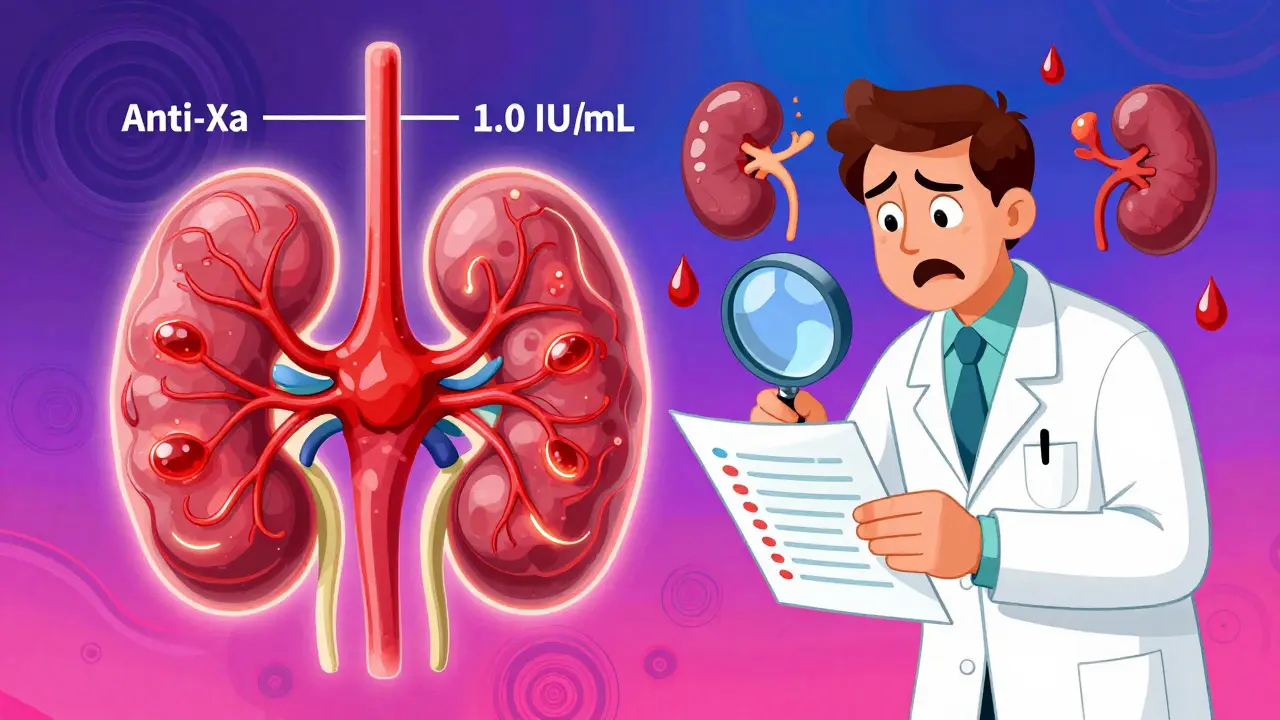
LMWH works by blocking factor Xa, a key player in blood clotting. Unlike unfractionated heparin, which needs frequent aPTT checks, LMWH has a more predictable effect in most people. But predictability isn’t the same as universality. In certain patients, the body doesn’t process the drug the way it should. That’s where Anti-Xa levels come in. The test measures exactly how much of the drug is active in the bloodstream at a given time. A level between 0.6 and 1.0 IU/mL is the target for treatment, and 0.2 to 0.5 IU/mL for prevention. But numbers alone don’t tell the story. They only matter when paired with what’s happening in the patient’s body.When Side Effects Trigger Testing
The biggest red flag for Anti-Xa testing is unexpected bleeding. If someone on LMWH starts bleeding heavily after minor trauma-or worse, spontaneously-it’s not just a coincidence. It could mean the drug has built up to dangerous levels. This is especially true in patients with kidney problems. When creatinine clearance drops below 30 mL/min, LMWH sticks around much longer. In severe kidney failure (CrCl <15 mL/min), its half-life can stretch from 5 hours to over 20 hours. Without a test, you’re flying blind. A single Anti-Xa level drawn 4-6 hours after a dose can reveal if the concentration is sky-high, justifying a dose reduction or switch. The other side of the coin is clotting despite treatment. If a patient develops a deep vein thrombosis or pulmonary embolism while on therapeutic-dose LMWH, something’s off. Maybe they’re not absorbing the drug. Maybe they’re metabolizing it too fast. Maybe they’re noncompliant. Anti-Xa testing can help rule out underdosing. In one 2018 audit at Ventura County Medical Center, patients with unexplained clots on LMWH who got tested had their doses adjusted correctly in 92% of cases-with zero complications from those changes.High-Risk Groups That Need It
Not everyone needs this test. But some groups are at clear risk:- Severe kidney impairment (CrCl <30 mL/min): The kidneys clear LMWH. When they fail, the drug accumulates. Anti-Xa levels guide safe dosing.
- Extreme body weight (over 150 kg or under 40 kg): Standard weight-based dosing doesn’t always work here. In morbidly obese patients, volume of distribution changes, and drug levels can be unpredictable.
- Pregnancy: Hormonal shifts and increased blood volume alter how LMWH behaves. Target levels shift to 0.2-0.6 IU/mL, and monitoring is often used in high-risk cases like prior VTE or antiphospholipid syndrome.
- Pediatric patients: Kids process drugs differently. Protocols exist for neonates and children, especially those on long-term anticoagulation.
- Drug interactions: Some antibiotics and medications can interfere with LMWH metabolism. If a patient suddenly bleeds after starting a new drug, check the level.

What the Numbers Don’t Tell You
Anti-Xa tests aren’t perfect. One number won’t tell you if someone is safe or in danger. A level of 1.2 IU/mL might seem high, but if the patient has no bruising or bleeding, it may not need adjustment. Conversely, a level of 0.8 IU/mL might look perfect-but if the patient just had a major GI bleed, you still need to act. That’s why the test should never be ordered in isolation. Studies show that 41% of patients with supratherapeutic Anti-Xa levels show no signs of bleeding. That’s why hospitals like Vanderbilt use multidisciplinary teams-pharmacists, hematologists, and nurses-to review each request before the test is done. In one program, inappropriate testing dropped by 63% after implementing structured order sets. Also, not all labs measure Anti-Xa the same way. There’s an 8-15% variation between machines and reagents. A level of 0.9 in one hospital might be 1.05 in another. Always know your lab’s reference range. And remember: the test can’t tell you if the patient is taking the drug at all. If compliance is in question, you need to talk to the patient, not just check the lab.When Not to Test
Most patients on LMWH for routine surgery prevention or simple DVT prophylaxis don’t need this test. A 2015 meta-analysis of over 12,800 patients found no difference in outcomes between those monitored and those not. Ordering it for routine post-op checks, follow-up visits, or just because “it’s there” adds cost and risk without benefit. In fact, inappropriate testing leads to harm. A 2018 audit found that 8% of patients who had their doses changed based on out-of-range Anti-Xa levels without clinical correlation ended up bleeding. Doctors sometimes see a number that’s “too high” and automatically lower the dose-even if the patient feels fine. That’s dangerous. Dose adjustments should only happen when the lab result matches the clinical picture.How the Test Is Done
Timing matters. The blood sample must be drawn 4-6 hours after the LMWH injection-that’s when the drug peaks in the blood. Drawing it too early or too late gives misleading results. The test is done using specialized coagulation analyzers like the STA-R Evolution or ACL TOP 750. Turnaround time is usually 2-4 hours in hospital labs. The cost? Around $45-$75 per test. That’s not trivial, especially when overused. There’s also no way to tell which LMWH drug is active-enoxaparin, dalteparin, or tinzaparin-just from the Anti-Xa result. All three are measured the same way. So if a patient switches from one to another, the level doesn’t automatically mean anything new.
What Comes Next
The future of Anti-Xa monitoring is precision, not volume. New point-of-care devices are being tested-like Diagnostica Stago’s STA-R Max 3-which showed 92% accuracy compared to central labs in a 2022 study. If these become widely available, testing could happen at the bedside, speeding up decisions. But the real win isn’t technology. It’s better protocols. Hospitals that use pharmacist-led anticoagulation teams, clear clinical algorithms, and education for providers see far fewer mistakes. The goal isn’t to test more-it’s to test smarter.What You Should Remember
- Anti-Xa monitoring is not routine. It’s a rescue tool. - Order it only when there’s a clinical red flag: unexplained bleeding or clotting despite proper dosing. - Always correlate the number with the patient’s symptoms. A high level without bleeding? Don’t adjust. A normal level with active bleeding? Look elsewhere. - Avoid testing in standard cases. It adds cost, risk, and confusion. - Know your lab’s reference range and timing rules. Don’t rely on generic numbers.Frequently Asked Questions
Do I need to check Anti-Xa levels every time someone gets LMWH?
No. Most patients on LMWH-like those after knee replacement or for DVT prevention-don’t need any monitoring. Anti-Xa testing is only used when something unusual happens, like unexpected bleeding or a clot despite treatment.
Can Anti-Xa levels be checked at any time after the injection?
No. For accurate results, the blood must be drawn 4-6 hours after the injection. That’s when the drug reaches its peak level. Drawing it earlier or later gives misleading numbers and can lead to wrong decisions.
Is Anti-Xa testing reliable for obese patients?
It can be, but only in specific cases. For patients over 150 kg or with BMI >40, standard dosing often works fine without testing. Studies show that using total body weight for dosing usually keeps levels in range. Testing is only needed if there’s a clinical problem-like a clot or bleed-that can’t be explained otherwise.
What if the Anti-Xa level is high but the patient isn’t bleeding?
Don’t change the dose just because the number is high. Many patients have supratherapeutic levels without any signs of bleeding. Always look at the whole picture: symptoms, kidney function, recent medications, and timing of the draw. Adjusting the dose based on a single number can cause under-anticoagulation and increase clot risk.
Can Anti-Xa testing detect if someone is not taking their LMWH?
No. The test only measures how much drug is in the blood at the time of the draw. It can’t tell you if the patient skipped a dose or took it late. If compliance is suspected, talk to the patient or caregiver. A low level could mean nonadherence-or it could mean the patient has a fast metabolism, kidney disease, or another issue.
Are there alternatives to Anti-Xa testing for LMWH?
For most patients, no. Unlike unfractionated heparin, which can be monitored with aPTT, LMWH doesn’t reliably affect that test. Other tests like platelet count or D-dimer can help rule out other problems, but only Anti-Xa gives a direct measure of the drug’s effect. That’s why it’s the gold standard when monitoring is truly needed.
Jillian Angus
December 24, 2025 AT 04:46Been on enoxaparin for 6 months after my pulmonary embolism. Never got tested. Never had an issue. Guess I'm just lucky.
CHETAN MANDLECHA
December 24, 2025 AT 06:17Anti-Xa testing is overhyped in most cases. I've seen residents order it for every obese patient like it's a magic bullet. The drug works fine if you dose by weight and check renal function. Stop overtesting.
Gray Dedoiko
December 25, 2025 AT 21:14My grandma bled out from a nosebleed on LMWH. They didn't check Anti-Xa till it was too late. If they'd tested sooner, she'd still be here. This isn't theoretical - it's life or death when it matters.
Johnnie R. Bailey
December 27, 2025 AT 05:55It's funny how we treat LMWH like it's some kind of autopilot drug. It's not. It's a finely tuned instrument - and like any instrument, it goes out of tune in people with weird metabolism, obesity, renal issues, or even just bad luck. Anti-Xa isn't about routine. It's about listening to the patient when the numbers don't match the symptoms. The body doesn't care about guidelines. It only cares about what's happening right now.
Chris Buchanan
December 28, 2025 AT 13:56Oh so now we're doing blood tests for every person on blood thinners? Next they'll be checking your Spotify playlist for clotting risk. LOL. Real talk - if your kidneys are trash, adjust the dose. If you're bleeding, stop the drug. Don't waste money on a test that won't change the next 5 minutes of care.
Pankaj Chaudhary IPS
December 29, 2025 AT 20:39As a practicing physician in rural India, I can tell you: we don't have the luxury of routine Anti-Xa testing. But when a patient with CKD stage 4 presents with GI bleeding - we fight for that test. It's not about cost. It's about survival. And yes, the target range matters. But clinical judgment matters more.
Cara Hritz
December 31, 2025 AT 15:02Wait so if you have a creatinine clearance under 30 you're supposed to get tested? But what if you're 90 and on dialysis? Do you still do it? I think the guidelines are outdated. I read a study last week that said Anti-Xa levels are useless in elderly patients because the correlation is all over the place. Also typo: 'CrCl ' should be 'CrCl.'
Rosemary O'Shea
December 31, 2025 AT 16:53How quaint. You treat a life-saving diagnostic tool like it's a bureaucratic checkbox. In Europe, we don't just 'dose by weight' - we *measure*. We don't rely on guesswork when anticoagulation is involved. To not monitor Anti-Xa in renal impairment is not just negligent - it's ethically indefensible. This is not a suggestion. It's a standard of care.
Ajay Sangani
January 1, 2026 AT 15:09you know what else is unpredictable? the pharma companies. they design these drugs so you need more tests so they can sell more tests. its not about the patient. its about profit. they dont want you to just use the drug. they want you to keep coming back. and the doctors? they just follow the script. its all a game.
EMMANUEL EMEKAOGBOR
January 3, 2026 AT 09:57While I appreciate the clinical insight, I must respectfully emphasize that the utility of Anti-Xa monitoring must be contextualized within resource-limited settings. In Nigeria, where access to laboratory infrastructure remains inconsistent, the decision to test must be guided not only by clinical indicators but also by feasibility. We do not abandon care in the absence of perfect tools - we adapt. When available, Anti-Xa is invaluable. When not, meticulous clinical vigilance becomes the surrogate. The goal remains the same: prevent harm.
Jamison Kissh
January 5, 2026 AT 07:30What’s interesting is how we treat LMWH like it’s a one-size-fits-all solution. But human biology is messy. Two people with the same weight, same CrCl, same dose - one stays at 0.7, the other spikes to 1.8. Why? Genetics? Gut flora? Unknown variables. Anti-Xa isn’t about following rules. It’s about accepting that medicine is still partly art. The test doesn’t replace intuition - it gives intuition data.
Sai Keerthan Reddy Proddatoori
January 6, 2026 AT 04:46LMWH is a government tool to control the population. They want you dependent on tests and drugs. Real healing is in nature. Eat garlic. Stop processed food. Why do you think they never tell you this? Because they make money off your fear. Anti-Xa? Just another scam.