Ulnar Neuropathy: Causes, Symptoms, and Effective Therapy Options

When your ring and little fingers go numb while you're driving, talking on the phone, or sleeping, it's not just a random tingling. It could be your ulnar nerve being squeezed - a condition called ulnar neuropathy. This isn't rare. In fact, it's the second most common nerve compression issue after carpal tunnel syndrome, affecting about 9% of all nerve entrapment cases. And if you're between 35 and 64, especially if you work with your arms bent for long periods, you're at higher risk.
What Exactly Is the Ulnar Nerve?
The ulnar nerve runs from your neck down to your hand. It starts at spinal nerves C8 and T1, then travels along the inside of your elbow, through a tight tunnel called the cubital tunnel, and down into your wrist, ending in your pinky and half of your ring finger. It’s not just a sensation wire - it controls key hand muscles that let you grip, pinch, and spread your fingers. When this nerve gets compressed, you don’t just feel weird tingles. You start losing strength. You might drop things. Your hand muscles can even shrink over time.
Where Does the Nerve Get Trapped?
There are two main spots where the ulnar nerve gets pinched:
- Cubital tunnel syndrome - at the elbow. This is the most common site. The nerve passes through a narrow bony groove behind the inner elbow (the medial epicondyle), with almost no padding. Bend your elbow for too long - like while sleeping or holding a phone - and the nerve gets squished.
- Guyon’s canal syndrome - at the wrist. Less common, but still significant. This happens when the nerve is compressed as it enters the palm. Causes include repetitive pressure (like leaning on your wrist while typing), ganglion cysts (which make up 40% of cases here), or even fractures.
Over 45% of wrist cases have no clear cause - they’re idiopathic. But elbow cases? Most are linked to posture or activity.
What Are the Symptoms?
Symptoms don’t come on all at once. They creep in. Here’s how they typically progress:
- Stage 1: Occasional numbness or tingling in the ring and little fingers - usually when the elbow is bent. You might wake up with a "dead" hand.
- Stage 2: Tingling becomes constant. You feel weakness when gripping, like struggling to open jars or hold a pen. Nighttime pain is common.
- Stage 3: Muscle wasting sets in. The small muscles between your fingers start to shrink. Your hand looks thinner. You might develop a "claw hand" - where your ring and pinky fingers curl inward. Your pinch grip weakens so much that you can’t hold a piece of paper between your thumb and index finger (this is called the Froment sign).
People often describe it as "my hand fell asleep and never woke up." And yes - it can get worse if you keep bending your elbow. A study found that sleeping with your elbow bent for hours was a major trigger for symptoms in over 60% of patients.
Who’s at Risk?
Men are slightly more likely than women to develop this. But it’s not just about gender. Certain jobs and habits increase risk:
- Plumbers, mechanics, and construction workers - elbow flexion all day.
- Customer service reps who hold phones to their ear for hours.
- People who rest their elbows on desks while typing.
- Those who sleep with their arms bent under pillows.
- Athletes who play tennis, golf, or do heavy weightlifting.
Even your posture at home matters. Slouching on the couch with your arm draped over the back? That’s a recipe for trouble.

How Is It Diagnosed?
Doctors don’t guess. They test. The process usually starts with a physical exam:
- Checking for numbness in the ring and little fingers.
- Testing muscle strength - especially the ones that spread your fingers.
- Looking for the Froment sign (thumb weakness when pinching).
- Tap or press along the nerve path - if it sparks tingling (Tinel’s sign), that’s a red flag.
Then comes nerve conduction studies. These measure how fast electrical signals move along the nerve. Slowed signals = compression. Ultrasound is also becoming popular - it can show swelling or movement of the nerve when the elbow bends. MRI is rarely needed unless a cyst or tumor is suspected.
Non-Surgical Treatment: The First Line
For mild to moderate cases, surgery is not the first answer. In fact, about 90% of people with early symptoms improve without it. Here’s what works:
1. Activity Changes
Stop doing what hurts. That means:
- Avoid leaning on your elbows.
- Don’t keep your arms bent for long periods - especially while sleeping or talking.
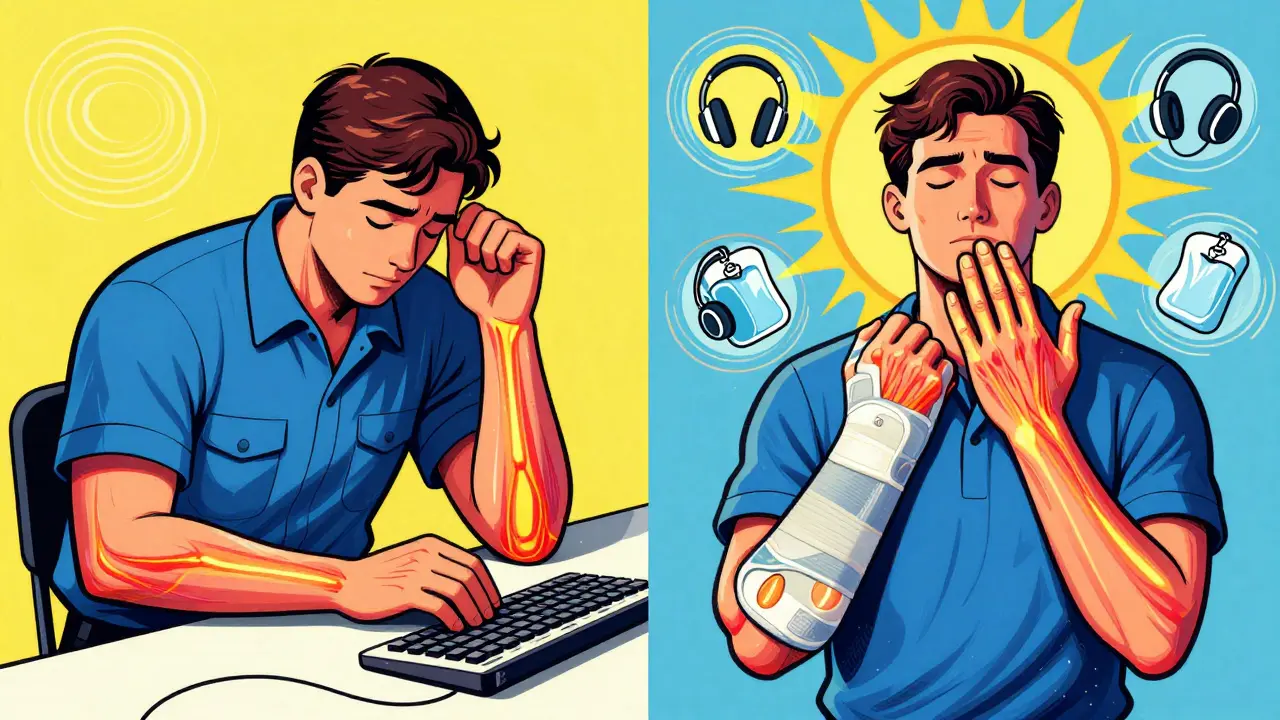
- Use a headset instead of holding your phone.
- Adjust your workstation so your elbows stay slightly bent (not locked) while typing.
2. Nighttime Bracing
Wearing a soft elbow splint at night is one of the most effective non-surgical treatments. It keeps your elbow from bending past 90 degrees while you sleep. Many patients report major improvement after just 4-6 weeks. Some need it full-time during flare-ups.
3. Medications
Over-the-counter NSAIDs like ibuprofen or naproxen help reduce swelling around the nerve. For nerve pain, doctors may prescribe gabapentin or pregabalin - these calm overactive nerves. Corticosteroid injections around the nerve can reduce inflammation, especially if symptoms are recent.
4. Physical Therapy
A certified hand therapist will teach you nerve gliding exercises. These aren’t stretches - they’re gentle movements that help the nerve slide smoothly through its tunnel. Do them 3-4 times a day. You’ll also get strengthening exercises for your hand muscles and stretches for your forearm. Progress is slow, but consistent therapy improves grip strength in over 70% of patients within 8-12 weeks.
Surgery: When It’s Necessary
If you have muscle wasting, constant numbness, or no improvement after 3-6 months of conservative care, surgery is usually recommended. Three main procedures are used:
- Simple decompression: The surgeon cuts the ligament over the cubital tunnel to give the nerve more space. It’s the least invasive. Recovery: 6-12 weeks.
- Decompression with anterior transposition: The nerve is moved from behind the elbow to the front. This prevents it from getting pinched when you bend your arm. Recovery: 3-6 months. Higher risk of infection.
- Medial epicondylectomy: Part of the bony bump (medial epicondyle) is removed to give the nerve more room. Used when the nerve keeps slipping out of place.
Studies show simple decompression and transposition are equally effective for most cases. But transposition has more complications. So unless the nerve is unstable or has been compressed for years, doctors usually start with decompression.
Still, about 12.5% of people have symptoms return after surgery - usually because the root cause (like repetitive pressure or poor posture) wasn’t addressed.
New and Emerging Therapies
Research is moving beyond traditional methods:
- Ultrasound-guided hydrodissection: A needle injects fluid around the nerve to gently separate it from surrounding tissue. Early results show promise for patients who don’t respond to bracing.
- Endoscopic decompression: A tiny camera and tools are used through a small incision. Less scarring, faster recovery. Still being studied but already used in some clinics.
- PRP injections: Platelet-rich plasma is injected to promote healing. Evidence is still limited - only small studies so far.
Doctors are also using tools like the QuickDASH questionnaire to track progress. It measures how much the condition affects daily life - grip, lifting, typing, even buttoning shirts.
Cost and Recovery
Non-surgical care usually costs $200-$500: doctor visit, splint, maybe therapy. Surgery? Between $5,000 and $15,000, depending on location and complexity. Insurance often covers it if conservative treatment failed.
Recovery time varies:
- Simple decompression: 6-12 weeks
- Transposition or epicondylectomy: 3-6 months
- Hand therapy starts 2-3 weeks after surgery
Most patients - 85-90% - regain good function and avoid permanent damage if treated in time. But delay? That’s when muscle loss becomes irreversible.
What Happens If You Ignore It?
Untreated ulnar neuropathy doesn’t just hurt. It disables. The muscles in your hand slowly die. Once they’re gone, no amount of surgery can bring them back. You’ll lose fine motor control - writing, typing, holding a fork becomes hard. You might permanently lose sensation in your fingers. That’s not just inconvenient. It changes how you live.
One patient I spoke to - a 52-year-old mechanic - waited 18 months before seeing a doctor. By then, his pinky finger wouldn’t straighten. He couldn’t grip his tools. He had to change careers. Early action saved his hand. Delay cost him his job.
Final Takeaway
Ulnar neuropathy isn’t a "wait and see" condition. It’s a progressive problem. If you feel tingling in your ring and little fingers - especially at night or after bending your elbow - don’t brush it off. Try the simple fixes first: change your posture, wear a night splint, avoid pressure on your elbow. If it doesn’t improve in 4-6 weeks, see a specialist. Get tested. Don’t wait for muscle loss. Because once it’s gone, you can’t get it back.
Can ulnar neuropathy go away on its own?
Sometimes, if it’s mild and caused by temporary pressure - like sleeping with your arm bent - symptoms can improve with rest and posture changes. But if the nerve is compressed for more than a few weeks, or if you feel weakness or muscle loss, it won’t heal on its own. Waiting too long risks permanent damage.
Is ulnar neuropathy the same as carpal tunnel?
No. Carpal tunnel affects the median nerve at the wrist and causes numbness in the thumb, index, and middle fingers. Ulnar neuropathy affects the ulnar nerve - usually at the elbow - and causes numbness in the ring and little fingers. They’re different nerves, different locations, different symptoms.
Can I still type or use a computer with ulnar neuropathy?
Yes, but you need to adjust. Use an ergonomic keyboard and mouse. Keep your elbows at a 90-degree angle. Don’t rest your forearms on hard surfaces. Take breaks every 30 minutes. If typing causes tingling, stop and stretch. Continuing without changes will make it worse.
Do I need an MRI to diagnose ulnar neuropathy?
Not usually. Nerve conduction studies and physical exams are the gold standard. Ultrasound is often enough to see swelling or movement of the nerve. MRI is only used if a cyst, tumor, or fracture is suspected - like in cases of unexplained wrist pain or sudden weakness.
How long does it take to recover after surgery?
Simple decompression takes 6-12 weeks. More complex surgeries like transposition or epicondylectomy take 3-6 months. You’ll start hand therapy 2-3 weeks after surgery. Full strength and sensation can take up to a year to return, especially if the nerve was compressed for a long time.
Are there any home remedies that help?
Yes - but they’re not cures. Ice packs for 10 minutes can reduce swelling. Avoid leaning on your elbow. Use a rolled towel under your arm while sleeping to keep it straight. Stretch your forearm muscles daily. But these only help in early stages. If symptoms persist, see a doctor - home remedies won’t fix nerve damage.
Can ulnar neuropathy come back after surgery?
Yes, in about 12.5% of cases. This usually happens if the original cause isn’t fixed - like continuing to rest your elbow on hard surfaces or not changing your work habits. That’s why lifestyle changes are just as important as surgery.
Alfred Noble
February 23, 2026 AT 13:40Also, stop leaning on your elbow while you're on the computer. I didn't realize how much I did it until I started paying attention. Game changer.
Emily Wolff
February 25, 2026 AT 01:42Cory L
February 26, 2026 AT 15:17Lisandra Lautert
February 28, 2026 AT 13:45William James
March 2, 2026 AT 00:58And yes - sleeping with your elbow bent is like sleeping with a kink in a garden hose. Eventually, the flow stops.
Joseph Cantu
March 3, 2026 AT 01:43Matthew Brooker
March 3, 2026 AT 22:56Valerie Letourneau
March 4, 2026 AT 18:01Jacob Carthy
March 4, 2026 AT 23:07Bhaskar Anand
March 5, 2026 AT 20:01David McKie
March 6, 2026 AT 15:12Southern Indiana Paleontology Institute
March 7, 2026 AT 17:42