Steroid Myopathy: How to Spot Weakness and Use Physical Therapy

Steroid Myopathy Symptom & Risk Checker
Symptom Assessment
Check the symptoms you are currently experiencing while taking corticosteroids:
Recovery Protein Calculator
Calculate your daily protein needs to counteract muscle catabolism:
Recommended Daily Protein Intake:
Based on 1.2–1.5g per kg of body weight to support muscle synthesis.
Action Plan:
- Spread intake across 3-4 meals
- Include Vitamin D supplementation
- Combine with moderate resistance training
- Avoid high-intensity workouts until strength returns
You’ve been taking prednisone or another steroid for months. Your inflammation is under control, but lately, you just feel… heavy. Getting out of a low chair requires pushing off with your arms. Climbing stairs feels like hiking up a steep hill. You aren’t in pain, but you’re weaker than you remember being.
If this sounds familiar, you might be dealing with steroid myopathy, also known as corticosteroid-induced myopathy. It’s a common, often overlooked side effect of long-term steroid use that causes painless muscle weakness, particularly in your hips and shoulders. The good news? It’s not permanent damage if caught early, and specific physical therapy strategies can help you regain strength without worsening the condition.
What Is Steroid Myopathy?
Steroid myopathy is a toxic, non-inflammatory muscle disease caused by exogenous corticosteroids. First described by Harvey Cushing in 1932, it remains the most common form of endocrine-related muscle disease today because steroids are so widely prescribed for conditions like asthma, rheumatoid arthritis, and autoimmune disorders.
The problem isn’t that the steroids are “bad”-they save lives by reducing dangerous inflammation. But they have a double-edged sword effect on muscles. Glucocorticoids bind to receptors in your muscle cells and trigger two harmful processes:
- Catabolic acceleration: They speed up the breakdown of muscle proteins through systems called the ubiquitin-proteasome and lysosomal pathways.
- Anabolic inhibition: They block your body’s ability to build new muscle tissue (myogenesis).
The result? Net muscle loss. This typically happens when patients take more than 10 mg of prednisone equivalents daily for four weeks or longer. However, acute cases can develop rapidly in hospital settings with high-dose IV steroids (40-60 mg/day) over just 2-3 weeks.
How to Recognize the Warning Signs
The tricky part about steroid myopathy is that it doesn’t hurt. Unlike injuries or inflammatory conditions like polymyositis, you won’t feel soreness or tenderness. Instead, you’ll notice functional failures in your proximal muscles-the big muscles closest to your trunk.
Your pelvic girdle (hips, thighs, glutes) is usually affected first and most severely. Shoulder girdle weakness follows later. Here’s what daily life looks like with undiagnosed steroid myopathy:
- You need to push off the armrests to stand up from a seated position.
- You struggle to lift your arms above shoulder height to brush your hair or reach a shelf.
- Climbing stairs requires holding the railing for balance and support.
- You feel unsteady on your feet, increasing fall risk.
A 2023 survey of patient forums revealed that 87% of respondents reported difficulty standing without using their arms, and 76% needed handrails for stairs. If you’re experiencing these issues, don’t assume it’s just “getting older” or “deconditioning.” Up to 40% of cases are misdiagnosed as disease progression.
Steroid Myopathy vs. Inflammatory Myopathy: Key Differences
Because both conditions cause proximal weakness, doctors sometimes confuse them. But the treatment paths are opposite: inflammatory myopathies require *more* immunosuppression, while steroid myopathy requires *less*. Here’s how to tell them apart.
| Feature | Steroid Myopathy | Inflammatory Myopathy (e.g., Polymyositis) |
|---|---|---|
| Pain | Painless weakness | Often painful or tender muscles |
| Creatine Kinase (CK) Levels | Normal (30-170 U/L) | Elevated (often >500 U/L) |
| EMG Findings | Unremarkable/Normal | Abnormal "early recruitment" patterns |
| Muscle Biopsy | Type 2b fiber atrophy; no inflammation | Inflammation, perifascicular atrophy |
| Response to Stopping Steroids | Weakness improves or stabilizes | Weakness worsens |
If your CK levels are normal but you’re weak, ask your doctor specifically about steroid myopathy. Standard manual muscle testing often misses early weakness-quantitative dynamometry detects deficits in 78% of patients who appear normal on routine exams.
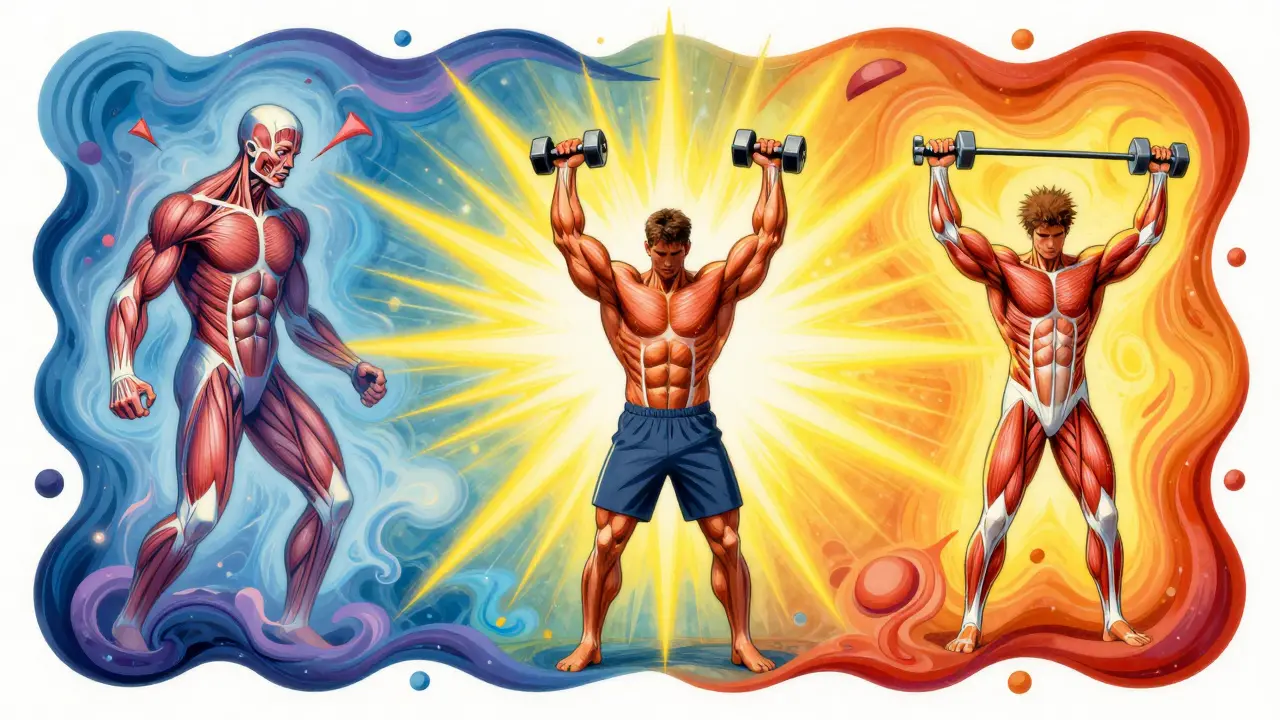
Physical Therapy Strategies That Work
Exercise is medicine, but not all exercise is equal here. Because steroids accelerate muscle breakdown, high-intensity workouts can actually make things worse. The goal is to stimulate protein synthesis without triggering excessive catabolism.
The American Physical Therapy Association recommends moderate-intensity resistance training, 2-3 times per week. A 2020 randomized controlled trial found that supervised resistance training improved timed chair-rise performance by 23.7% compared to 8.2% in controls after 12 weeks.
Safe Exercise Protocol
- Start Low: Begin at 30% of your 1-repetition maximum (1RM). This is a weight you can lift 10-12 times with good form.
- Progress Slowly: Increase intensity by only 5-10% every two weeks, based on tolerance.
- Focus on Proximal Muscles: Prioritize exercises for quadriceps, glutes, hamstrings, and shoulder stabilizers.
- Avoid Exhaustion: Stop before failure. The last few reps should still feel manageable.
- Include Balance Training: Since fall risk is higher, incorporate single-leg stands and heel-to-toe walking.
Avoid heavy lifting, sprinting, or high-impact activities until your baseline strength returns. Consistency matters more than intensity.
Functional Tests to Track Progress
You don’t need fancy lab equipment to monitor improvement. These simple tests, validated in clinical studies, help you and your therapist track changes objectively:
- Gower’s Maneuver: Time how long it takes to stand up from lying on the floor. Normal is under 10 seconds. If you’re using your hands to “walk” up your legs, that’s a sign of hip extensor weakness.
- Timed Chair Rise Test: Sit in a standard chair and stand up five times without using your arms. A time under 10 seconds is considered normal for most adults.
- Shoulder Abduction Strength: Lift your arms out to the sides against light resistance. Note any asymmetry or fatigue.
These tests have an 89% sensitivity for detecting early myopathy. Re-test every 4-6 weeks to ensure your rehab plan is working.

Can You Prevent Steroid Myopathy?
Prevention starts with medication management. Never stop steroids abruptly, but work with your prescriber to find the lowest effective dose. Alternatives like Vamorolone, a selective glucocorticoid receptor modulator (SEGRM), show promise in Phase II trials, causing 40% less muscle weakness than prednisone at equivalent anti-inflammatory doses.
While on steroids, support your muscles with:
- Adequate Protein Intake: Aim for 1.2-1.5 grams of protein per kilogram of body weight daily to counteract catabolism.
- Vitamin D Supplementation: Steroids impair calcium absorption and vitamin D metabolism, compounding muscle weakness.
- Regular Screening: Only 32% of rheumatology practices routinely assess muscle strength in steroid users. Advocate for yourself-ask for a strength check every 3-6 months.
When to See a Specialist
Contact your healthcare provider if you notice sudden worsening of weakness, difficulty breathing (which can indicate respiratory muscle involvement), or frequent falls. Acute steroid myopathy in critical care settings can lead to prolonged ventilation needs in 15-20% of cases, making early recognition vital.
Recovery is possible. With targeted physical therapy, dose optimization, and nutritional support, most patients see significant improvement within 3-6 months of adjusting their regimen.
Is steroid myopathy reversible?
Yes, in most cases. Once the steroid dose is reduced or discontinued, muscle strength typically begins to recover within weeks to months. Physical therapy accelerates this process by stimulating muscle protein synthesis and preventing further atrophy.
Which steroids cause myopathy?
All systemic corticosteroids can cause myopathy, including prednisone, prednisolone, dexamethasone, and fludrocortisone. Dexamethasone has a higher incidence rate due to its potent fluorinated structure, especially in high-dose protocols like those used for leukemia treatment.
Why are my CK levels normal if I have muscle weakness?
Creatine kinase (CK) leaks into the blood when muscle fibers are damaged or inflamed. Steroid myopathy causes muscle *atrophy* (shrinking) rather than active damage or inflammation. Therefore, CK levels remain within the normal range (30-170 U/L), which helps distinguish it from inflammatory myopathies.
Can I do cardio if I have steroid myopathy?
Yes, but focus on low-impact activities like swimming, stationary cycling, or elliptical training. Avoid high-impact running or jumping, which increase fall risk and may exacerbate muscle breakdown. Resistance training is more critical for rebuilding lost muscle mass.
How long does it take to see improvements with physical therapy?
Most patients notice functional improvements within 4-8 weeks of consistent, moderate-intensity resistance training. Full recovery may take 3-6 months, depending on the duration of steroid exposure and individual factors like age and nutrition.