Specialty Prescribing: Why Specialists Prefer Brand-Name Drugs
Ever wonder why your specialist insists on a specific brand-name medication when a cheaper generic or biosimilar seems available? It's not usually about the logo on the box. In the world of specialty prescribing is the practice of prescribing high-cost, complex medications used to treat rare or chronic conditions like cancer, multiple sclerosis, and rheumatoid arthritis, the stakes are incredibly high. For a doctor, choosing a brand-name drug over a cheaper alternative isn't just a preference-it's often a calculated clinical decision based on patient safety and outcome predictability.
The financial scale of these drugs is staggering. We aren't talking about a few extra dollars at the pharmacy counter. These medications often cost more than $670 per month, and in many cases, the annual bill exceeds $100,000. While they make up a tiny fraction of total prescriptions-roughly 0.5% to 6% depending on the year-they eat up over half of the total drug spending in programs like Medicare Part D. When a specialist writes a script for a brand-name specialty drug, they are navigating a complex web of clinical necessity and administrative hurdles.
The Clinical Logic Behind Brand Preference
Why not just go generic? For most common ailments, generics are identical. But Specialty Drugs are different. Many are large-molecule biologics, which are grown in living cells rather than synthesized from chemicals. This makes them incredibly sensitive. A specialist might prefer a brand-name drug because they have years of data on how that specific formulation behaves in a patient with a rare mutation.
Take a scenario with multiple sclerosis. A patient might be using Ocrevus, and while a provider might see a cheaper alternative on paper, the specific protein structure or the way the drug is delivered can be the difference between remission and a relapse. When a doctor says a biosimilar isn't "appropriate," they are often referring to the risk of "switching"-the possibility that a patient who is stable on a brand-name drug might develop antibodies or lose response if moved to a different version.
Furthermore, specialty medications often require strict Risk Evaluation and Mitigation Strategies (or REMS), which are safety programs required by the FDA. Brand-name manufacturers often provide more comprehensive support guides and monitoring tools, making the drug safer to administer in a clinical setting.
The Role of PBMs and Distribution Hurdles
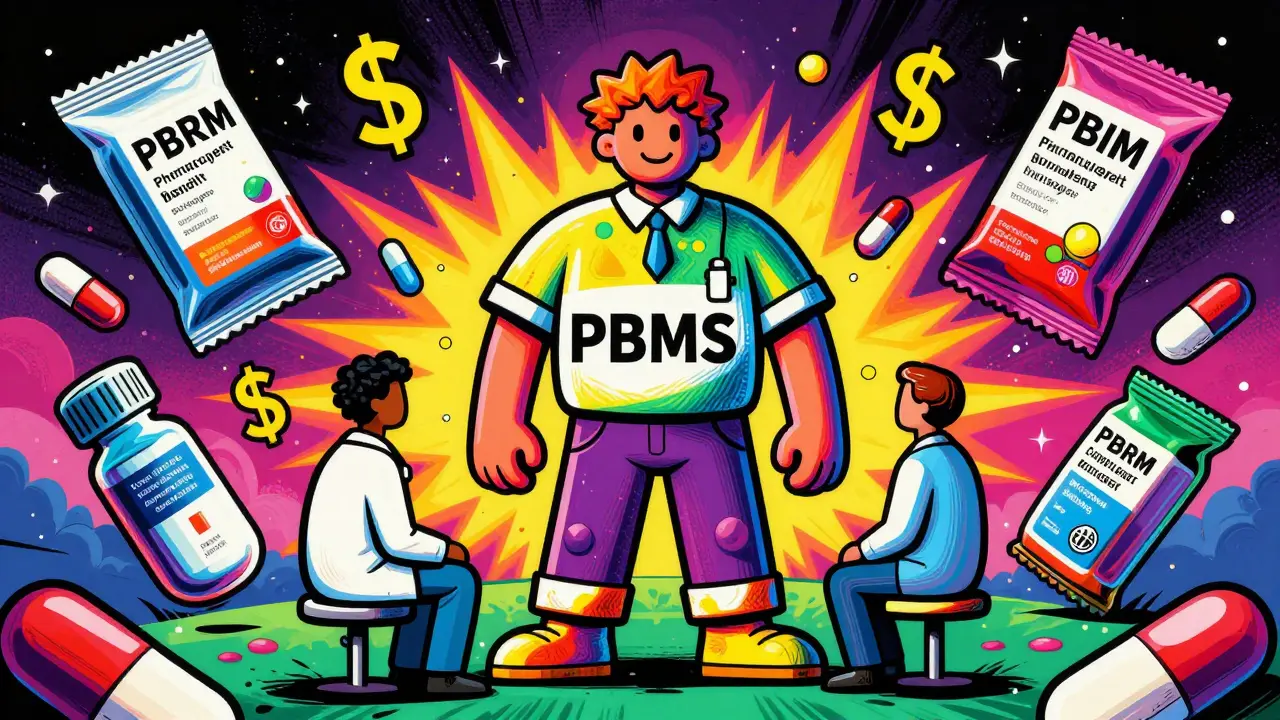
It's not just about the science; it's about the system. Pharmacy Benefit Managers, commonly known as PBMs, act as the middleman between drug makers, pharmacies, and insurance companies. The "Big 3"-Caremark Rx, Express Scripts, and OptumRx-control a massive portion of the specialty drug market. This concentration creates a weird paradox where the cheapest drug isn't always the one the patient can actually get.
The FTC recently pointed out a disturbing trend: some PBMs have actually marked up specialty generic drugs by thousands of percent. This means that even if a generic exists, the price inflation by the middleman can make the cost difference between the brand and the generic almost negligible, or even make the generic harder to access through a specific insurance formulary.
| Feature | Traditional Drugs | Specialty Drugs |
|---|---|---|
| % of Total Prescriptions | High (Generics ~90%) | Very Low (approx. 0.5% - 6%) |
| % of Total Spending | Low | Very High (over 50%) |
| Administration | Mostly Oral (Pills) | Injection or Infusion |
| Cost per Month | Variable (often low) | Typically > $670 |
| Handling | Standard | Cold-chain / Specialized |
The Administrative Burden on Providers
If you think being a doctor is all about seeing patients, you haven't seen the paperwork involved in specialty prescribing. Providers spend an average of 13.4 hours per week on Prior Authorization, and nearly 80% of that time is spent on specialty medications. This is a grueling process where the insurance company asks the doctor to prove that the expensive brand-name drug is the only option.
Oncologists and rheumatologists feel this the most. When a doctor is fighting for a patient's life in a cancer ward, spending hours arguing with an insurance adjuster about whether a patient can try a cheaper, less-effective drug first is an immense source of frustration. For many specialists, the brand-name drug is the one with the most robust evidence base, and they are unwilling to gamble with a patient's health just to satisfy a PBM's cost-cutting algorithm.
The Influence of Industry and Data
We have to address the elephant in the room: industry influence. There is data showing that doctors who receive payments from pharmaceutical companies tend to prescribe brand-name drugs at higher rates. For example, a look at internists showed that those receiving more than $5,000 in industry payments had brand-prescribing rates around 30%, compared to 20% for those who received nothing. While this suggests a correlation, many doctors argue that these payments are for legitimate research and speaking engagements that actually help them understand the latest clinical data.
However, the real driver is often the lack of therapeutic alternatives. In many specialty areas, there simply isn't a generic that does the same thing. When the only other option is a drug that doesn't work for the patient's specific genetic mutation, the brand-name choice is the only logical one, regardless of cost.

Navigating the Path to Treatment
Getting a patient started on a specialty drug is a multi-week process. It's not as simple as handing over a piece of paper. Providers must enroll in specific specialty pharmacy networks, which can take up to a month. Then there's the coordination between the clinic, the specialty pharmacy, and the payer. About 42% of specialty drug starts are delayed by at least a week due to these administrative hurdles.
To make this work, providers rely on a few key tools:
- Patient Assistance Programs: These help patients afford co-pays that can jump from $50 to $850 overnight when a formulary changes.
- NORD (National Organization for Rare Disorders): A critical resource for patients with rare diseases to find financial help.
- Specialty Pharmacy Certification Board: Ensures that the pharmacists handling these drugs are trained in cold-chain storage and complex dosing.
The Future of Specialty Pricing
The current system is hitting a breaking point. The Congressional Budget Office projects that specialty drugs will make up 60% of all Medicare Part D spending by 2030. This is unsustainable. In response, the Inflation Reduction Act of 2022 has finally given Medicare the power to negotiate prices for some of the highest-cost drugs.
We are also seeing a push for transparency. Senator Bernie Sanders introduced the "Specialty Drug Price Transparency Act" in early 2025 to tackle the massive markups applied by PBMs. If these regulations take hold, we might see a shift where the "brand vs. generic" debate becomes less about the insurance company's profit and more about the patient's actual clinical needs.
Why can't I just switch to a generic specialty drug?
Specialty drugs, especially biologics, are much more complex than standard pills. Switching to a biosimilar or generic can sometimes trigger an immune response or lead to a loss of efficacy if the drug doesn't match your specific biological needs. Your specialist's preference for a brand-name drug is usually based on the need for stability in your treatment.
What is a PBM and why do they affect my medication?
Pharmacy Benefit Managers (PBMs) are the middlemen who manage prescription drug benefits for insurers. They decide which drugs are on the "formulary" (the list of covered meds) and negotiate prices. Because they control the distribution network, they can influence which brand or generic is available to you and how much you pay in co-pays.
What is Prior Authorization and why does it take so long?
Prior authorization is a process where your doctor must prove to your insurance company that a specific, expensive drug is medically necessary before they agree to pay for it. It takes a long time because it requires extensive documentation, clinical justifications, and often multiple rounds of back-and-forth communication between the clinic and the insurer.
Are there programs to help pay for these expensive drugs?
Yes. Many pharmaceutical companies offer patient assistance programs. Additionally, organizations like the National Organization for Rare Disorders (NORD) provide financial aid and resources to help patients access critical specialty medications they otherwise couldn't afford.
Will the cost of specialty drugs ever go down?
There are signs of change. The Inflation Reduction Act of 2022 allows Medicare to negotiate prices for certain high-cost drugs, and new legislation is being proposed to limit the markups that PBMs can charge. As more biosimilars enter the market and regulation increases, prices may stabilize, though specialty drugs will likely remain expensive due to their complexity.
Mayur Pankhi Saikia
April 24, 2026 AT 12:02plz... the arugment that biologics are too complex for generics is just a thin veil for big pharma profit margins!!!! i've seen better data in a high school project than what some of these so-called specialists use to justify brand names... simply pathetic,,,,
Mel Glick
April 24, 2026 AT 18:41Exactly. It's a total scam!
Olayinka Ibukunoluwa Mercy
April 26, 2026 AT 12:42It is so heart-wrenching to think about the stress patients face during those multi-week delays!!! 💔 Please keep sharing these resources like NORD, they are absolute lifesavers for so many families!!! ✨🙏💖
Rick Brewster
April 28, 2026 AT 06:50one must ponder if the very concept of a brand name is merely a societal construct designed to soothe the primal fear of the unknown in the medical practitioner who is terrified of any deviance from the established path of least resistance even though we all know that the essence of healing is the embrace of the anomaly and the willingness to question the dogma of the pharmaceutical industrial complex which has become a god in its own right despite its obvious flaws in logic and morality
Saptatshi Biswas
April 30, 2026 AT 06:26The mention of industry payments is the only part of this piece that actually matters. It is absolutely scandalous that doctors are being paid off to push brand-name drugs while the global south suffers from a complete lack of basic medicine access. The arrogance of this Western medical system is unparalleled and it is truly a tragedy that profit is prioritized over the actual survival of the human race in such a calculated and cruel manner. This is not clinical logic, it is corporate greed masked as medicine!
Dave Edwards
May 1, 2026 AT 22:48Oh please, the drama about 'clinical necessity' is just a convenient excuse for doctors to feel important by playing gatekeeper with expensive drugs. It's practically a moral failure to let PBMs run the show while pretending that the 'protein structure' is the real issue. Give me a break! :-)
Divyanshu Giri
May 3, 2026 AT 22:44Keep fighting the good fight for your health folks! Just stay strong and keep pushing those insurance companies until you get what you need! You got this! 🚀