Sedative-Hypnotics: Benzodiazepines vs. Non-Benzodiazepines for Sleep
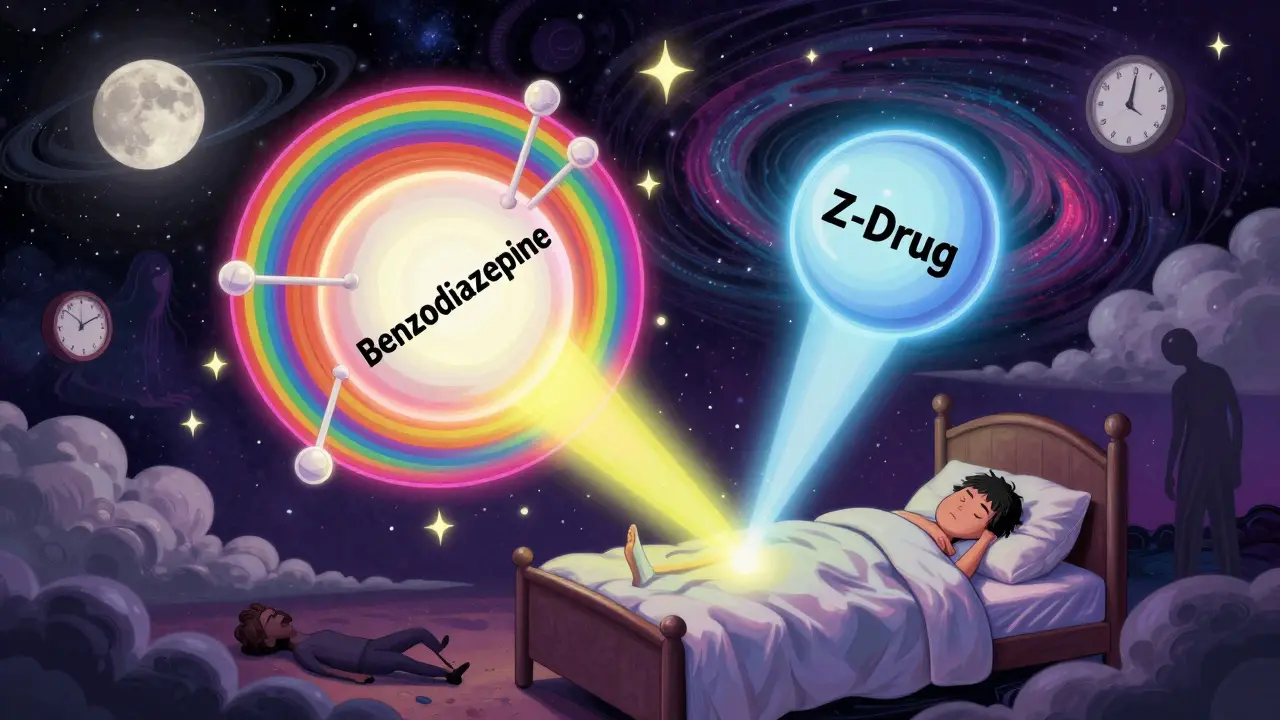
More than 6 million Americans filled prescriptions for non-benzodiazepine sleep drugs in 2022. Another 3.8 million got benzodiazepines. Both are meant to help you sleep. But the truth is, they might be making your sleep worse over time.
How These Drugs Actually Work
Both benzodiazepines and non-benzodiazepines (often called Z-drugs) work by boosting GABA, the brain’s main calming chemical. But they do it differently.
Benzodiazepines like diazepam, lorazepam, and temazepam attach to multiple spots on GABA receptors. That’s why they calm anxiety, relax muscles, and induce sleep. But this broad effect also causes more side effects - dizziness, confusion, memory gaps.
Non-benzodiazepines like zolpidem (Ambien), eszopiclone (Lunesta), and zaleplon (Sonata) were designed to be more precise. They mainly target one subtype of GABA receptor, called omega-1. The idea was simple: sleep without the grogginess. But in practice, that difference isn’t as big as it sounds.
Both types are broken down by the liver. If your liver isn’t working well, these drugs can build up in your system. That’s why doctors avoid giving them to people with severe liver disease. Kidney problems matter too - especially if your creatinine clearance is below 30 mL/min.
How Long They Last Matters More Than You Think
Half-life isn’t just a pharmacology term. It’s the difference between waking up refreshed and feeling like you’ve been hit by a truck.
Flurazepam, a long-acting benzodiazepine, can stay in your body for over 200 hours. That means even if you take it at night, you’re still carrying it into the next day. Studies show this leads to poor coordination, slow thinking, and trouble focusing - especially if you take it every night.
Short-acting ones like triazolam or zaleplon clear faster. Zaleplon’s half-life is just 1 to 1.5 hours. That’s why it’s sometimes used for people who wake up in the middle of the night. But here’s the catch: they’re more likely to cause rebound insomnia. You fall asleep, but when the drug wears off, your brain overcompensates - and you wake up wide awake.
Zolpidem lasts about 2 to 4.5 hours. Eszopiclone hangs around longer - 5 to 7 hours. That’s why Lunesta is marketed as a full-night solution. But the FDA found that even at half the original dose, women still had enough drug in their system the next morning to impair driving. That’s why the recommended dose for women was cut in half in 2013.
Efficacy: Do They Even Work Long-Term?
They work - for a while.
Most people report falling asleep faster in the first week. But after two to four weeks, the effect fades. Your brain adapts. You need more to get the same result. That’s tolerance. And it happens fast.
A 2013 study by Dr. Daniel Kripke found that after eight weeks of using zolpidem intermittently, people showed no improvement in health, mood, or performance. Not even a small one. The drug didn’t make them feel better. It didn’t improve their sleep quality. It just kept them dependent.
Reddit users report the same thing. In r/insomnia, 68% said their Z-drug stopped working after two to three weeks. One wrote: “I took Ambien for three nights in a row. On the fourth, I slept for six hours - but woke up feeling like I hadn’t slept at all.”
Benzodiazepines feel more reliable over time - but that’s a trap. Their long half-lives mask the decline. You think it’s working because you’re still falling asleep. But your sleep architecture is broken. You’re missing deep sleep and REM. You’re not restoring your brain.
The Hidden Dangers: More Than Just Drowsiness
Daytime drowsiness is the most common complaint. A 2021 meta-analysis found 34% of users reported drowsiness severe enough to affect work or driving.
But that’s just the tip.
Both classes increase your risk of falls - especially if you’re over 65. A 2012 JAMA study showed benzodiazepines raised hip fracture risk by 2.3 times. Non-benzodiazepines? 1.8 times. Both are dangerous. But benzodiazepines are worse.
Then there’s memory. The VA’s 2023 warning says sedative-hypnotics carry a five-fold higher risk of memory and concentration problems. That’s not just forgetting where you put your keys. It’s trouble learning new things, mixing up names, getting lost in familiar places.
And then there’s the scary stuff: sleepwalking, sleep-driving, making phone calls you don’t remember. Between 2005 and 2010, zolpidem was involved in 66% of FDA-reported sleep-driving incidents. People have crashed cars, driven miles, even committed crimes - all while asleep.
One user on r/Benzos wrote: “I took temazepam and woke up in the kitchen at 3 a.m. with a knife in my hand. I didn’t remember taking it. I didn’t remember walking there.”
Withdrawal: The Price of Stopping
Stopping these drugs isn’t like quitting caffeine.
Benzodiazepines can trigger seizures, hallucinations, panic attacks, and even delirium. Withdrawal can last weeks or months. Tapering is essential - usually 10% reduction every one to two weeks. Go too fast, and your nervous system goes haywire.
Non-benzodiazepines are “easier” to quit - but that’s misleading. You won’t have seizures. But you’ll get brutal rebound insomnia. You’ll sleep worse than before you started. Some people describe it as “sleep deprivation on steroids.”
One woman on a patient forum said: “I quit Lunesta after six months. I didn’t sleep for five nights straight. My heart raced. I cried all day. I thought I was going crazy.”
Both classes cause anxiety, sweating, nausea, and tremors. The difference? Benzodiazepines are more dangerous. Non-benzodiazepines are more deceptive.

Who Should Avoid Them Completely?
People over 65. The American Geriatrics Society says both classes are “potentially inappropriate” for older adults. Why? Falls, fractures, confusion, memory loss. The risk isn’t small. It’s life-threatening.
People with sleep apnea. These drugs relax the muscles in your throat. If you already stop breathing at night, they make it worse. The VA warns they can trigger chronic high blood pressure, heart attacks, and strokes.
People with a history of substance abuse. Both classes can be addictive. Benzodiazepines create a sense of calm euphoria. Z-drugs can feel like a quick fix - until they don’t. And then you need more.
Anyone taking opioids, alcohol, or certain antidepressants. Mixing these with sleeping pills can slow your breathing to dangerous levels - even cause death.
What Should You Do Instead?
The American Academy of Sleep Medicine says the first-line treatment for chronic insomnia isn’t a pill. It’s CBT-I - Cognitive Behavioral Therapy for Insomnia.
CBT-I teaches you how to retrain your brain around sleep. It’s not about counting sheep. It’s about fixing bad habits: lying in bed awake for hours, checking the clock, napping too much, using your bed for scrolling or working.
Studies show CBT-I works better than pills - and lasts longer. People who do CBT-I stay asleep longer. They wake up less. They don’t need drugs. And their memory and balance stay intact.
There are also newer drugs on the horizon. Suvorexant (Belsomra) and lemborexant (Dayvigo) block orexin, a brain chemical that keeps you awake. They don’t affect GABA. Early data shows 30-40% less next-day drowsiness. But they’re expensive. And long-term safety? Still being studied.
The Bottom Line
Neither benzodiazepines nor non-benzodiazepines are safe for long-term use. Both increase your risk of memory loss, falls, addiction, and weird nighttime behaviors. The VA no longer recommends them. The American Academy of Sleep Medicine doesn’t either.
If you’ve been on one of these for more than a few weeks, you’re not sleeping better. You’re just managing withdrawal.
Don’t stop cold turkey. Talk to your doctor. Start CBT-I. Sleep better without a pill. Your brain - and your balance - will thank you.