Rheumatoid Arthritis Monitoring: CDAI, DAS28, and Imaging Explained

Living with Rheumatoid Arthritis is a chronic autoimmune condition that causes persistent joint inflammation, pain, and potential structural damage if left unmanaged means your treatment plan isn't static. It’s a moving target. You might feel great one month and stiff the next. The key to staying ahead of this unpredictable disease lies in precise monitoring. But how do doctors actually measure what’s happening inside your joints? They don’t just guess. They rely on standardized tools like the Clinical Disease Activity Index (CDAI), the Disease Activity Score (DAS28), and advanced imaging techniques.
These aren't just random numbers on a chart. They are the compass guiding your 'treat-to-target' strategy-a proven approach where the goal is to reach remission or low disease activity to prevent long-term joint destruction. Understanding these metrics helps you participate actively in your care, ask better questions, and understand why your doctor might adjust your medication. Let’s break down exactly how these three pillars of RA monitoring work, their pros and cons, and what they mean for your daily life.
The Clinical Disease Activity Index (CDAI): Simplicity in Action
The Clinical Disease Activity Index is a composite score used to quantify rheumatoid arthritis severity based on four clinical parameters without requiring blood tests, often referred to as CDAI, was developed by the American College of Rheumatology (ACR) and published in 2005. It has become a favorite in many clinics because it gets straight to the point. Unlike other scores, CDAI does not require any laboratory blood tests. This makes it incredibly practical for routine visits where you want an immediate assessment.
CDAI calculates your disease activity by adding up four specific components:
- Tender Joint Count (TJC): The number of out of 28 specific joints that hurt when pressed.
- Swollen Joint Count (SJC): The number of out of those same 28 joints that are visibly swollen.
- Patient Global Assessment (PtGA): Your own rating of your overall disease activity on a scale of 0 to 10.
- Physician Global Assessment (PGA): Your doctor’s rating of your overall disease activity on a scale of 0 to 10.
The total score ranges from 0 to 76. Here is how the results are interpreted according to established thresholds:
- Remission: Score less than 2.8
- Low Disease Activity: Score between 2.8 and 10
- Moderate Disease Activity: Score between 10 and 22
- High Disease Activity: Score greater than 22
The beauty of CDAI is its speed. Studies show it takes less than two minutes to calculate during a visit. In fact, data from the Rheumatology Informatics System for Effectiveness (RISE) registry indicates that 78% of US rheumatologists use CDAI in more than half of their patient encounters. Why? Because it correlates strongly with a physician’s clinical impression. However, there is a catch. Since it ignores blood markers like inflammation levels, it might miss subclinical inflammation-damage happening silently beneath the surface. If your CDAI says you’re in remission but you still have high inflammatory markers, you might need a different tool to get the full picture.
DAS28: The Blood-Test Heavyweight
If CDAI is the quick check-up, the Disease Activity Score with 28-joint count is a comprehensive rheumatoid arthritis metric that combines joint counts with blood-based inflammatory markers to assess disease severity, or DAS28, is the deep dive. Originating in Europe in the 1990s through research by the European League Against Rheumatism (EULAR), DAS28 adds a crucial layer of information: systemic inflammation. It exists in two main variants: DAS28-ESR (using Erythrocyte Sedimentation Rate) and DAS28-CRP (using C-Reactive Protein).
The formula is more complex than CDAI. For DAS28-CRP, it looks like this:
0.56 × √TJC28 + 0.28 × √SJC28 + 0.36 × ln(CRP+1) + 0.0072 × age + 0.0041 × duration
This calculation yields a score with slightly different thresholds:
- Remission: Less than 2.6
- Low Disease Activity: 2.6 to 3.2
- Moderate Disease Activity: 3.2 to 5.1
- High Disease Activity: Greater than 5.1
The inclusion of CRP or ESR gives DAS28 a significant advantage: it captures inflammatory burden that joint counts alone might miss. This is vital because inflammation drives joint erosion. However, this strength is also its weakness in real-world practice. Lab results often arrive days after your appointment. According to a 2022 analysis of the RISE registry, 68% of cases experience workflow disruptions because lab results are delayed. This forces doctors to make provisional decisions or wait, which can slow down treatment adjustments. While EULAR guidelines often prefer DAS28, especially in Europe where it is used in 68% of practices, the logistical hurdle remains a common frustration for both patients and providers.
| Feature | CDAI | DAS28 (CRP/ESR) |
|---|---|---|
| Blood Tests Required? | No | Yes (CRP or ESR) |
| Calculation Speed | Immediate (< 2 mins) | Delayed (pending labs) |
| Remission Threshold | < 2.8 | < 2.6 |
| Best For | Routine clinic visits | Research & detailed inflammatory assessment |
| Limitation | Misses subclinical inflammation | Workflow disruption due to lab delays |
Imaging: Seeing What the Eyes Miss
Sometimes, how you feel and what the scores say don’t match the reality inside your bones. This is where imaging comes in. Monitoring RA isn't just about pain; it's about preventing structural damage. Over the decades, we’ve moved from basic X-rays to sophisticated technologies that can see inflammation before it causes permanent harm.
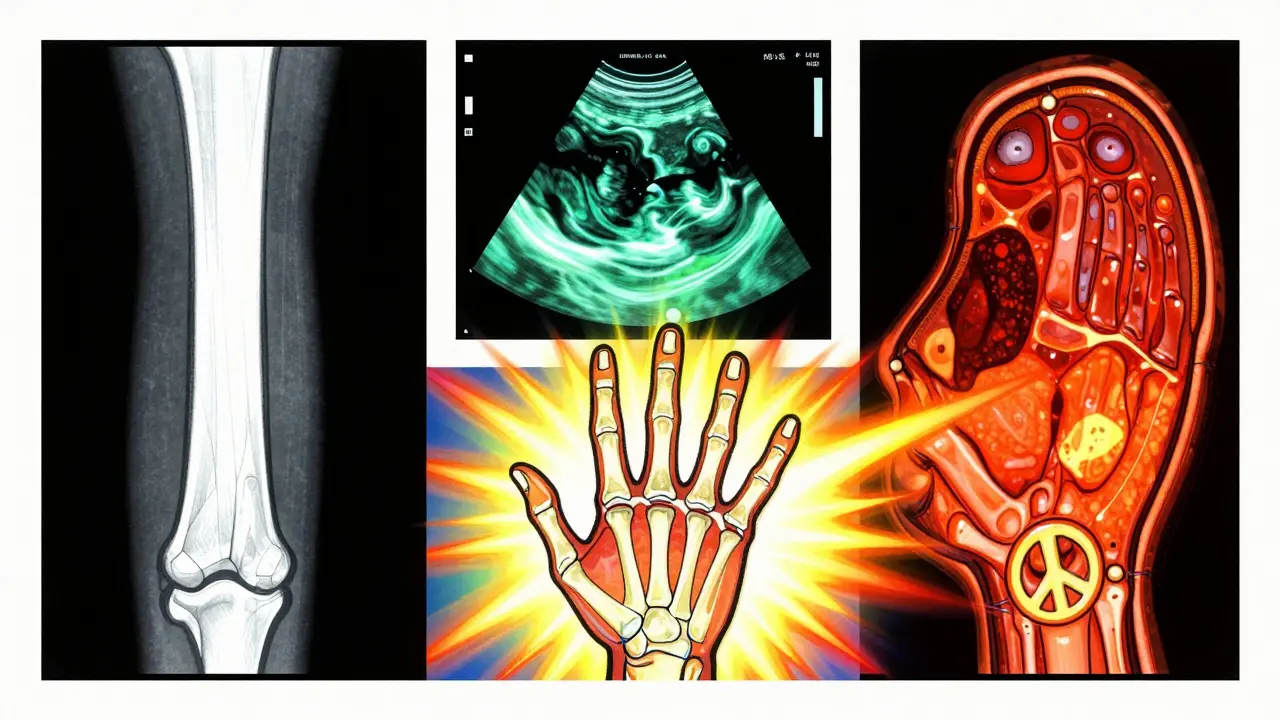
Conventional Radiography (X-rays) has been the gold standard since the 1940s. Doctors use the Sharp/van der Heijde scoring system (SHS) to evaluate erosions and joint space narrowing in the hands and wrists. The maximum score is 448, and an increase of 5 units annually is considered progression. X-rays are cheap, widely available, and perfect for tracking long-term structural damage. But they are blunt instruments. They only show changes after 6 to 12 months of active disease. By the time an erosion shows up on an X-ray, the damage is already done.
Musculoskeletal Ultrasound offers a much sharper view. Introduced clinically in the 1990s, ultrasound can detect synovitis (joint lining inflammation) with 85% sensitivity, compared to just 65% for physical examination alone. Using the OMERACT scoring system, radiologists look for fluid and increased blood flow (Power Doppler). Ultrasound is responsive to change-you can see improvement weeks after starting a new drug. It’s also relatively affordable (around $150 per scan in the US) and provides immediate visual feedback during your appointment. In 2022, EULAR guidelines suggested integrating ultrasound into routine monitoring when clinical uncertainty exists, noting it changes treatment decisions in 22% of such cases.
Magnetic Resonance Imaging (MRI) is the most sensitive tool available. It uses the RA MRI Score (RAMRIS) to evaluate synovitis, bone edema (osteitis), and erosions. Crucially, MRI can detect bone edema-the precursor to erosion-up to 12 months before it appears on an X-ray. With 89% sensitivity for predicting future erosions, MRI is powerful. However, it’s expensive (approximately $1,200 per scan in the US) and less accessible. Consequently, it’s reserved for specialized centers, clinical trials, or complex diagnostic dilemmas rather than routine monitoring.
Putting It All Together: The Treat-to-Target Strategy
So, which method is right for you? The answer is usually all of them, used strategically. Modern rheumatology follows a 'treat-to-target' approach, endorsed by both ACR and EULAR guidelines updated in 2022. The goal is clear: achieve remission or low disease activity as quickly as possible to preserve function and quality of life.
In practice, this often looks like a hybrid model. Your doctor might use CDAI for monthly or quarterly check-ins because it’s fast and easy. If your CDAI suggests you’re doing well, but you report fatigue or stiffness, they might order a CRP test to calculate DAS28, checking for hidden inflammation. If there’s still doubt, or if you’re not responding to treatment, they might order an ultrasound to visualize the joint lining directly.
Studies support this comprehensive approach. The GO-BACK study (2018) found that treat-to-target strategies using these monitoring tools reduced radiographic progression by 30-50% compared to routine care. That’s a massive difference in long-term outcomes. It means fewer surgeries, less disability, and a better life.
However, be aware of the 'discordance' factor. Research from the REAL cohort study in Brazil showed a 33% discordance rate between patient global assessments and physician assessments. Often, patients rate their symptoms higher than doctors do. This gap highlights why your voice matters. Don’t hesitate to speak up if your score says 'remission' but you still feel exhausted or painful. Fatigue, for instance, accounts for 14% of minimal important difference estimates but is poorly captured by CDAI or DAS28. Your subjective experience is a critical part of the data.
Future Trends: AI and Remote Monitoring
The landscape of RA monitoring is evolving rapidly. We are seeing the rise of digital health tools. Apps like RheumaTrack allow for remote collection of Patient-Reported Outcome Measures (PROMs), giving doctors continuous data streams rather than snapshot visits. By 2027, experts predict that 50% of RA monitoring will incorporate continuous remote data alongside traditional clinic assessments.
Artificial Intelligence is also entering the room. New software like QUASAR automates power Doppler scoring with 88% agreement with expert readers. Projects like DeepJoint are achieving 92% accuracy in detecting erosions from images. These tools aim to reduce human error and variability, making monitoring more consistent regardless of who performs the exam. The NIH-funded RACoon trial is currently testing protocols that combine CDAI, ultrasound, and wearable activity trackers to create personalized monitoring schedules. This shift toward precision medicine means your monitoring plan will become increasingly tailored to your specific risk profile and response patterns.
What is the best score to monitor Rheumatoid Arthritis?
There is no single 'best' score, as each serves a different purpose. The CDAI is often preferred for routine clinical practice due to its simplicity and lack of requirement for blood tests. DAS28 is valuable for capturing systemic inflammation via CRP or ESR but can be delayed by lab processing. Many experts recommend using CDAI for regular follow-ups and incorporating DAS28 or imaging when clinical uncertainty exists or to assess inflammatory burden more deeply.
How often should I get imaging for RA?
Imaging frequency depends on your disease status. Routine X-rays are typically done annually to monitor for structural damage. Ultrasound may be used more frequently, such as every 6-12 months, or whenever there is a discrepancy between your symptoms and clinical scores. MRI is generally reserved for initial diagnosis or complex cases due to its high cost and limited availability, though some high-risk patients may receive it quarterly in specialized settings.
Can I be in remission if my DAS28 score is high?
Technically, no. Remission is defined by specific thresholds (DAS28 < 2.6). However, 'clinical remission' can sometimes exist with mild residual inflammation. If your DAS28 is high but your CDAI is low, it suggests significant systemic inflammation despite few tender/swollen joints. This discrepancy warrants further investigation, possibly including ultrasound, to ensure silent inflammation isn't causing joint damage.
Why does my doctor use CDAI instead of DAS28?
Doctors often choose CDAI for its efficiency. It allows for immediate calculation during the visit without waiting for lab results. This facilitates faster decision-making regarding medication adjustments. Additionally, CDAI has shown strong correlation with physician clinical impression and radiographic progression, making it a robust tool for routine 'treat-to-target' monitoring in busy clinical settings.
What is the role of ultrasound in RA monitoring?
Ultrasound detects synovitis and blood flow in joints with higher sensitivity than physical exam alone. It is particularly useful when clinical scores and patient symptoms don't align. It can identify active inflammation even when joint swelling is minimal, helping doctors confirm if current treatments are effectively suppressing disease activity at the tissue level.