Respiratory Depression from Opioids and Other Medications: Critical Signs You Can't Ignore

Opioid Risk Assessment Tool
Risk Assessment
This tool calculates your risk of opioid-induced respiratory depression based on key medical factors and medication combinations.
Risk Assessment Results
When someone takes an opioid for pain, they expect relief-not a slow, silent shutdown of their breathing. Yet every year, thousands of people experience opioid-induced respiratory depression, a condition where the brain stops telling the lungs to breathe. It doesn’t always look like an overdose. No screaming. No collapse. Just quiet, shallow breaths. And if you miss the signs, it can turn deadly in minutes.
What Respiratory Depression Really Looks Like
Respiratory depression isn’t just slow breathing. It’s breathing that’s too shallow, too irregular, and too unresponsive to your body’s needs. A normal adult breathes 12 to 20 times per minute. When opioids suppress the brainstem’s respiratory centers, that number can drop below 8. That’s not just slow-it’s dangerous.
Here’s what actually happens: your body builds up carbon dioxide (CO2) because you’re not exhaling enough. Your blood oxygen drops. But here’s the trick-supplemental oxygen can hide this. Someone on oxygen might still have a saturation of 95%, but their CO2 levels could be spiking past 50 mmHg. That’s when the brain stops reacting to low oxygen or high CO2. They’re not getting the signal to breathe harder. They’re essentially asleep at the wheel of their own breathing.
Look for these key signs:
- Respiratory rate under 8 breaths per minute
- Oxygen saturation below 85% (without supplemental oxygen)
- Shallow, irregular, or gasping breaths
- Extreme drowsiness or inability to wake up
- Confusion, disorientation, or slurred speech
- Blue lips or fingertips (cyanosis)
- Slow heart rate (bradycardia) or, less commonly, fast heart rate
Don’t wait for blue lips. By then, it’s too late. The earliest warning is often just a change in breathing pattern-slower, quieter, less rhythmic. If someone who was alert suddenly seems "just tired," that’s a red flag.
It’s Not Just Opioids
Many people think respiratory depression only comes from heroin or oxycodone. But it’s not that simple. Any drug that depresses the central nervous system can do it. Benzodiazepines like Xanax or Valium. Sleep meds like zolpidem. Alcohol. Muscle relaxants. Even some antidepressants when mixed with opioids.
The real danger isn’t one drug-it’s the combo. Taking an opioid with a benzodiazepine increases the risk of respiratory depression by more than six times. Mix in alcohol? That risk jumps to 14.7 times higher. This isn’t theoretical. It’s happening in homes, in nursing homes, and in hospitals every day.
People assume if they’re taking prescribed meds, they’re safe. But a patient on long-term morphine for cancer pain might be fine. Then they get a new prescription for sleep aids after surgery. Within hours, their breathing slows. No one connects the dots.
Who’s Most at Risk
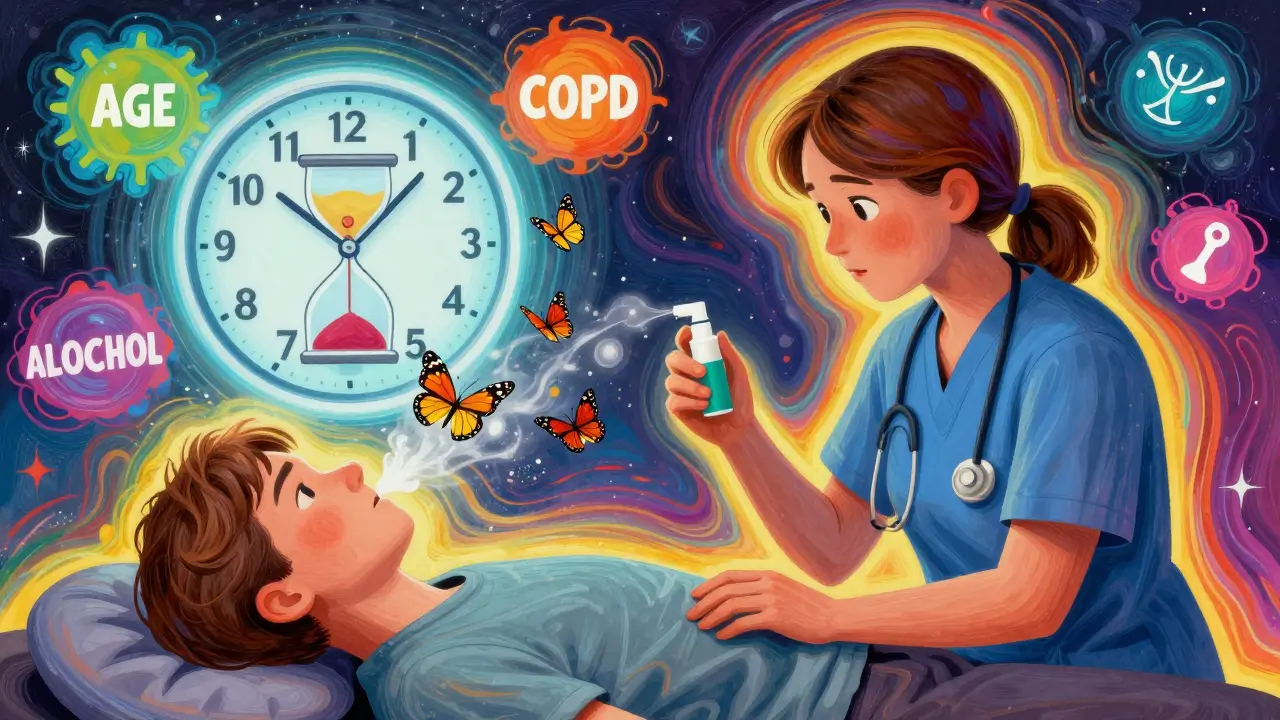
Some people are far more vulnerable. Age matters. People over 60 have more than three times the risk. Women are 1.7 times more likely than men to experience it. Why? We don’t fully know-but body composition, metabolism, and hormonal differences likely play a role.
But the biggest risk factor? Being opioid-naïve. Someone who’s never taken opioids before. Their body hasn’t built tolerance. A standard dose meant for chronic pain patients can be fatal to them.
Other high-risk groups:
- People with sleep apnea
- Those with lung disease like COPD
- Patients with kidney or liver problems (slows drug clearance)
- Anyone taking multiple CNS depressants
- People with a history of substance use disorder
And here’s the scary part: many of these risk factors aren’t even checked before prescribing. A 72-year-old woman with mild COPD gets a prescription for oxycodone after a hip replacement. Her doctor doesn’t ask about her nightly Xanax. She doesn’t mention it. Two days later, she’s found unresponsive.
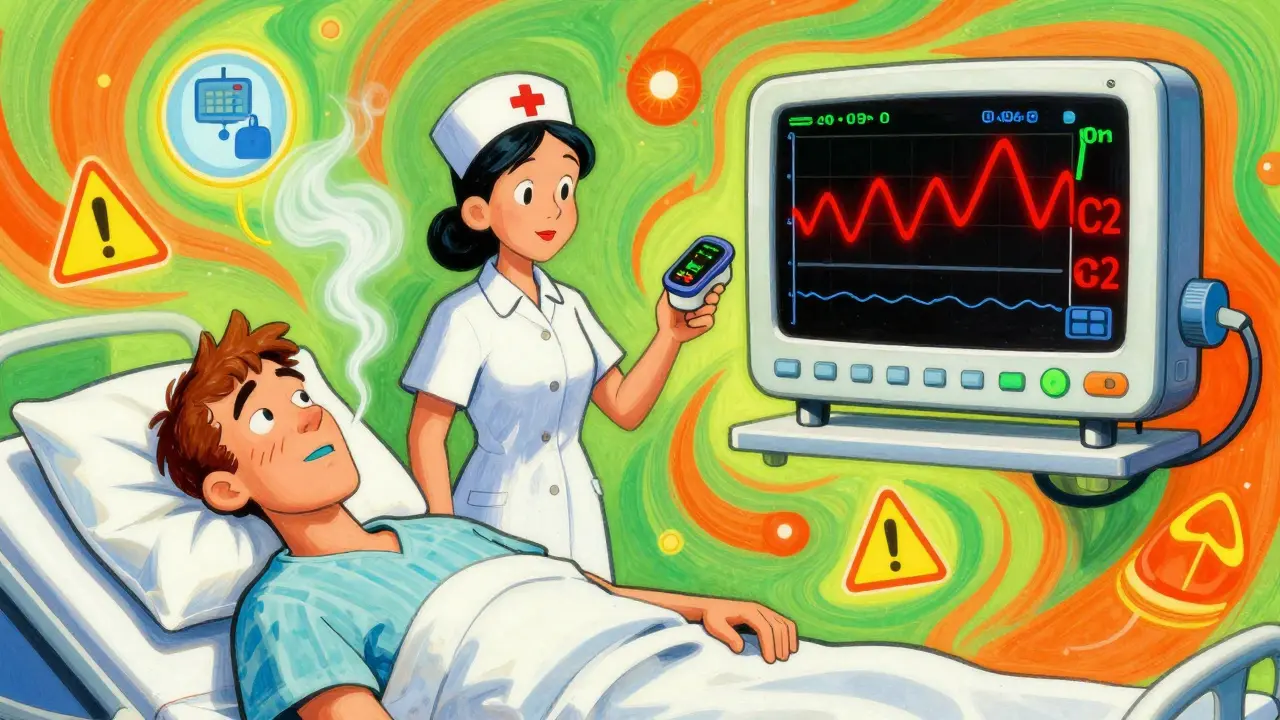
Monitoring: What Works and What Doesn’t
Hospitals have tools to catch this early. Pulse oximeters measure oxygen levels. Capnography measures CO2 in exhaled breath. Capnography is more accurate-it catches breathing problems before oxygen drops. But only 22% of U.S. hospitals use it consistently for opioid patients.
Why? Alarm fatigue. Nurses hear too many false alarms. A patient shifts in bed, the monitor beeps, they ignore it. Over time, they stop responding. Studies show 68% of hospital units struggle with this.
And even when devices are used, staff aren’t trained. Only 42% of nurses can correctly identify early signs of respiratory depression in simulation tests. That’s not a technology problem. It’s a training problem.
Best practices? For patients not on oxygen, use pulse oximetry with alarms set at 90% saturation. For those on oxygen, use capnography with alarms set for CO2 above 50 mmHg or breathing rate below 10 per minute. Continuous monitoring-not every 4 hours-is the standard for high-risk patients.
What to Do If You Suspect It
If you’re caring for someone on opioids and notice their breathing slowing down:
- Try to wake them. Shake them gently. Call their name loudly.
- Check their breathing. Count for 15 seconds and multiply by 4. Is it under 8?
- If they don’t respond or breathing is shallow, call emergency services immediately.
- If you have naloxone (Narcan), administer it. One spray in each nostril or one injection into the thigh.
- Keep giving breaths if they’re not breathing on their own. Don’t wait for EMS to arrive.
Naloxone reverses opioid effects within minutes. But it wears off faster than some opioids. That means the person can slip back into respiratory depression hours later. That’s why they need to be monitored for at least 2 hours after naloxone is given.
Never assume someone is just "sleeping it off." If they’re unresponsive and breathing slowly, treat it like a medical emergency. Because it is.
Prevention: What’s Working
Some hospitals are turning things around. Those that use pharmacist-led opioid dosing, mandatory staff training, and continuous monitoring for high-risk patients have cut respiratory depression cases by nearly half.
Here’s what’s working:
- Screening for risk factors before giving opioids
- Avoiding fixed-dose schedules for opioid-naïve patients
- Requiring 2-hour monitoring after the first opioid dose
- Using the FDA-approved Opioid Risk Calculator (ORC), which predicts individual risk with 84% accuracy
- Training staff to recognize subtle changes-not just obvious collapse
And it’s not just hospitals. Family caregivers need to know this too. If you’re helping a loved one manage pain at home, learn the signs. Keep naloxone on hand. Don’t let stigma stop you from saving a life.
The Bigger Picture
Respiratory depression from opioids isn’t rare. It’s preventable. And yet, it’s still one of the top 10 preventable drug-related harms in the U.S., costing $1.2 billion a year. Medicare and Medicaid now treat severe cases as "never events"-meaning hospitals get penalized if they happen.
New tools are coming. AI systems that predict respiratory depression 15 minutes before symptoms appear. New opioid drugs designed to relieve pain without slowing breathing. But none of that matters if we don’t look for the signs.
The truth is simple: if someone’s breathing is too slow, too shallow, or too quiet, it’s not normal. It’s not just tired. It’s life-threatening. And you don’t need a medical degree to notice it. You just need to pay attention.
Gerald Tardif
December 29, 2025 AT 03:52Been a nurse for 18 years. Saw this happen once with a guy on oxycodone after his knee surgery. He was just "sleeping"-no noise, no drama. His wife thought he was finally resting. Took me 20 seconds to notice his breaths were like whispers. We got naloxone in, he woke up crying. No one ever thanked me. But I’m glad I was there.
People think if they’re not overdosing with a needle, they’re fine. Not true. It’s silent. It’s sneaky. And it kills more than you think.
Monika Naumann
December 30, 2025 AT 04:52This is precisely why India banned all opioid prescriptions without mandatory psychiatric evaluation. We do not allow our citizens to be chemically sedated by Western pharmaceutical greed. Your hospitals are profit-driven death traps. Here, we use ayurvedic pain management-no respiratory risk, no corporate lobbying, no false promises. Shame on you for normalizing this.
Anna Weitz
December 31, 2025 AT 05:07Think about it-your brain is supposed to regulate breathing like a thermostat but opioids turn it off like a light switch. We’re not talking about addiction here we’re talking about the central nervous system being hijacked by molecules that weren’t meant to be there. The body doesn’t know how to fight back because evolution never prepared us for synthetic opioids. We’re lab rats in a pharmacological experiment and no one’s asking if this is ethical.
And don’t get me started on how the FDA approves these drugs based on placebo-controlled trials where the placebo group gets sugar pills but the opioid group gets a death sentence wrapped in a prescription.
It’s not medicine it’s slow-motion murder dressed in white coats.
Jane Lucas
December 31, 2025 AT 22:28my grandma was on morphine after her hip surgery and she just kept falling asleep more and more. we thought she was tired from the pain meds. turns out she was barely breathing. we had to call 911. they gave her naloxone and she was fine. but i wish someone had told us to watch her breathing. not just if she was awake. like... actually count the breaths. that’s the key.
keep naloxone in the house. it’s not just for drug addicts. it’s for grandma too.
Elizabeth Alvarez
January 1, 2026 AT 22:30They’re hiding this on purpose. Did you know the CDC knew about opioid-induced respiratory depression since the 90s? But they kept pushing it because the pharmaceutical companies funded their research. The same companies that paid off politicians to loosen prescribing laws. The same ones that told doctors "it’s not addictive" while they made billions.
And now they’re rolling out AI systems to detect it? That’s not innovation-that’s damage control. They knew. They knew people were dying quietly. And they let it happen. They’re still selling these drugs. They’re still writing prescriptions. They’re still making money off your loved ones’ last breaths.
Don’t believe the hype. This isn’t a medical crisis. It’s a corporate crime.
Miriam Piro
January 3, 2026 AT 06:06it’s not just opioids it’s the whole system. the system wants you numb. the system wants you docile. the system doesn’t want you breathing too deeply because deep breaths mean you’re thinking too much. and thinking too much leads to questions. and questions lead to revolution.
they give you pain meds so you don’t ask why you’re in pain in the first place. why your job is soul-crushing. why your rent is 3x your wage. why you’re lonely. why you’re depressed. so you take the pill. you stop breathing. you stop feeling. you stop caring. and the system wins.
naloxone is just a bandaid on a bullet wound. the real cure is ending capitalism.
✌️
Kylie Robson
January 4, 2026 AT 12:45Respiratory depression is mediated by mu-opioid receptor agonism in the preBötzinger complex of the ventral respiratory group. This leads to decreased chemoreceptor sensitivity to hypercapnia and hypoxemia, resulting in blunted ventilatory drive. The threshold for respiratory suppression varies based on pharmacokinetic parameters such as volume of distribution and clearance, which are heavily influenced by hepatic and renal function.
Capnography is superior because it measures end-tidal CO2, which correlates directly with arterial pCO2, whereas pulse oximetry only detects downstream hypoxemia-a lagging indicator. The delay between CO2 elevation and oxygen desaturation can be 3–8 minutes, depending on ventilation-perfusion mismatch.
Also, the FDA ORC has a sensitivity of 84% but a specificity of only 69%, meaning nearly 1 in 3 low-risk patients are flagged falsely, contributing to alarm fatigue. This is why institutional protocols must include dynamic risk reassessment every 2 hours, not static screening.
Andrew Gurung
January 4, 2026 AT 18:48Oh my god. I just realized my ex was probably dying slowly every night he took his pain meds and my Xanax. I thought he was just being dramatic when he said he felt "like he was drowning in air." I didn’t know what that meant. I thought he was being poetic. He was literally suffocating.
And now I’m crying in my car because I didn’t know. I didn’t LOOK. I just assumed he was sleeping. I’m so sorry, Daniel. I’m so sorry.
😭💔
Will Neitzer
January 5, 2026 AT 18:51Thank you for this comprehensive and clinically accurate overview. As a healthcare educator, I have trained over 200 nursing students on the subtleties of opioid-induced respiratory depression. Too often, we focus on the dramatic presentations-cyanosis, collapse, arrest-when the true danger lies in the quiet, progressive decline.
I encourage all caregivers, whether professional or familial, to adopt the "Breathe, Watch, Act" protocol: Breathe-count respirations for a full 15 seconds; Watch-for irregularity, shallowness, or altered mental status; Act-do not wait for cyanosis or unresponsiveness. Administer naloxone if available and call for help immediately.
Knowledge is not power unless it is applied. Please share this with someone who needs to hear it.