Prostate Cancer Screening and Treatment: Understanding PSA Tests, Biopsies, and Modern Options

What PSA Testing Really Tells You (and What It Doesn’t)
A PSA test measures the level of prostate-specific antigen in your blood-a protein made by the prostate gland. It’s not a cancer test. It’s a signal. A red flag that says, "Something’s going on in there. Let’s look closer." Since the 1990s, it’s been the go-to tool for catching prostate cancer early. But here’s the truth: PSA testing catches more noise than cancer.
Most men with a PSA level above 4.0 ng/mL don’t have cancer. In fact, only about 1 in 4 men who get a biopsy because of a high PSA result actually have the disease. That means 75% of those biopsies are unnecessary. And for every 1,000 men screened, 100 will get false positives. That’s 100 men who go through anxiety, pain, and risk of infection for no reason.
Even worse, PSA levels can rise for reasons that have nothing to do with cancer. An enlarged prostate, a recent bike ride, a urinary infection, or even ejaculation 48 hours before the test can bump up your numbers. That’s why doctors now recommend waiting at least two days after sex or vigorous exercise before testing.
There’s no universal cutoff anymore. Ten years ago, 4.0 ng/mL was the line. Now, many guidelines, including the National Comprehensive Cancer Network, say 3.0 ng/mL or higher should trigger further evaluation. But here’s the catch: lowering the threshold catches more cancers-yes-but it also catches way more men who don’t need treatment. For Black men, who already face higher prostate cancer risk and worse outcomes, this shift means 66% more are being sent for biopsies that may not be needed.
Why Biopsies Are Still Necessary (and Why They’re Harsh)
If your PSA is high, or if something looks off on an MRI, the next step is usually a biopsy. It’s the only way to confirm cancer. But it’s not a simple needle poke. It’s a procedure done under local anesthesia, where 10-14 cores of prostate tissue are pulled out through the rectum. You’ll feel pressure. You might bleed. You might get an infection. About 1 in 20 men end up in the hospital after a biopsy.
And even when you get cancer, the biopsy doesn’t always tell the full story. Some tumors are slow-growing and will never harm you. These are called indolent cancers. But they still get labeled as cancer. And once labeled, many men feel they must treat it-because society says cancer = danger.
Studies show that 38% of men who get unnecessary biopsies suffer anxiety that lasts more than six months. One man told his doctor, "I thought I was going to die. I didn’t sleep for weeks." That’s the emotional toll. And it’s real.
Doctors are trying to reduce these false alarms. The Stockholm3 trial found that if you repeat a PSA test for men with levels between 3-10 ng/mL, you can cut unnecessary biopsies by nearly 17%. That’s 17% fewer men going through pain and fear for no reason.
What Comes After a High PSA? The New Tools
If your PSA is borderline, you’re not stuck with a biopsy right away. There are better ways now.
The 4Kscore and Prostate Health Index (PHI) are blood tests that look beyond total PSA. They measure different forms of PSA and other proteins linked to aggressive cancer. These tests can tell you if you’re more likely to have a dangerous tumor-not just any tumor. In men with PSA between 2-10 ng/mL, these tests are far better at spotting the kind of cancer that needs treatment.
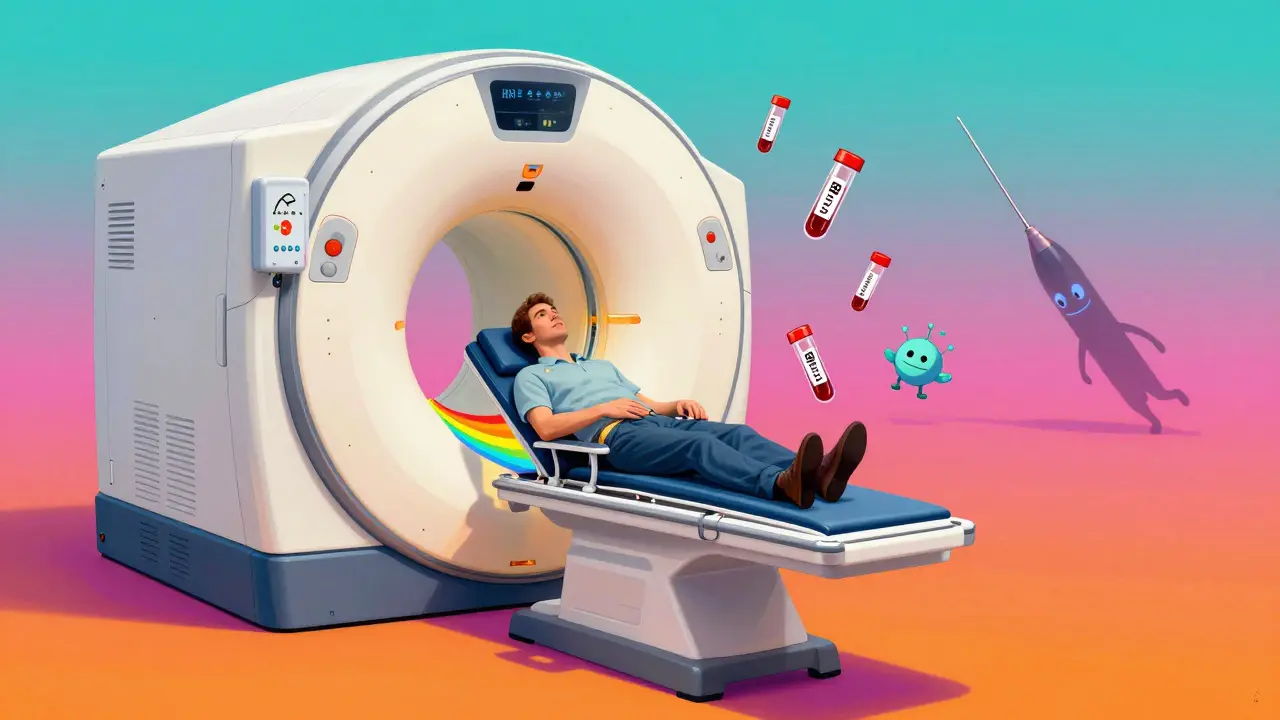
Then there’s multiparametric MRI. It’s not a blood test. It’s a detailed scan of the prostate. It can show suspicious areas without cutting into you. If the MRI looks clean, you might skip the biopsy entirely. Studies show that combining MRI with PSA reduces unnecessary biopsies by half. The PICTURE trial, still underway, is testing whether MRI-first screening can safely replace the old PSA-biopsy chain.
And now there’s PSMA-PET/CT. This isn’t for screening. It’s for staging. If you’ve been diagnosed, this scan shows where the cancer has spread-with 91% accuracy when paired with MRI. It’s expensive-$3,000 or more-and not available everywhere. But for men with high-risk results, it’s changing how treatment is planned.
Still, access is unequal. These tests cost $300-$450. Insurance often requires prior approval. Many primary care doctors don’t know how to order them. And in rural areas, they’re simply not an option.
Treatment Isn’t One-Size-Fits-All
Once cancer is confirmed, the big question isn’t "Do I treat it?" It’s "Which treatment?"
Many prostate cancers grow so slowly they’ll never cause problems. For these men, the best choice is often active surveillance. You get regular PSA tests, MRIs, and repeat biopsies. You don’t get surgery or radiation unless the cancer starts changing. About 60% of men diagnosed with low-risk cancer choose this path. They live normal lives. No impotence. No incontinence. No side effects.
But if the cancer is aggressive-Grade Group 3 or higher-then treatment is needed. The two main options are surgery (radical prostatectomy) and radiation (external beam or brachytherapy). Both work well. Both can cause side effects: erectile dysfunction in up to 50% of men, urinary leakage in 5-15%. The choice often comes down to age, overall health, and personal priorities.
Some men pick surgery because they want the tumor gone. Others pick radiation because it’s less invasive. Neither is "better." It’s about fit. A 65-year-old with heart disease might avoid surgery. A 50-year-old athlete might choose it to avoid lifelong monitoring.
And now there’s focal therapy-targeting only the tumor, not the whole gland. It’s still experimental, but early results show promise for men with small, contained cancers. Less damage. Faster recovery.
The Hidden Inequality in Prostate Cancer Care
Black men are 70% more likely to die from prostate cancer than White men. Why? It’s not just biology.
Black men are more likely to have aggressive cancer at diagnosis. But they’re also less likely to get screened early. When they do get screened, they’re more likely to have a PSA level between 3-4 ng/mL-right in the "gray zone." And studies show they’re 2.3 times more likely to get a biopsy than White men with the same PSA level. Yet their cancer detection rate is 18% lower. That means more biopsies. More pain. More fear. And still, fewer cancers found.
Access to advanced tests like MRI and 4Kscore is worse in low-income communities. Urologists are scarce in rural areas. And many Black men report being rushed through decisions, not given time to understand options.
Guidelines now say screening should be personalized. But personalization only works if you have access to information, time, and specialists. Right now, that’s not true for everyone.
What You Should Do Now
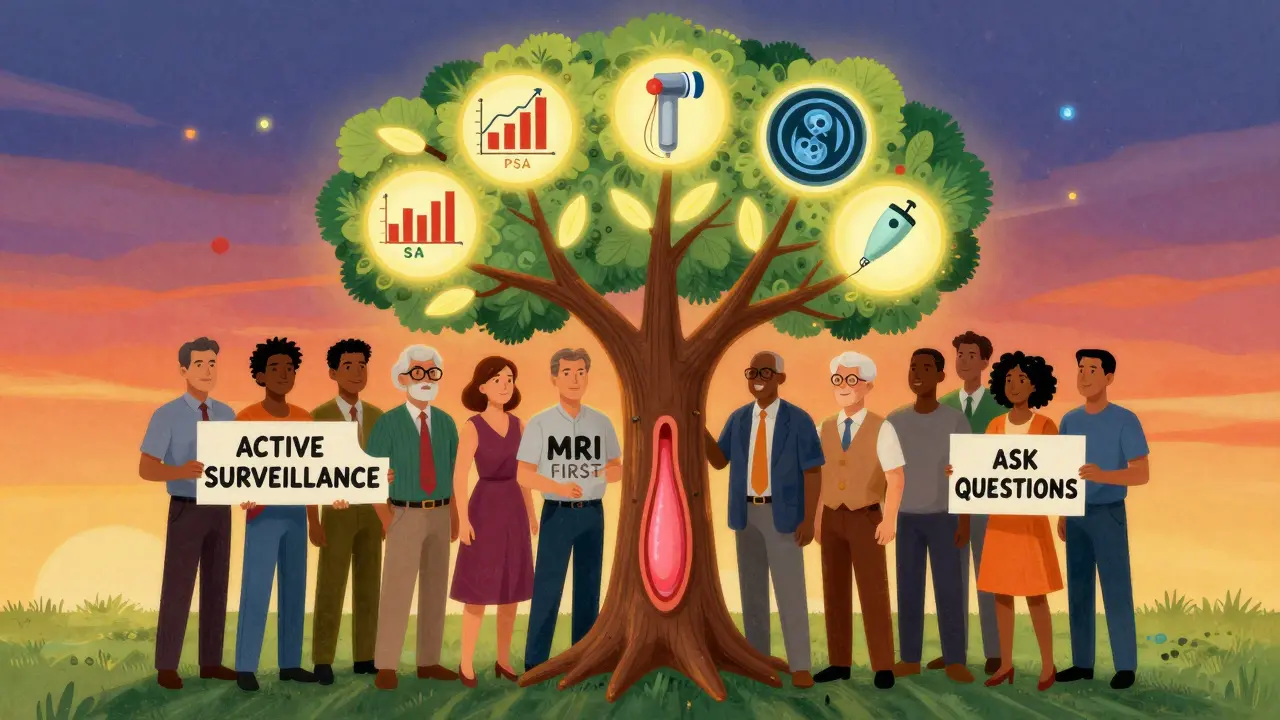
If you’re a man over 45, here’s what to do:
- Get a baseline PSA at age 40-45. This sets your personal trend. A rising PSA over time matters more than any single number.
- If your PSA is above 3.0 ng/mL, don’t panic. Ask for a repeat test. Wait two days after sex or exercise.
- If it stays high, ask about an MRI or a 4Kscore/PHI test before jumping to biopsy.
- If cancer is found, ask: "Is this aggressive?" Don’t rush into treatment. Get a second opinion.
- If it’s low-risk, consider active surveillance. It’s not ignoring cancer. It’s managing it wisely.
And if you’re a Black man, or have a family history of prostate cancer, start the conversation earlier. Don’t wait for symptoms. Prostate cancer doesn’t cause pain until it’s advanced.
Where the Field Is Headed
By 2028, experts predict a 30% drop in unnecessary biopsies because of better tools. PSA won’t disappear. But it won’t be the boss anymore. It’ll be one piece of a bigger puzzle-combined with genetics, imaging, and AI that tracks PSA speed over time.
The future isn’t about finding every single cancer. It’s about finding the ones that matter. The ones that will kill you if left alone. The rest? They can wait. Or never need treatment at all.
The goal isn’t to scare you. It’s to empower you. You don’t need to be a medical expert. But you do need to ask questions. Push for better tests. Demand time to understand your options. Your prostate isn’t just a gland. It’s part of your life. And how you handle this matters-not just for survival, but for how you live after.
Bob Cohen
February 1, 2026 AT 22:27Naresh L
February 3, 2026 AT 12:30PSA isn't a diagnosis. It's a doorway. And we hand people a sledgehammer when they asked for a key.
Aditya Gupta
February 5, 2026 AT 08:47Chris & Kara Cutler
February 6, 2026 AT 23:28Lilliana Lowe
February 7, 2026 AT 18:50vivian papadatu
February 9, 2026 AT 14:34It’s not ignorance. It’s systemic neglect. We need better training - not just better tests.
Melissa Melville
February 9, 2026 AT 16:34Deep Rank
February 10, 2026 AT 01:04Black men? They’re being used as lab rats. Every biopsy is a cash grab. And the ‘active surveillance’ thing? That’s just a fancy way of saying ‘we’re not sure so let’s watch you die slowly.’
Naomi Walsh
February 10, 2026 AT 14:00Bryan Coleman
February 11, 2026 AT 12:11Just ask. Just say 'can we do an mri before the needle?' They can't say no.
Sami Sahil
February 11, 2026 AT 13:44franklin hillary
February 13, 2026 AT 01:08It’s not about finding every cancer. It’s about finding the ones that will kill you. The rest? Let them sleep. Let them live. Let them be.
Ishmael brown
February 14, 2026 AT 07:55