Preventing Bleeding While Using Anticoagulants: A Practical Guide
Anticoagulant Bleeding Risk Assessment Tool
Fill in your details and click "Analyze" to see your risk profile.
Taking blood thinners is a balancing act. On one hand, you're preventing a life-threatening clot from traveling to your brain or lungs. On the other, you're making your body less capable of stopping a bleed. For most, this is a manageable trade-off, but for the 1-3% of patients who experience significant bleeding events annually, it becomes a medical emergency. The goal isn't just to "thin the blood," but to maintain a precise window where you are safe from both strokes and spontaneous hemorrhage.
Understanding the Tools: What are Anticoagulants?
Before looking at prevention, we need to understand what these drugs actually do. Anticoagulants is a class of medications designed to prevent blood clots from forming or to stop existing clots from growing larger. They don't actually "thin" the blood in terms of viscosity; instead, they interfere with the chemical process of coagulation.
We generally split these into a few main groups:
- Vitamin K Antagonists: The most famous is Warfarin. It has been around since the 1950s and requires a strict diet and regular blood tests.
- DOACs (Direct Oral Anticoagulants): These are the newer arrivals like Apixaban, Rivaroxaban, and Dabigatran. They are popular because they don't require constant monitoring.
- Heparins: These are usually given via injection or IV in hospitals for fast-acting results.
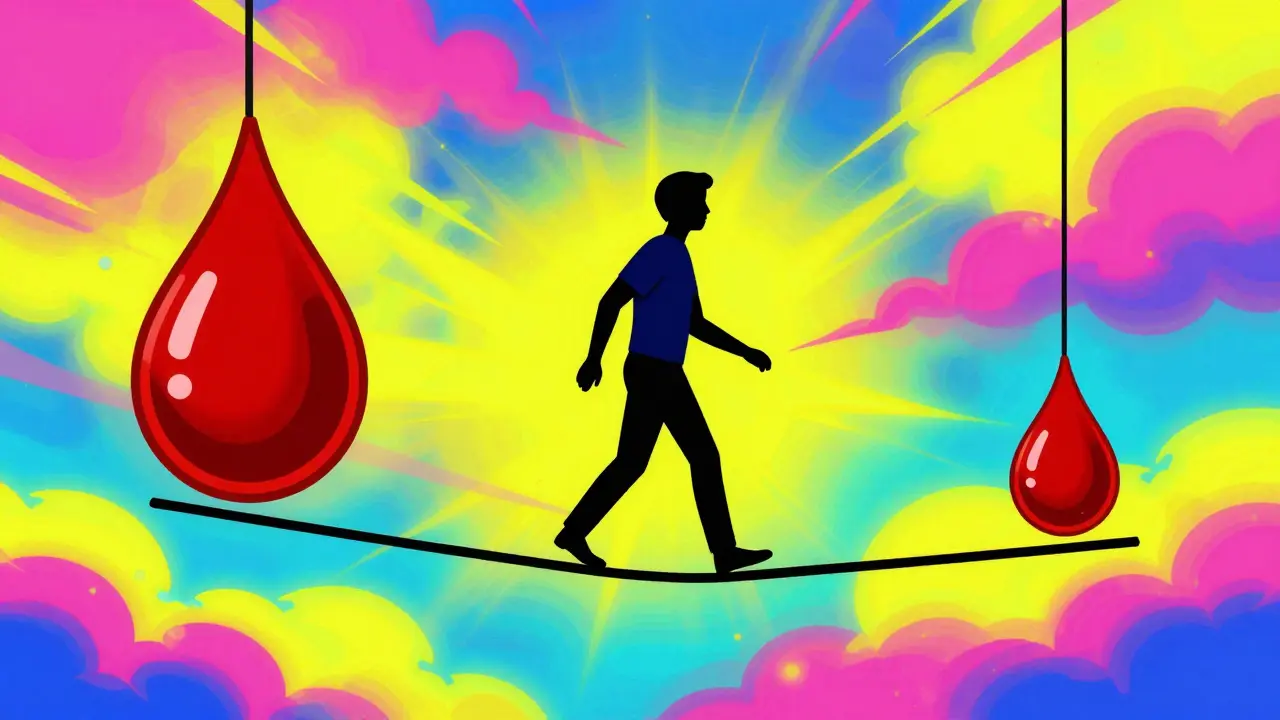
The High-Wire Act of Hemorrhage Prevention
The core of hemorrhage prevention is managing risk factors that make bleeding more likely. It isn't just about the drug you take, but who you are and what else is in your system. For instance, if you're over 75, your risk of bleeding is two to three times higher than a younger patient. Your kidneys also play a massive role; if your renal function is low, drugs like apixaban can build up in your system, effectively "over-thinning" your blood.
Another huge red flag is "dual therapy." This happens when a doctor prescribes an anticoagulant alongside an antiplatelet drug (like aspirin). While this might be necessary after a heart stent, it increases the risk of a major bleed by 50% to 70%. If you're on both, your monitoring needs to be much tighter.
| Feature | Warfarin | DOACs (e.g., Apixaban) | Heparins (LMWH) |
|---|---|---|---|
| Monitoring Required | High (INR tests) | Low/None | Minimal |
| Bleeding Risk | Higher | Lower (approx 20% less) | Moderate |
| Primary Use | Mechanical valves | Atrial fibrillation | Acute hospital care |
| Reversal Speed | Slow (hours to days) | Fast (with specific agents) | Very Fast |
How to Manage Warfarin and the INR Puzzle
If you're on Warfarin, you've likely heard of the International Normalized Ratio (or INR). This is a standardized measurement of how long it takes your blood to clot. For most people, the target is between 2.0 and 3.0. If your number drops too low, you're at risk for a stroke; if it climbs too high, you're at risk for a brain bleed or internal hemorrhage.
Consistency is everything here. A sudden increase in spinach or kale (which are rich in Vitamin K) can actually cancel out your medication. On the flip side, skipping a dose or taking certain antibiotics can spike your INR. Experts suggest that maintaining a "Time in Therapeutic Range" (TTR) of over 70% is the sweet spot for safety. For every 10% you dip below that, your risk of a major bleed climbs by about 15%.

DOACs: The Modern Alternative and Its Pitfalls
Many people are switching to DOACs because they're easier. No more weekly blood draws. However, the trade-off is a lack of routine monitoring. You can't just "check your level" with a simple test. This makes renal function assessment critical. Since the kidneys clear these drugs from your body, a decline in kidney function (measured by Creatinine Clearance) can lead to toxic levels of the drug.
For example, if your CrCl is below 50 mL/min, your risk of major bleeding doubles. Doctors usually check this every 3 to 6 months. If you notice a sudden decrease in urine output or swelling in your ankles, it's time to get your kidney function checked immediately to avoid a bleeding crisis.
Emergency Reversals: What Happens When Things Go Wrong?
When a patient on blood thinners has a serious accident or needs emergency surgery, doctors have to "turn off" the anticoagulant quickly. This is where reversal agents come in. They act like an antidote to stop the bleeding.
- For Warfarin: Doctors use 4f-PCC (four-factor prothrombin complex concentrate). It can fix an INR in about 15 minutes, whereas Vitamin K alone could take a whole day.
- For Dabigatran: There is a specific antidote called Idarucizumab that works almost instantly.
- For Factor Xa Inhibitors (Apixaban/Rivaroxaban): Andexanet alfa is the gold standard, though it is incredibly expensive-sometimes costing around $13,000 per dose.
- For Heparin: Protamine sulfate is used to neutralize the drug's effect.

Practical Tips for Daily Life
Living with a bleeding disorder or taking anticoagulants doesn't mean you have to live in a bubble, but you should change a few habits. First, ditch the razors. Switch to an electric shaver to avoid those small nicks that won't stop bleeding. Second, be cautious with NSAIDs. Taking ibuprofen or aspirin for a headache can irritate your stomach lining and, combined with a blood thinner, lead to a gastrointestinal bleed.
Watch for the "silent" signs of bleeding. It's not always a gash in the skin. Keep an eye out for:
- Bruises that appear for no reason.
- Gums that bleed excessively during brushing.
- Stool that looks like coffee grounds or is black and tarry.
- Unusually dark or pinkish urine.
Can I take aspirin while on a blood thinner?
Only if your doctor specifically tells you to. Combining antiplatelets like aspirin with anticoagulants significantly increases the risk of major bleeding (by 50-70% in some cases). This is usually only done for high-risk heart patients under strict supervision.
What is the fastest way to reverse Warfarin?
The fastest method is the administration of four-factor prothrombin complex concentrate (4f-PCC), which can correct the International Normalized Ratio (INR) within about 15 minutes. Vitamin K is also used but takes much longer to work.
Why do I need kidney tests if I'm taking a DOAC?
Most DOACs, such as Apixaban and Rivaroxaban, are cleared from the body by the kidneys. If your kidney function drops, the drug stays in your system longer and reaches higher concentrations, which drastically increases your risk of a major hemorrhage.
Are DOACs safer than Warfarin?
Generally, yes. Clinical trials show that DOACs have a 19-20% lower risk of major bleeding compared to Warfarin. However, Warfarin is still the only safe choice for people with mechanical heart valves or antiphospholipid syndrome.
What should I do if I miss a dose of my blood thinner?
Follow the specific instructions provided by your pharmacist. Generally, you should not double the dose to "catch up," as this can spike your bleeding risk. Contact your healthcare provider to determine the best time to resume your schedule.
Next Steps and Troubleshooting
If you are starting a new anticoagulant, your first step is to establish a baseline. Get your kidney function (CrCl) and liver enzymes checked. If you are on Warfarin, keep a food log of your green vegetable intake for two weeks so your doctor can see how your diet affects your INR.
For those who experience a bleeding event, the focus shifts to the "restart" strategy. If you had a minor bleed and your risk of a blood clot is low (for example, a low CHA₂DS₂-VASc score for atrial fibrillation), your doctor might suggest stopping the drug permanently. However, for high-risk patients, the goal is usually to restart the medication as soon as it is medically safe to prevent a stroke.
mimi clouet
April 14, 2026 AT 16:49Electric shavers are literally a lifesaver! 🪒 I always tell people that the smallest cut can turn into a total nightmare when you're on these meds. Also, don't forget to use a soft-bristled toothbrush because gum bleeding is so common 🦷✨
Clare Elizabeth
April 15, 2026 AT 13:23so helpful!! honestly just knowing there are reversal agents makes me feel so much better about the whole process lets go health!
Sam Dyer
April 16, 2026 AT 23:25Typical pharma nonsense pushing the new DOACs because they're more expensive. Warfarin worked just fine for decades before these corporate suits decided to "simplify" things for a premium price. Absolute joke. 🙄
S.A. Reid
April 17, 2026 AT 01:38It is quite fascinating how we are encouraged to trust these synthetic compounds blindly. One must wonder if the emphasis on "monitoring" is simply a method to keep patients tethered to a medical surveillance state under the guise of safety. I find it highly improbable that the renal function is the only variable at play here. Perhaps there are subterranean influences regarding the efficacy of these agents that the pharmaceutical conglomerates are not disclosing to the general public. I shall maintain my skepticism regarding the so-called gold standard treatments. It is a marvel of modern hubris to believe we can perfectly balance human blood chemistry with a pill. Truly, the irony of "preventing" a bleed by introducing a chemical that prevents clotting is almost poetic in its absurdity. I suspect these protocols are designed to maximize clinical visits rather than patient wellness. One must always look beyond the provided table of data to see the invisible hand of profit. It is simply a matter of intellectual discernment. The notion that a $13,000 dose is "necessary" for reversal is a laughable admission of a broken system. We are mere data points in a massive corporate experiment. I prefer my autonomy over their guided balance. The chemistry is merely a tool for control. The truth is rarely found in a clinical guide. It is buried in the fine print of a balance sheet. The high-wire act is not medical, it is financial. We are the ones walking the rope while they hold the net and charge us for the privilege. I shall continue to question the narrative.
Jasmin Stowers
April 18, 2026 AT 10:00totally agree with the part about the kidneys. it really is the hidden factor
Mark Dueben
April 19, 2026 AT 09:18It might be worth mentioning that some people find a transition to soft toothbrushes helps a lot with the gum issues. It's a small change that makes a big difference in daily comfort.
Catherine Mailum
April 20, 2026 AT 03:23oh sure just a "small nick" and now you're bleeding for three hours like a horror movie scene. lovely
Anurag Moitra
April 21, 2026 AT 16:13The mention of the CHA₂DS₂-VASc score is an important detail for clinicians and patients alike to consider during the restart strategy.
Becca Suttmiller
April 22, 2026 AT 09:38I appreciate the reminder about the coffee ground appearance in stool. Many people ignore that sign until it's too late.
Ikram Khan
April 23, 2026 AT 10:22Whoa! 13k for one dose?! That is absolutely insane!! 😱 How does anyone even afford that without insurance? Just wild!