Peanut Allergy Prevention: Early Introduction and OIT Guide

If you're navigating the first few months of your baby's life, you're probably wondering when to start solids and how to handle allergens. The shift from "avoidance" to "introduction" is one of the biggest changes in pediatric health over the last decade, and getting the timing right can change your child's health trajectory.
Peanut allergy prevention is no longer about waiting for the "safe" age of three; it's about using a narrow window of opportunity in early infancy to teach the immune system that peanuts are friends, not foes.
The Big Shift: Why We Stopped Waiting
Before 2015, the standard advice from the American Academy of Pediatrics the largest association of pediatricians in the United States was to delay peanut introduction until ages 2 or 3. Unfortunately, the data showed a worrying trend: as we delayed introduction, allergy rates spiked. In 1997, only 0.4% of children had peanut allergies; by 2010, that number jumped to 2.0%.
Everything changed with the LEAP study Learning Early About Peanut Allergy, a landmark clinical trial that proved early introduction reduces allergy risk. This research showed that infants at high risk-specifically those with severe eczema or an egg allergy-who ate peanut-containing foods early were significantly less likely to develop an allergy. This wasn't just a minor improvement; it was a paradigm shift that led to the 2017 guidelines from the NIAID National Institute of Allergy and Infectious Diseases.
Who is at Risk? The Three-Tiered Approach
Not every baby needs the same strategy. Doctors now use a three-tiered risk assessment to decide when and how to introduce peanuts. This ensures that babies who need medical supervision get it, while others can simply start at home.
| Risk Level | Criteria | Recommended Timing | Method |
|---|---|---|---|
| High Risk | Severe eczema or egg allergy | 4-6 months | Medical consultation + supervised intro |
| Moderate Risk | Mild to moderate eczema | Around 6 months | At-home introduction |
| Low Risk | No eczema or food allergies | Around 6 months | At-home introduction |
If your child falls into the high-risk category, the window of opportunity is tight. Experts like Dr. Matthew Greenhawt emphasize that the maximal benefit happens between 4 and 6 months. This is because the gut and immune system are uniquely receptive during this period, allowing them to develop a tolerance that lasts into adulthood.
How to Safely Introduce Peanuts at Home
Once your pediatrician gives the green light and your baby is developmentally ready for solids (they can sit up and have good head control), the process is simpler than most parents think. The goal isn't to feed a baby a whole peanut-which is a major choking hazard-but to introduce the protein.
Here are a few safe ways to do it:
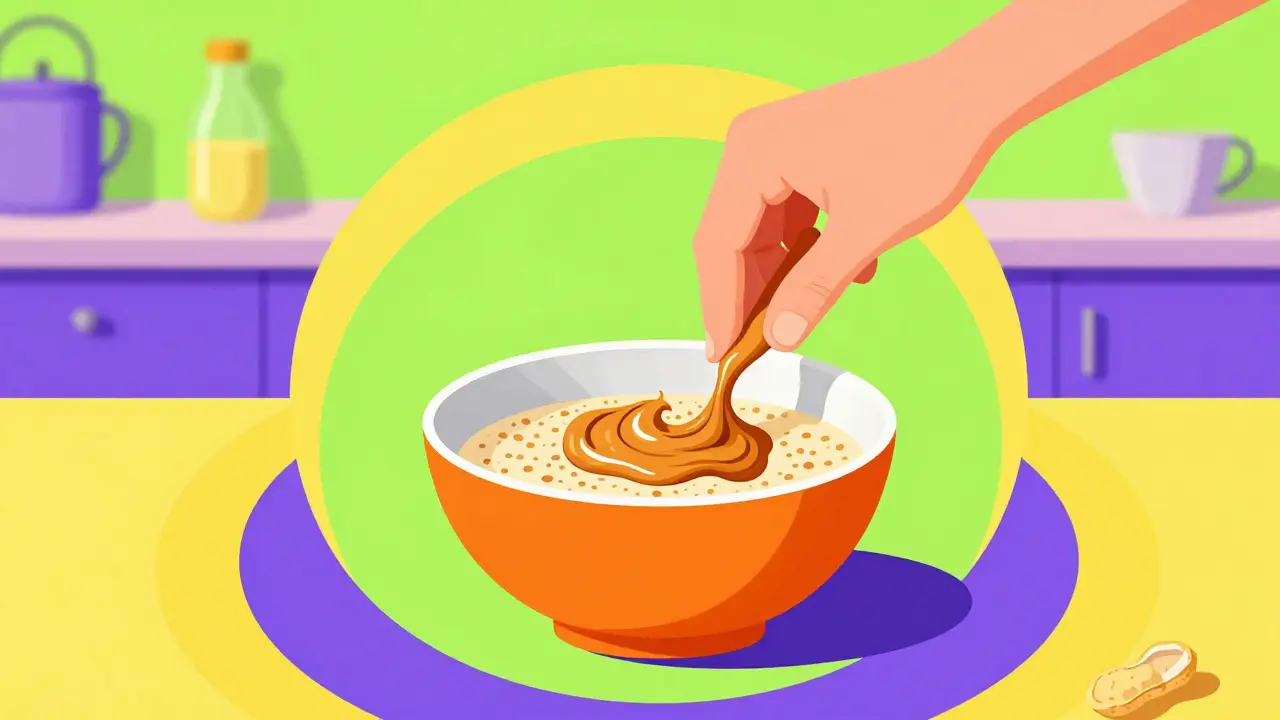
- The Dilution Method: Mix two teaspoons of smooth peanut butter with two to three tablespoons of warm water, breast milk, or formula. This creates a thin consistency that's easy for a baby to swallow.
- The Mix-In: Stir a small amount of smooth peanut butter into infant cereal or pureed fruits and vegetables.
- Ready-Made Options: Use spoonable peanut butter pouches designed specifically for infants, which are formulated for safe swallowing.
For those in the high-risk group, the LEAP study protocol suggested 2g of peanut protein (roughly 2 teaspoons of peanut butter) three times a week. It's important to keep this consistent; the protective effect comes from regular exposure, not a one-time taste test.
Understanding OIT: When Prevention Isn't Enough
What happens if a child already has a peanut allergy? This is where Oral Immunotherapy OIT is a medical process where a patient consumes gradually increasing amounts of an allergen under medical supervision to build tolerance (OIT) comes in. While early introduction is a preventive measure for babies, OIT is a treatment for children who are already sensitized.
OIT works by slowly introducing tiny, measured doses of peanut protein over several months or years. The goal isn't necessarily to allow the child to eat peanut butter sandwiches freely, but to raise their "reaction threshold." This means that if they accidentally eat something with a trace of peanut, they won't go into anaphylaxis. It's a high-stakes process that must be done in a clinic with emergency equipment on hand.
The Long-Term Impact: Does it Actually Work?
You might wonder if this "early start" is just a temporary fix. The long-term follow-up data suggests otherwise. Research published in The Lancet showed that the protective effect of early introduction lasted even after 12 months of avoiding peanuts. This suggests that early exposure induces true immunological tolerance-essentially teaching the body that peanuts are safe for good.
The numbers are impressive. A pooled analysis of the LEAP and EAT studies showed a 98% reduction in peanut allergy prevalence in children who followed the protocol strictly. Even in children with severe eczema, the risk was slashed by 67%. In the U.S., following these guidelines has already contributed to a drop in prevalence from 2.2% in 2015 to about 1.6% in 2023.

Common Pitfalls and Parental Anxiety
Despite the evidence, many parents are still terrified of the first dose. A survey found that over 60% of parents feel significant anxiety about introducing peanuts. This fear is often fueled by outdated advice or horror stories about allergic reactions. It's important to remember that the risk of a severe reaction during a controlled introduction is very low compared to the lifetime risk of managing a severe allergy.
Another common mistake is using the wrong form of peanut. Never give a baby whole peanuts, chunks of peanut butter, or peanut-flavored candies. Stick to smooth, diluted peanut butter or infant-specific products. Also, don't wait until the baby is "older and stronger." The evidence shows that the effectiveness of prevention drops if you wait too long past the 6-month mark.
The Future of Allergy Prevention
We're moving beyond just peanuts. New research, such as the 2024 EAT study extension, is looking at "multi-allergen" introduction. The idea is that if early exposure works for peanuts, it might also work for eggs, milk, and soy. By introducing a variety of common allergens early, we could potentially see a massive drop in all food allergies.
Current trials, like the PRESTO trial funded by the COFAR Consortium of Food Allergy Researchers, are refining the exact dose and timing to make these guidelines even more effective. If implementation rates continue to climb, experts predict that peanut allergy prevalence could drop to 1.2% by 2030.
Christopher Cooper
April 8, 2026 AT 00:08The LEAP study is a fantastic example of how scientific consensus evolves when we actually look at the data instead of relying on outdated traditions. It's truly inspiring to see how a shift in timing can fundamentally alter a child's health trajectory and save families from years of anxiety and emergency room visits. I find it fascinating that the gut is so uniquely receptive during that narrow window between four and six months. This kind of evidence-based medicine is exactly what we need more of in pediatric care to ensure the next generation is healthier and more resilient.
Victoria Gregory
April 8, 2026 AT 14:20This is such a relief for new parents!!! 🌟 It feels like such a weight off the shoulders knowing there's a clear path to help our little ones avoid these scary allergies ✨. Just imagine the peace of mind we can give families if everyone knows about this early window 💖💖.
Ethan Davis
April 10, 2026 AT 08:11Funny how the "official guidelines" suddenly flip every ten years once the pharmaceutical companies find a new way to make money off OIT clinics. They tell you to wait, then they tell you to rush it, and all the while they're just experimenting on babies to see what sticks. Don't trust the "paradigm shift" blindly.
Daniel Trezub
April 11, 2026 AT 13:36Pretty sure the 98% reduction stat is a bit overblown if you actually dig into the trial's exclusion criteria. It's always the same with these studies; they cherry-pick the best-case scenarios to make the headline look impressive while ignoring the nuance of genetic predisposition.
dwight koyner
April 12, 2026 AT 19:28It is imperative that parents remember the distinction between prevention and treatment. For those in the high-risk category, the supervision of a medical professional during the first introduction is not merely a suggestion, but a critical safety measure to manage potential anaphylactic responses effectively.
Alexander Idle
April 13, 2026 AT 17:43Absolute chaos! One minute we're told peanuts are poison for babies, and the next we're basically feeding them PB&J at six months. The sheer inconsistency of medical advice is enough to drive any sane person to a complete breakdown!
jack hunter
April 13, 2026 AT 19:10probly just another way to get us to buy those expensive "infant-specific" pouches lol. why use 5 ingredients when 1 will do? the whole thing feels like a scam to make simple parenting more complcated thn it needs to be
Darius Prorok
April 13, 2026 AT 23:26Just use smooth peanut butter. It's the simplest way. No need to overthink it.
Michael Flückiger
April 15, 2026 AT 20:29This is exactly the kind of progress we need!!! It's so great to see science working for us!!!! Let's get the word out and help every parent feel confident!!!!
GOPESH KUMAR
April 16, 2026 AT 11:35The human obsession with controlling every biological outcome is amusing. We try to "teach" the immune system, forgetting that nature often has its own design. Whether it is early introduction or avoidance, we are simply playing a game of probability with the genetic lottery.
Sarabjeet Singh
April 16, 2026 AT 19:31Good to see these updates. Very helpful for those of us managing family health in different regions.
Jamar Taylor
April 17, 2026 AT 07:02You've got this, parents! Just take it one step at a time and follow the guide. The effort you put in now is going to make such a huge difference for your kids later on. Keep pushing forward!
Timothy Burroughs
April 18, 2026 AT 17:36this is why american healthcare is a joke lol they just make up new rules and everyone panics while the real doctors in other countries have known this for ages
Nikhil Bhatia
April 19, 2026 AT 00:56Too much text for a basic dietary change.
charles mcbride
April 20, 2026 AT 15:56It really is an amazing time for medical breakthroughs. Seeing the prevalence of these allergies actually drop because of a simple change in timing gives me so much hope for the future of pediatric health. We're finally getting the evidence we need to protect these kids properly.