NSAIDs and Kidney Disease: How to Prevent Acute Kidney Injury
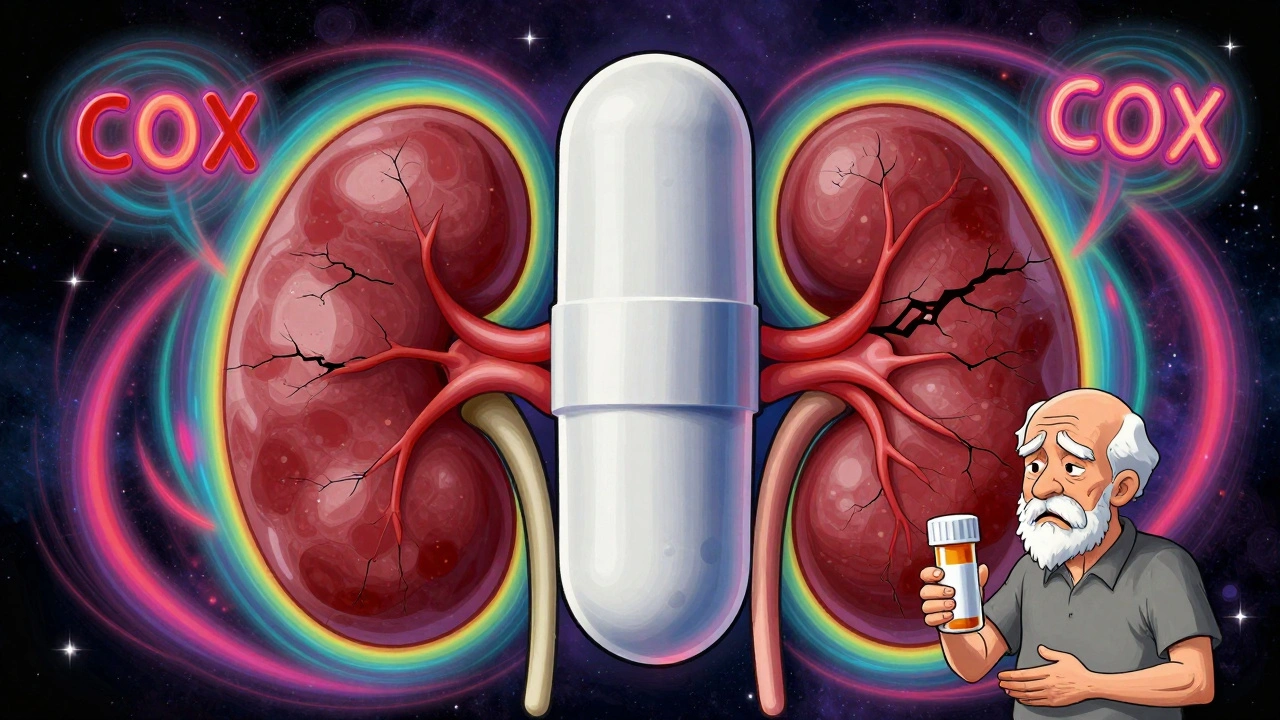
Every year, tens of thousands of people end up in the hospital with sudden kidney damage - not from an infection, not from a chronic illness, but from something they bought over the counter: NSAIDs. Ibuprofen. Naproxen. Aspirin. These drugs are everywhere. You grab them for a headache, a sore back, or menstrual cramps without thinking twice. But if you have kidney disease, or even just a slightly reduced kidney function, these common painkillers can trigger acute kidney injury - sometimes in just a few days.
How NSAIDs Actually Hurt Your Kidneys
NSAIDs work by blocking enzymes called COX-1 and COX-2. That’s how they reduce pain and swelling. But your kidneys rely on those same enzymes to make prostaglandins - chemicals that keep blood flowing through them. When you take NSAIDs, you cut off that signal. Your kidneys don’t get the message to stay open. Blood flow drops. Glomerular filtration rate (GFR) can plunge by 20-40% within 24 hours.
This isn’t just theory. In hospitalized patients, 1-5% of all acute kidney injury cases are directly linked to NSAID use. For people with existing kidney problems, the risk jumps even higher. The damage isn’t always obvious. You might not feel sick. Your urine output might not change right away. But your creatinine - the lab marker doctors use to check kidney function - can spike silently.
There are two main ways NSAIDs damage the kidneys. The first is hemodynamic - meaning it’s about blood flow. This happens in 70-80% of cases. The second is acute interstitial nephritis (AIN), an immune reaction. This is rarer, but more dangerous. It can cause fever, rash, and heavy protein in the urine. It often gets mistaken for an infection.
The Triple Whammy: When NSAIDs Team Up With Other Drugs
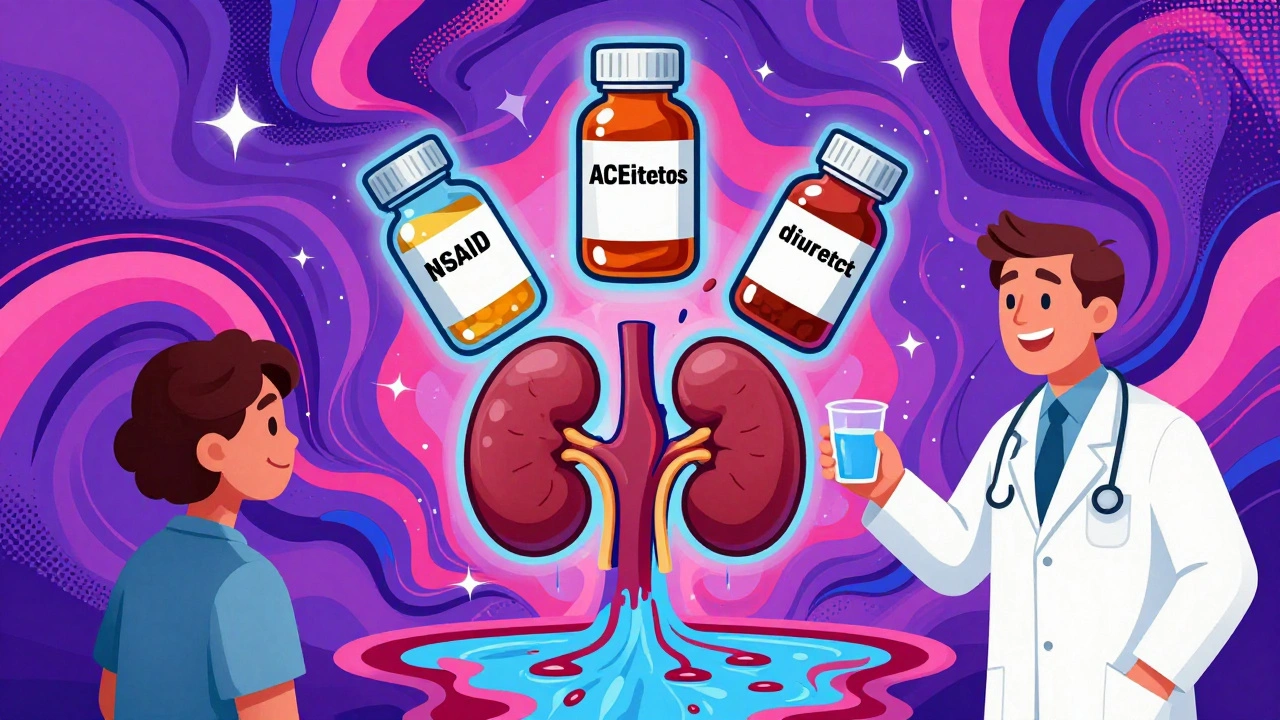
One of the most dangerous combinations you might not even know about is called the “triple whammy.” It happens when NSAIDs are taken with ACE inhibitors or ARBs (blood pressure meds) and diuretics (water pills). This trio is common in older adults with high blood pressure, heart failure, or kidney disease.
Here’s why it’s deadly: ACE inhibitors lower blood pressure by relaxing blood vessels. Diuretics reduce fluid volume. NSAIDs block the kidneys’ backup system for maintaining blood flow. Together, they leave the kidneys with no way to compensate. Studies show this combo increases the risk of acute kidney injury by 31%. In the first 30 days of using all three, the risk nearly doubles.
Doctors often prescribe these drugs without realizing how they interact. Patients don’t know to ask. And by the time creatinine rises, the damage is already done.
Who’s at Highest Risk?
Not everyone who takes NSAIDs gets kidney injury. But some people are far more vulnerable:
- People with eGFR below 60 mL/min/1.73m² - that’s stage 2 or worse chronic kidney disease
- Those over 65 - kidney function naturally declines with age
- People on diuretics, ACE inhibitors, or ARBs
- Those who are dehydrated - from illness, heat, or not drinking enough
- People with heart failure or liver cirrhosis
- Those taking high doses of NSAIDs (800mg ibuprofen three times daily, for example)
A 2020 case study from the University of Rhode Island followed a 72-year-old man with an eGFR of 58 - just below the danger line. He started taking 800mg ibuprofen three times a day for arthritis. Within 72 hours, his eGFR dropped to 22. He needed hospitalization. He had no prior history of kidney problems. No warning signs. Just a common painkiller.
What About Acetaminophen? Is It Safer?
If you have kidney disease and need pain relief, acetaminophen (Tylenol) is usually the better choice. It doesn’t affect kidney blood flow like NSAIDs do. Studies show it carries 40-50% less risk of causing acute kidney injury.
But it’s not perfect. High doses over long periods can harm the liver. Stick to the lowest effective dose - no more than 3,000mg per day. Avoid alcohol while taking it. And never use it if you already have liver disease.
Opioids are another option for severe pain, but they come with addiction risks. About 15-25% of long-term users develop dependence. They don’t hurt the kidneys directly, but they’re not ideal for daily use.
Topical NSAIDs: A Safer Alternative?
If you need the anti-inflammatory power of NSAIDs but want to protect your kidneys, consider topical versions. Gels, creams, and patches - like diclofenac gel - deliver the drug straight to the skin where it hurts. Less than 10% of the dose enters your bloodstream.
A 2024 JAMA Internal Medicine trial with 3,200 patients found topical NSAIDs caused 40-50% fewer kidney problems than oral versions. For localized pain - like a sore knee or shoulder - this is a game-changer.
They won’t help with full-body pain or arthritis in multiple joints. But for targeted relief, they’re a smart, safer option.
Exercise, Heat, and NSAIDs: A Hidden Danger
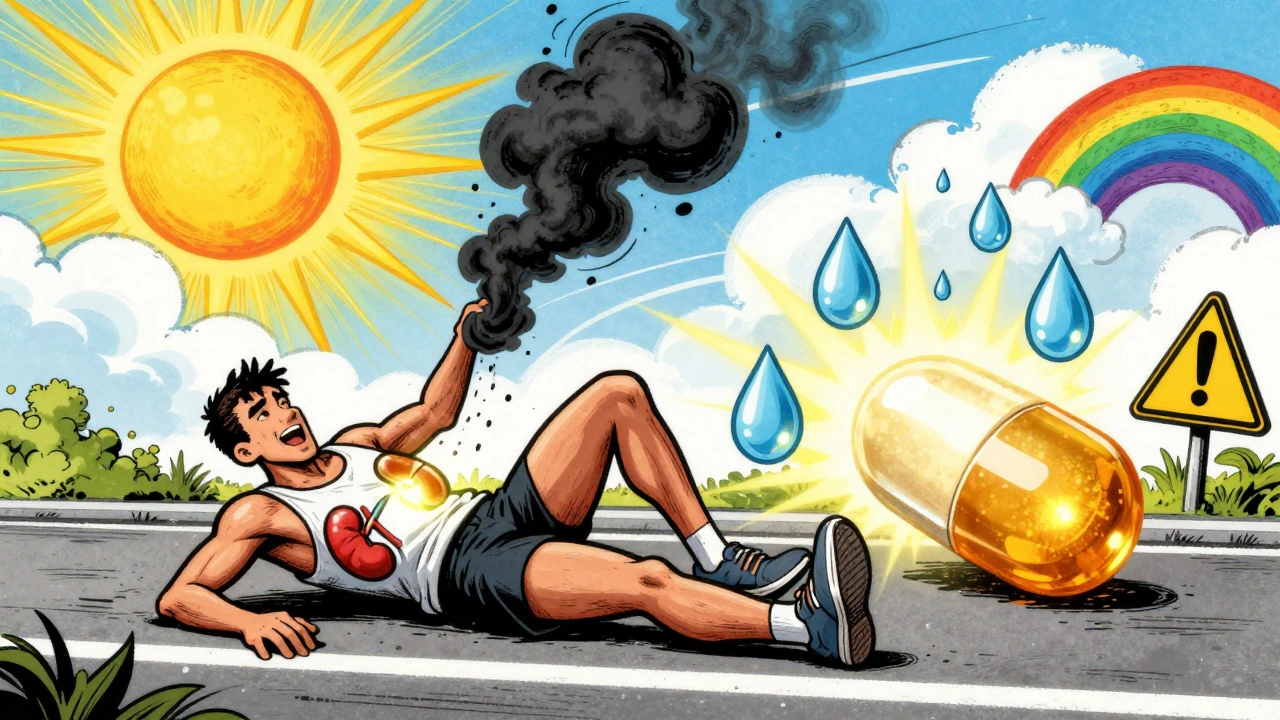
Many runners and athletes take NSAIDs before long events to prevent muscle soreness. But during exercise, your kidneys are already under stress. Blood flow shifts away from them to support muscles. Add NSAIDs into the mix, and you’re cutting off the kidneys’ last line of defense.
Studies show NSAID use during prolonged exercise can reduce renal blood flow by 30-50% beyond normal exercise effects. Dehydration makes it worse. In marathon runners, the risk of acute kidney injury jumps - though the absolute rate is still low, at about 0.001% of participants.
Here’s what to do instead: Hydrate properly. Drink 5-10 mL per kg of body weight 2-4 hours before exercise. During activity, aim for 0.4-0.8 liters per hour. Keep your urine specific gravity below 1.020 - that means it’s light yellow, not dark. Skip the NSAIDs before long runs, hikes, or workouts in the heat.
What Should You Do? A Practical 4-Step Plan
If you have kidney disease or are at risk, here’s what to do:
- Check your kidney function first. Ask your doctor for an eGFR and urine albumin-to-creatinine ratio. If your eGFR is below 60, NSAIDs should be avoided unless absolutely necessary.
- Avoid the triple whammy. Never combine NSAIDs with ACE inhibitors, ARBs, and diuretics. If you’re on any of these, talk to your doctor before taking any painkiller.
- Limit duration. Don’t use NSAIDs for more than 7-10 days without reevaluation. If pain lasts longer, you need a different plan - not a stronger dose.
- Monitor if you must use them. If you’re on chronic NSAIDs (e.g., for arthritis), get your creatinine checked every week. Watch for symptoms: less urine, swollen ankles, unexplained fatigue, nausea.
The American Geriatrics Society says NSAIDs should be avoided entirely if your eGFR is below 30. If it’s between 30 and 60, use the lowest possible dose for no more than 3 days a week.
Why This Problem Is So Hard to Spot
Doctors don’t always warn patients. A 2023 survey of nephrologists found that 58% regularly see patients who didn’t know NSAIDs could hurt their kidneys. On Reddit’s kidney forums, 72% of people who suffered NSAID-induced AKI said their doctor never mentioned the risk. Sixty-five percent thought “over-the-counter” meant “safe.”
And here’s the cruel part: early kidney injury often has no symptoms. You don’t feel pain. You don’t feel sick. Your creatinine might not rise until damage is already significant. By then, recovery isn’t guaranteed.
Dr. George Lucas, a nephrologist in Rio de Janeiro, says: “NSAID-related nephrotoxicity is frequently overlooked until significant renal impairment has occurred.”
What’s Changing? New Tools and Hope
There’s progress. In 2023, the American Society of Nephrology launched the NSAID-RF Risk Calculator. It uses 12 factors - age, blood pressure, eGFR, diuretic use - to predict your 30-day risk of kidney injury with 87% accuracy.
Researchers are also testing new drugs. One combination - ibuprofen plus acetylcysteine - is in phase 2 trials. It aims to reduce oxidative stress in the kidneys while keeping pain relief.
And in 2025, scientists identified genetic variants in the PTGS2 gene that may predict who’s most likely to suffer kidney damage from NSAIDs. Personalized risk assessment is coming.
For now, the best defense is awareness. Know your numbers. Know your meds. Know your risks.
Recognizing Early Signs of Kidney Trouble
If you’re taking NSAIDs and have kidney disease, watch for these red flags:
- Less urine than usual - 78% of AKI cases show this
- Swelling in ankles or feet - 65% report this
- Unexplained fatigue or nausea - 52% experience this
- Confusion or dizziness - signs of fluid and electrolyte imbalance
- Sudden weight gain - from fluid retention
If you notice any of these, stop NSAIDs immediately and contact your doctor. Don’t wait. Early action can prevent permanent damage.
Annie Gardiner
December 8, 2025 AT 06:47Okay but have you ever tried ibuprofen after a 12-hour shift and not felt like a god? I get the science, but people aren’t lab rats. My grandma takes it daily for her knees and she’s 82 and still gardening. Maybe the real problem is doctors who scare people with numbers instead of listening.
Rashmi Gupta
December 9, 2025 AT 12:04NSAIDs are not the villain. The villain is the Western obsession with quick fixes. We don’t sit with pain. We numb it. Then we blame the medicine. In India, we have turmeric, ginger, yoga, massage - ancient tools that don’t require a pharmacy. Why are we so afraid of discomfort?
Kumar Shubhranshu
December 10, 2025 AT 17:14Mayur Panchamia
December 12, 2025 AT 01:42Kenny Pakade
December 13, 2025 AT 06:51Brooke Evers
December 14, 2025 AT 05:06I just want to say how important this post is. I’m a nurse and I’ve seen so many older patients come in with AKI after taking OTC painkillers for ‘just a few days.’ They never thought it was a big deal. I always tell them: your kidneys don’t scream. They whisper. And by the time you hear it, it’s too late. Please, if you’re over 60 or have any chronic condition - talk to your pharmacist before popping that pill. It’s not weak to ask. It’s wise.
Saketh Sai Rachapudi
December 14, 2025 AT 07:26Priya Ranjan
December 15, 2025 AT 01:22Let me be clear: if you're taking NSAIDs and have any kidney risk factors, you're not just being careless - you're being selfish. Your kidneys are not your personal property. They're part of a system that affects your family, your insurance, your hospital bed. When you ignore medical advice, you burden everyone. This isn't about pain. It's about responsibility.
Gwyneth Agnes
December 15, 2025 AT 15:06Ashish Vazirani
December 16, 2025 AT 09:50And then there’s the TRAGEDY - the athlete who takes NSAIDs before a marathon thinking they’re being smart. They push through pain. They collapse at mile 20. They end up in ICU. Their family finds a bottle of Advil in their gym bag. The coroner writes ‘acute kidney injury.’ The coach says ‘he was just determined.’ The world says ‘he was brave.’ But I say - he was stupid. And the system let him down. No one told him. No one warned him. And now his kidneys are gone. For what? A medal? A photo? A post on Instagram?
Mansi Bansal
December 16, 2025 AT 20:13It is imperative to underscore that the pathophysiological mechanisms underlying NSAID-induced nephrotoxicity are not merely pharmacological but also sociocultural in nature. The normalization of over-the-counter analgesic consumption in the absence of clinical oversight reflects a systemic erosion of medical literacy, particularly within neoliberal healthcare paradigms. Furthermore, the commodification of pain management has resulted in the deprioritization of holistic, non-pharmacological interventions - a trend which must be rectified through policy reform and public health education.
Katie O'Connell
December 18, 2025 AT 00:30While the data presented is statistically compelling, one cannot ignore the epistemological gap between clinical studies and lived experience. The notion that a single biomarker - eGFR - should dictate pharmaceutical use ignores the complex interplay of psychosocial factors, cultural norms, and individual autonomy. To reduce human health to a number is not medicine - it is algorithmic paternalism.
Inna Borovik
December 18, 2025 AT 12:14Interesting. But where’s the data on topical NSAIDs in elderly patients with osteoarthritis? The JAMA study had mostly middle-aged folks. Also, what about renal outcomes in patients who use topical NSAIDs for 6+ months? I’ve seen cases where people use diclofenac gel daily for years and still have normal creatinine - but no one tracks long-term renal function in those studies. This feels like half-baked advice.
Andrew Frazier
December 18, 2025 AT 13:11Karen Mitchell
December 19, 2025 AT 02:21Let’s be honest - this isn’t about kidney health. It’s about control. Doctors don’t want you to self-manage. They want you dependent. They profit from your fear. If you’re healthy, you don’t need their tests, their meds, their ‘risk calculators.’ This post is fear dressed as science. Take the pill. Live your life. Stop letting experts tell you how to feel pain.