Noise Exposure Limits: Protecting Hearing at Work and Concerts
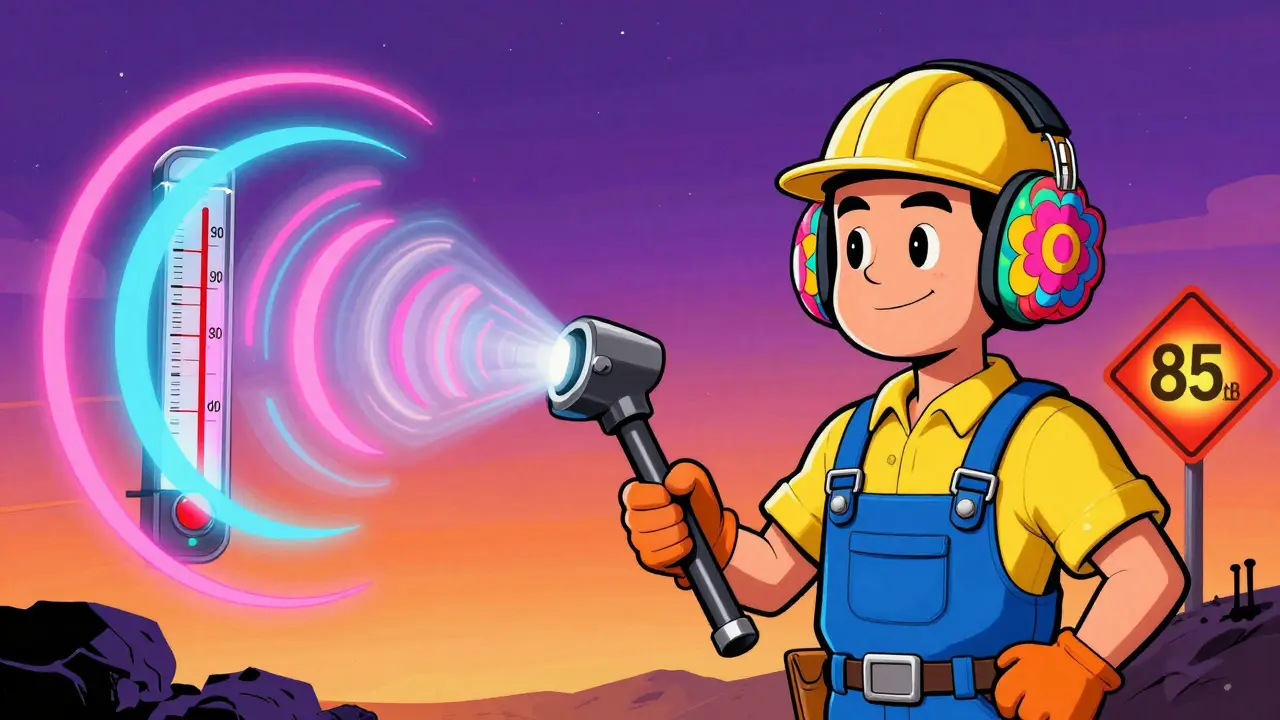
Every year, millions of people lose their hearing-not from aging, not from illness, but from something completely preventable: too much noise. Whether you're working on a construction site, operating machinery, or standing front row at a concert, your ears are being exposed to sound levels that can permanently damage your hearing. The good news? We know exactly how much noise is too much. The bad news? Many workplaces and venues still ignore the science.
What Counts as Dangerous Noise?
Sound is measured in decibels (dB), and not all noise is created equal. A normal conversation is around 60 dB. A lawnmower hits 90 dB. A rock concert? That’s 110 to 120 dB. At 85 dB, the danger starts. That’s the level of heavy city traffic or a blender running nonstop. According to the National Institute for Occupational Safety and Health (NIOSH), exposure to 85 decibels for eight hours a day is the threshold where hearing damage begins to accumulate. This isn’t a guess-it’s based on decades of research.
The problem? Not all rules follow this standard. The Occupational Safety and Health Administration (OSHA) lets employers allow up to 90 dB over eight hours. That’s five decibels higher than what science says is safe. Why does that matter? Because decibels work on a logarithmic scale. A 5 dB increase doesn’t just mean 5% more noise-it means noise energy has increased by more than 50%. At 90 dB, your ears are getting more than twice the sound energy they’d get at 85 dB over the same time. That’s why NIOSH recommends 85 dB as the limit, not 90.
How Exposure Time Changes with Noise Level
Noise doesn’t just add up-it multiplies. For every 3-decibel increase, the safe exposure time is cut in half. This is called the 3-dB exchange rate, and it’s used by NIOSH, the European Union, and Australia. Here’s what that looks like in practice:
- 85 dB → 8 hours
- 88 dB → 4 hours
- 91 dB → 2 hours
- 94 dB → 1 hour
- 100 dB → 15 minutes
- 110 dB → less than 2 minutes
OSHA uses a 5-dB exchange rate, which gives you much longer exposure times at high levels. At 100 dB, OSHA says you can work for 4 hours. NIOSH says 15 minutes. That’s a huge difference. And it’s not just about rules-it’s about real damage. Studies show workers exposed to 85-90 dB for 20 years show measurable hearing loss. That’s not rare. It’s common.
Workplace Rules: What’s Required
In the U.S., if noise hits 85 dB over eight hours, employers must start a hearing conservation program. That includes:
- Free hearing tests (audiograms) within six months of starting and every year after
- Training on how to use earplugs and earmuffs properly
- Providing hearing protection at no cost
- Monitoring noise levels with sound meters
But here’s the catch: most workers don’t use protection correctly. NIOSH found that without hands-on training, only 40% of workers wear hearing protection properly. With training, that jumps to 85%. That’s not a small gap-it’s the difference between keeping your hearing and losing it.
The best way to protect hearing? Stop the noise at the source. Engineering controls like soundproof enclosures, quieter machinery, or vibration dampers are more effective than just handing someone earplugs. But many companies skip this step because it costs more upfront. The real cost? Workers’ compensation claims for hearing loss cost over $1 billion a year in the U.S. alone. That’s more than the cost of fixing the machines.
Concerts Aren’t Safe Either
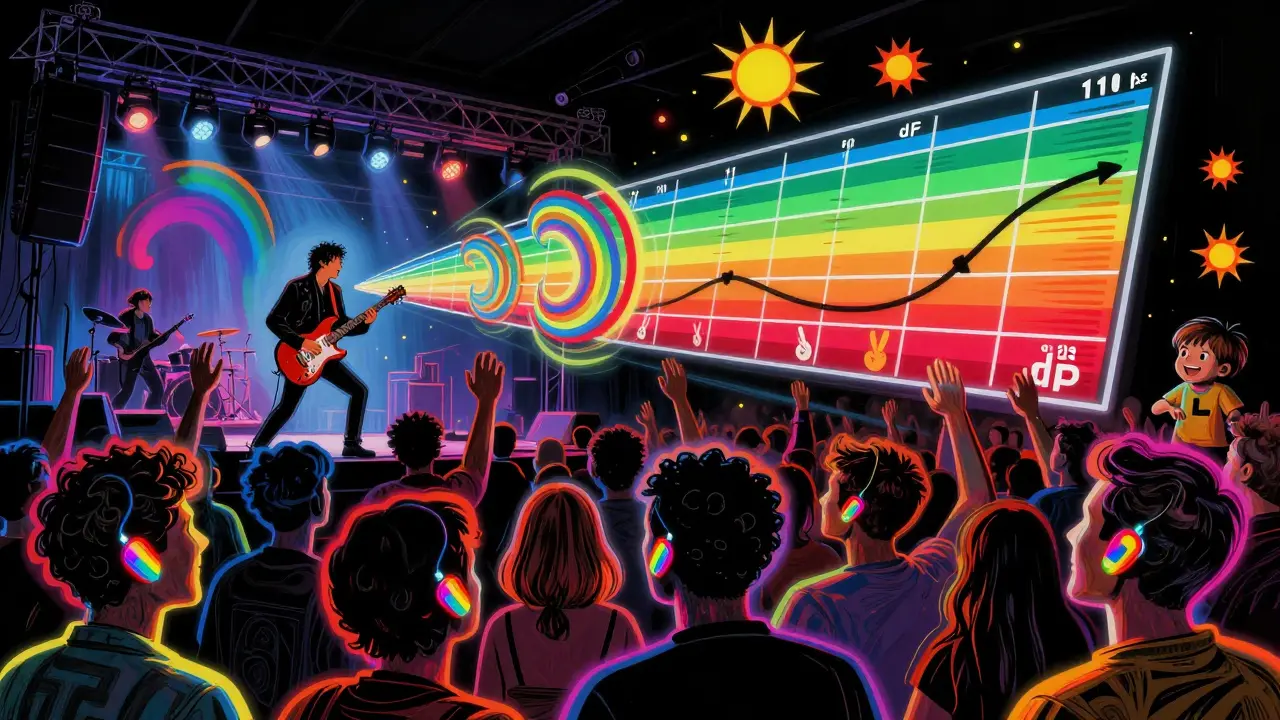
You don’t have to work in a factory to risk your hearing. A single concert can expose you to 110-120 dB. That’s louder than a chainsaw. Studies show that 50% of people who go to loud concerts experience a temporary threshold shift-a short-term muffling of hearing. For some, it never comes back. Permanent damage starts with these temporary shifts.
Organizations like the World Health Organization recommend limiting personal audio device use to 40 hours a week at 80 dB. But most people blast music at 90-100 dB for hours. And concerts? They’re not regulated like workplaces. No one’s checking the decibel levels at the front of the stage. That’s changing. Some festivals now use real-time sound displays. The Lifehouse Festival gives out free earplugs-and 75% of attendees use them. That’s proof that people will protect their hearing if it’s easy and visible.
Even musicians aren’t safe. A 2022 survey found that 63% of professional musicians have some degree of hearing loss. Orchestral players often face 89-94 dB during performances. No one tells them to take breaks. No one monitors their exposure. That’s why groups like the American Speech-Language-Hearing Association are pushing for mandatory noise monitoring in venues where staff work more than eight hours a week.
Global Standards: Who’s Doing It Right
Not every country is behind. Australia’s Safe Work Australia uses the same 85 dB standard as NIOSH. The European Union sets action levels at 80 dB and 85 dB, with a hard limit of 87 dB-even after ear protection. The UK’s rules are similar. China follows NIOSH too. The U.S. is an outlier because OSHA’s 90 dB rule hasn’t changed since 1983. California already moved to 85 dB with the 3-dB exchange rate. Other states are watching.
The trend is clear: the science says 85 dB. The EU says 85 dB. Australia says 85 dB. The only place still clinging to 90 dB is the U.S. federal standard-and even that’s being challenged. In 2023, OSHA increased inspections at music venues after a 40% spike in hearing loss complaints from musicians. Apple and Spotify now warn users when their headphone volume hits 85 dB equivalent. That’s not a coincidence. It’s a response to the data.
What You Can Do Right Now
You don’t need a law to protect your ears. Here’s what works:
- At work: Ask if your employer is measuring noise levels. If they’re not, request it. You have a right to know.
- Wear earplugs: Foam ones cost $1. Use them. Custom-molded ones last years and sound better.
- At concerts: Sit farther back. The front row is the loudest. Use the free earplugs. They’re not for wimps-they’re for smart people.
- At home: Use your phone’s volume limiter. Most phones let you set a max volume. Turn it on. Play music at 60% or less.
- Get tested: If you’re regularly around loud noise, get a hearing test every two years. Catching loss early means you can stop it.
There’s no cure for noise-induced hearing loss. Once the hair cells in your inner ear are damaged, they don’t grow back. No surgery. No pill. No app. Just prevention.
Why This Matters Beyond the Workplace
Healing hearing loss isn’t just about music or machinery. It’s about connection. It’s about hearing your child laugh, understanding your doctor, or enjoying a quiet evening with friends. Hearing loss doesn’t just affect your ears-it affects your relationships, your job, your mental health. Studies link untreated hearing loss to higher risks of depression and dementia.
The good news? We have the tools. We have the science. We have the standards. What we need now is action. Whether you’re a worker, a concertgoer, or a parent, your hearing is worth protecting. Don’t wait until you can’t hear the doorbell. Start today.
Cory L
February 24, 2026 AT 15:27Joseph Cantu
February 26, 2026 AT 06:37Jacob Carthy
February 27, 2026 AT 21:17Lisandra Lautert
February 28, 2026 AT 13:36Bhaskar Anand
February 28, 2026 AT 22:24William James
March 2, 2026 AT 17:09David McKie
March 3, 2026 AT 05:55Southern Indiana Paleontology Institute
March 3, 2026 AT 07:50