Neuromodulation: Spinal Cord Stimulation and Who It Works For
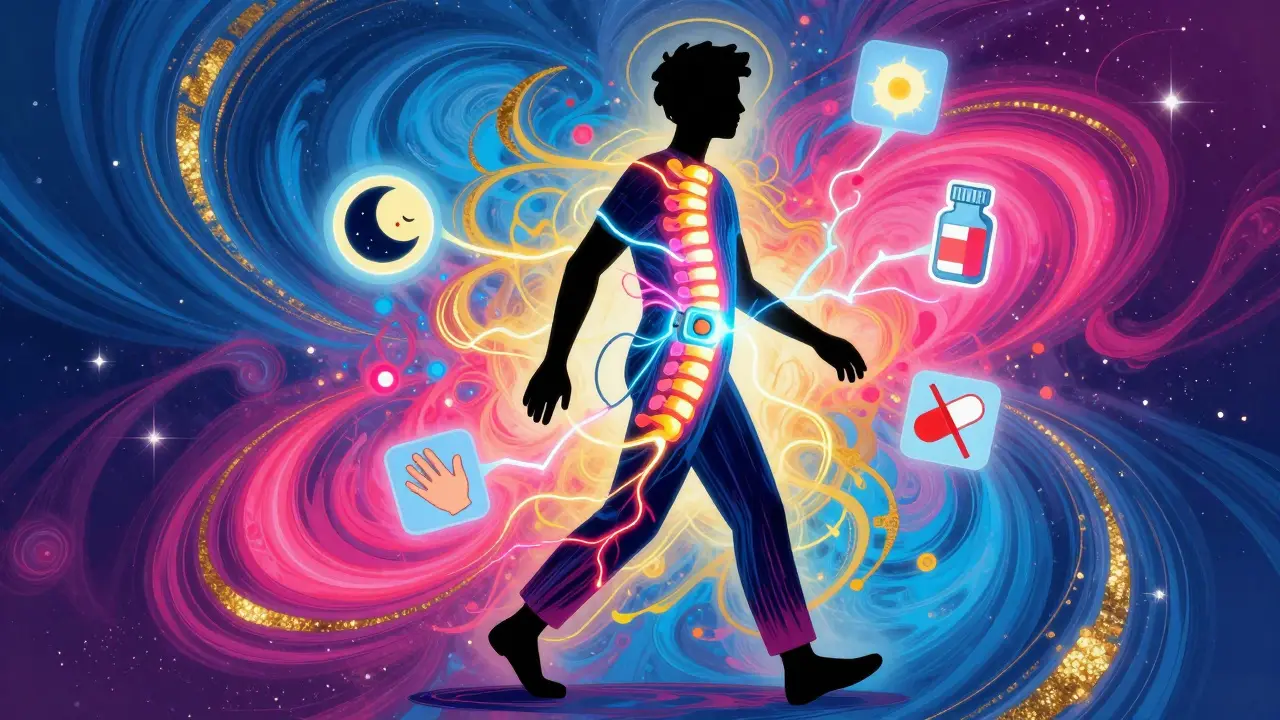
When your pain won’t go away-even after surgery, physical therapy, or months of pills-what’s left? For many people, spinal cord stimulation (SCS) becomes the next step. It’s not a cure. But for those who qualify, it can mean walking again, sleeping through the night, or cutting opioid use in half. This isn’t science fiction. It’s real, FDA-approved, and used by tens of thousands every year. But not everyone is a good candidate. And knowing who is-and who isn’t-can make all the difference.
What Is Spinal Cord Stimulation?
Spinal cord stimulation, sometimes called dorsal column stimulation, is a way to interrupt pain signals before they reach your brain. A small device, about the size of a pacemaker, is implanted under your skin-usually in the abdomen or buttocks. Thin wires, called leads, run from this device to the epidural space around your spinal cord. These leads send gentle electrical pulses that replace pain with a mild tingling sensation-or, in newer systems, no sensation at all.
The idea isn’t new. Dr. C. Norman Shealy first tried it in 1967. But today’s systems are far more advanced. Modern devices like Boston Scientific’s WaveWriter Alpha™ Prime, Medtronic’s Intellis™, and Abbott’s Proclaim™ let doctors fine-tune frequency, pulse width, and current type. You can choose between traditional stimulation (30-120 Hz), high-frequency (1,000-10,000 Hz), or burst patterns that mimic how your nerves naturally fire. Some systems even adjust automatically when you stand up or sit down.
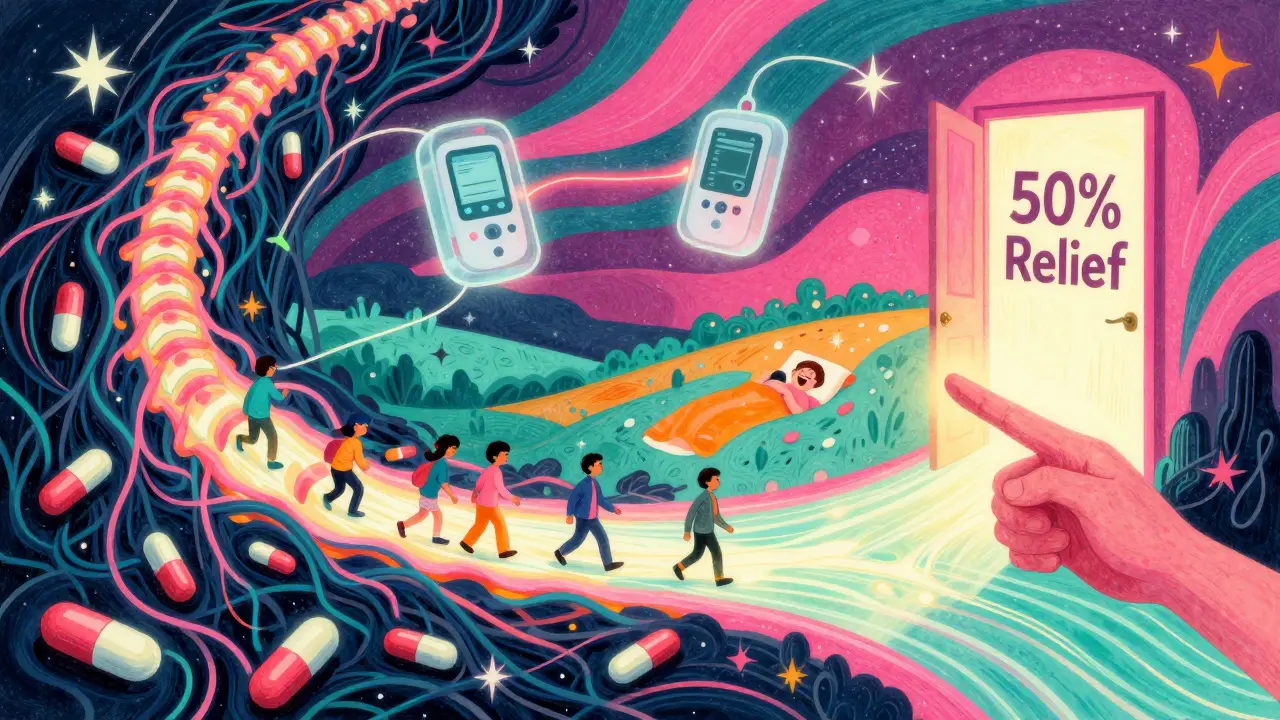
What’s the goal? Not to eliminate pain completely, but to cut it by at least 50%. Studies show that 56% to 85% of well-selected patients hit that mark. And for many, that’s enough to stop relying on opioids, get back to work, or play with their grandchildren again.
How It Compares to Other Pain Treatments
Let’s be clear: SCS isn’t the first thing you try. It’s not a replacement for physical therapy, nerve blocks, or even TENS units. Those are less invasive and cheaper. A TENS unit costs under $200. SCS? The full implant-including surgery-runs $25,000 to $45,000 in the U.S.
So why choose it? Because for some, nothing else works.
Compare it to opioids. A 2021 JAMA study of over 2,000 chronic pain patients found that after one year, those with SCS used 57% fewer opioids. After two years? That number jumped to 63%. And 72% of SCS patients had at least half their pain reduced-compared to just 41% with pills alone.
But it’s not perfect. Unlike TENS, SCS requires surgery. And surgery carries risks: infection, lead movement, or device failure. About 18.7% of patients need a second surgery within two years to fix a broken lead or misplaced device. That’s why patient selection matters more than the technology itself.
Compared to peripheral nerve stimulation (which targets specific nerves in arms or legs), SCS works better for back and leg pain-78% success rate versus 62%. But if your pain is only in your foot or hand, peripheral stimulation might be a better fit.
Who Is a Good Candidate for SCS?
Not everyone with chronic pain is a candidate. In fact, if you skip the screening, failure rates can hit 40%. Here’s what experts say makes someone a good fit:
- You’ve tried conservative treatments for 12 to 24 months-physical therapy, injections, medications-and they didn’t help.
- Your pain has a clear source: failed back surgery syndrome, complex regional pain syndrome (CRPS), or persistent leg pain after spinal surgery.
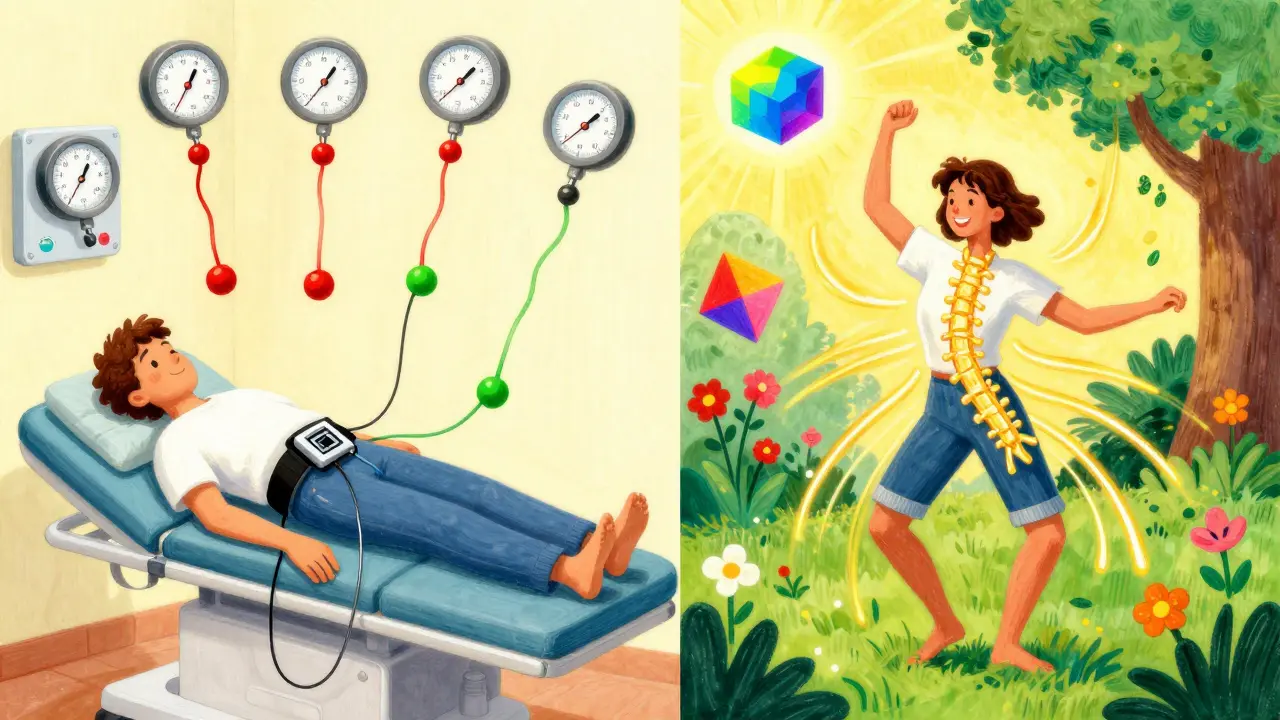
- You’ve had a successful trial stimulation. That means temporary leads are placed for 5-7 days, and you get at least 50% pain relief.
- You’re mentally and emotionally ready. Untreated depression cuts success rates by 35%. Anxiety and unrealistic expectations? Also red flags.
- You can operate the device. That means learning to adjust settings, recognize when leads move, and follow MRI safety rules.
Age isn’t a barrier. Most patients are between 50 and 75. But younger people with CRPS or traumatic nerve injuries are also strong candidates. What matters is function: Can you walk? Sleep? Work? If pain has stolen that, SCS might help get it back.
Who Should Avoid SCS?
Some people simply shouldn’t get SCS. These are hard limits:
- You’re pregnant. The effects on fetal development aren’t fully known.
- You can’t operate the device. If you have dementia, severe arthritis in your hands, or no support system, you won’t manage the programming.
- You failed the trial. If you didn’t get at least 50% pain relief during testing, the permanent implant won’t help.
- You have an active infection. Any infection-skin, urinary, dental-must be cleared before surgery.
- You’re unable to commit to follow-ups. Programming adjustments happen over weeks and months. Skipping them leads to poor results.
Also, if you’re hoping for 100% pain relief, you’re setting yourself up for disappointment. SCS doesn’t erase pain. It softens it. Think of it like turning down a loud alarm-not turning it off.
The Two-Step Process: Trial and Implant
Getting SCS isn’t a one-time decision. It’s a two-phase process.
Phase 1: The Trial
First, temporary leads are inserted through your back using X-ray guidance. You’re sedated, but awake. The leads connect to an external battery you carry on a belt. You go home for 5-7 days and use it normally. Keep a pain diary. Did you sleep better? Walk farther? Need fewer pills? That data decides if you move forward.
Phase 2: Permanent Implant
If the trial works, you come back for surgery. This takes about 60-90 minutes. The leads are placed permanently in the epidural space. The pulse generator is tucked under your skin-usually in the lower abdomen or upper buttock. You’ll be back home the same day or the next.
It takes 2-4 weeks to adjust. You’ll need at least one programming session. Some need three or four. The device isn’t “set and forget.” It’s more like tuning a radio. Too little signal? Pain returns. Too much? Tingling becomes uncomfortable. Your doctor helps you find the sweet spot.
Real-World Outcomes and Risks
People share their stories online. On Healthgrades, 82% of 4+ star reviews say they regained the ability to walk without opioids. 65% say they cut monthly medication costs by $800. That’s life-changing.
But there’s another side. On Reddit’s r/ChronicPain, 41% of negative posts mention lead migration-where the wires shift and stimulation stops working. 67% talk about battery replacement every 5-9 years. That’s another surgery.
Complications aren’t rare. Infection happens in 3.8% to 7.2% of cases. Lead movement occurs in 15% of patients within six months. And 22% of failures come from patients not using the device correctly-forgetting to charge it, turning it off, or not reporting changes.
Long-term data is mixed. At six months, 76% still have good pain relief. At three years? That drops to 58%. At five years? Only 52%, according to a 2022 meta-analysis. Some experts think part of the early success is a placebo effect that fades.
Cost and Insurance Coverage
Medicare covers SCS for three specific conditions: failed back surgery syndrome, CRPS, and chronic low back and leg pain. Private insurers often follow suit. But coverage isn’t automatic. You’ll need detailed records: pain logs, imaging, trial results, and proof you tried everything else.
Even with coverage, out-of-pocket costs can hit $5,000-$10,000. That’s for surgery, device, hospital fees, and follow-ups. Some patients pay more if their device isn’t MRI-safe and they need an upgrade later.
Device prices vary. Boston Scientific’s WaveWriter Alpha™ Prime has a 24-month battery life. Medtronic’s Intellis™ 2 adjusts automatically when you move. Abbott’s Proclaim™ offers burst mode without tingling. The tech matters-but so does your body’s response.
What’s Next for Spinal Cord Stimulation?
The future is getting smarter. Boston Scientific’s Evoke® system-still in trials-uses real-time neural feedback to adjust stimulation on its own. No need to press buttons. Just walk, sit, or lie down, and the device adapts. Early results show 83% of patients had meaningful pain relief at one year.
Also, newer systems are MRI-compatible. Older devices could be damaged by MRI machines. Now, models like Boston Scientific’s Precision Montage™ MRI let you get full-body scans at 1.5T or 3.0T without removing the device. That’s huge for long-term care.
And the market is growing. With aging populations and the opioid crisis, SCS procedures are rising 12.3% each year. The global market is expected to hit $4 billion by 2029.
Final Thoughts
Spinal cord stimulation isn’t magic. It’s a tool. And like any tool, it works best in the right hands-with the right person.
If you’ve been living with pain for years, and nothing else has helped, SCS might be worth exploring. But don’t rush it. Get the trial. Talk to your pain specialist. Ask about your mental health. Understand the risks. Know that you’ll need to learn how to use it-and keep using it.
For those who fit the profile, it’s not just about less pain. It’s about getting back to life.
Is spinal cord stimulation the same as a pacemaker?
In form, yes-it’s a small device implanted under the skin. But function? No. A pacemaker regulates heart rhythm. SCS interrupts pain signals in the spinal cord. The technology is similar, but the purpose is completely different.
Can I still get an MRI with a spinal cord stimulator?
It depends on the model. Older systems are not MRI-safe. Newer ones like Boston Scientific’s Precision Montage™ MRI and Medtronic’s Intellis™ are designed to be used with full-body 1.5T and 3.0T MRI scans. Always check with your doctor before scheduling an MRI. Never assume your device is safe without confirmation.
Does SCS eliminate the need for pain medication?
Not always-but often. Studies show SCS patients reduce opioid use by 57-63% after one to two years. Many stop taking them entirely. But some still need occasional pain relievers, especially for flare-ups. SCS reduces dependence, not always eliminates it.
How long does the battery last in a spinal cord stimulator?
Traditional devices last 3-5 years. Newer ones like Boston Scientific’s WaveWriter Alpha™ Prime last up to 24 months-but that’s because they use more power for advanced waveforms. Rechargeable models can last 7-9 years. Battery replacement requires minor surgery, but it’s less invasive than the original implant.
What if the stimulation stops working after implantation?
It’s common. Lead migration (movement of the wires) happens in about 15% of cases within six months. Infection or device failure can also cause loss of function. Most cases are fixed with a minor adjustment or revision surgery. If pain returns, contact your pain specialist right away. Don’t wait.
Are there non-surgical alternatives to SCS?
Yes. Transcutaneous electrical nerve stimulation (TENS) units, nerve blocks, radiofrequency ablation, and spinal cord stimulation trials (without implant) are less invasive. But none offer the same level of long-term relief for severe, persistent pain. SCS is typically considered only after these options have failed.
Can SCS help with nerve pain in the arms or hands?
It can-but it’s not the best choice. SCS works best for back and leg pain. For pain in the arms, hands, or shoulders, peripheral nerve stimulation (targeting specific nerves) is often more effective. Your doctor will evaluate your pain pattern to determine the best approach.
Suzette Smith
February 10, 2026 AT 10:31I get that SCS works for some folks, but let’s be real-how many people are just being upsold because the device companies have the best marketing teams? I know a guy who got one, spent $30k, and now his device glitches when he sneezes. He’s back on opioids and hates his life. Maybe we’re treating symptoms instead of root causes. Why not fix the system instead of implanting gadgets?
Autumn Frankart
February 11, 2026 AT 01:29SCS? More like SCAM. Big Pharma and the implant industry are in bed together. Did you know the FDA approved the first SCS device after a 3-day review? And the trials? They were funded by Boston Scientific. Meanwhile, real holistic treatments-like infrared saunas, magnesium infusions, and ancestral diet protocols-are ignored because they can’t be patented. They don’t want you cured. They want you dependent. And the military? They’ve been using this tech on veterans since the 90s… but they’ll never tell you why.
Pat Mun
February 12, 2026 AT 14:39Look, I’ve been living with CRPS for 11 years. I tried everything-acupuncture, ketamine infusions, even a nerve block that left me numb for six months. Nothing worked. Then I did the trial. And holy hell, it changed everything. I slept through the night for the first time in a decade. I started walking to the mailbox again. It’s not magic. It’s not perfect. But it gave me back the small things-the quiet mornings, the ability to hug my kid without wincing. I know the risks. I know about battery replacements and lead shifts. But I’d do it again. If you’ve tried everything else and you’re still standing? Give it a real shot. Don’t let fear rob you of hope.
Sophia Nelson
February 12, 2026 AT 22:24Why is everyone acting like this is some miracle cure? I had a cousin get one. Two months later, the leads migrated. She had to get another surgery. Then the battery died. Then the damn thing started shocking her when she sat down. Now she’s got scar tissue the size of a grapefruit and still in pain. And they charge you $150 per programming session. This isn’t medicine-it’s a money pit with wires.
Skilken Awe
February 14, 2026 AT 05:34Let’s not romanticize this. SCS is a Class III medical device with a 15% migration rate and a 7% infection rate. You’re talking about implanting a foreign object into the epidural space, a zone with zero immune surveillance. And you think the ‘burst mode’ or ‘high-frequency’ specs matter? Please. It’s all just waveform theater. The real variable is the surgeon’s skill-and 40% of them are barely trained. The industry’s growth? That’s not demand. That’s profit-driven overutilization. Wake up.
andres az
February 14, 2026 AT 23:08They say SCS reduces opioid use by 60%. But what about the people who get it and still need opioids? What about the ones who get addicted to the device itself? I mean, think about it-you’re now dependent on a machine that needs charging, software updates, and $800 replacement batteries. It’s not healing. It’s commodifying pain. And the fact that they’re pushing this on veterans and low-income patients? That’s exploitation dressed as innovation.
Steve DESTIVELLE
February 16, 2026 AT 00:47When pain becomes a permanent companion, we forget that it is not merely a signal but a conversation between body and mind. The spinal cord stimulator does not silence the voice of suffering-it merely changes its tone. Is this progress? Or is it the modern equivalent of plugging your ears while the house burns down? We treat symptoms because we fear the silence of inquiry. Who are we to say the body cannot heal if we do not first listen? The wires may carry current-but they cannot carry truth.
Stephon Devereux
February 16, 2026 AT 20:03For those asking if SCS is worth it-yes, if you’ve exhausted every other option and you’re medically screened. But here’s the thing most don’t say: the biggest predictor of success isn’t the device. It’s your mental health. Depression, anxiety, trauma-they don’t just coexist with chronic pain. They amplify it. If you’re doing SCS because you’re desperate, not because you’re prepared, you’re setting yourself up to fail. Talk to a therapist. Get your sleep hygiene in order. Learn to breathe through flare-ups. The device helps, but it doesn’t replace the work. And if your doctor skips the psychological eval? Walk out. This isn’t just hardware. It’s a partnership with your nervous system. Treat it like one.