Methotrexate and NSAIDs: How Their Interaction Increases Kidney Risk and Drug Levels
Methotrexate-NSAID Risk Assessment Tool
Drug Interaction Risk Assessment
This tool helps evaluate the risk of kidney injury and elevated methotrexate levels when taking NSAIDs. Based on your specific situation, it provides a risk assessment and safety recommendations.
Risk Assessment Result
When you take methotrexate for rheumatoid arthritis or another autoimmune condition, you’re already managing a delicate balance. Your body depends on clean kidney function to clear the drug safely. Now add a common painkiller like ibuprofen or naproxen - and suddenly, that balance can tip into danger. The interaction between methotrexate and NSAIDs isn’t just a footnote in a drug manual. It’s a real, measurable risk that can lead to kidney injury, dangerously high drug levels, and even life-threatening complications - especially if no one’s checking your blood work.
Why Methotrexate and NSAIDs Don’t Mix Well
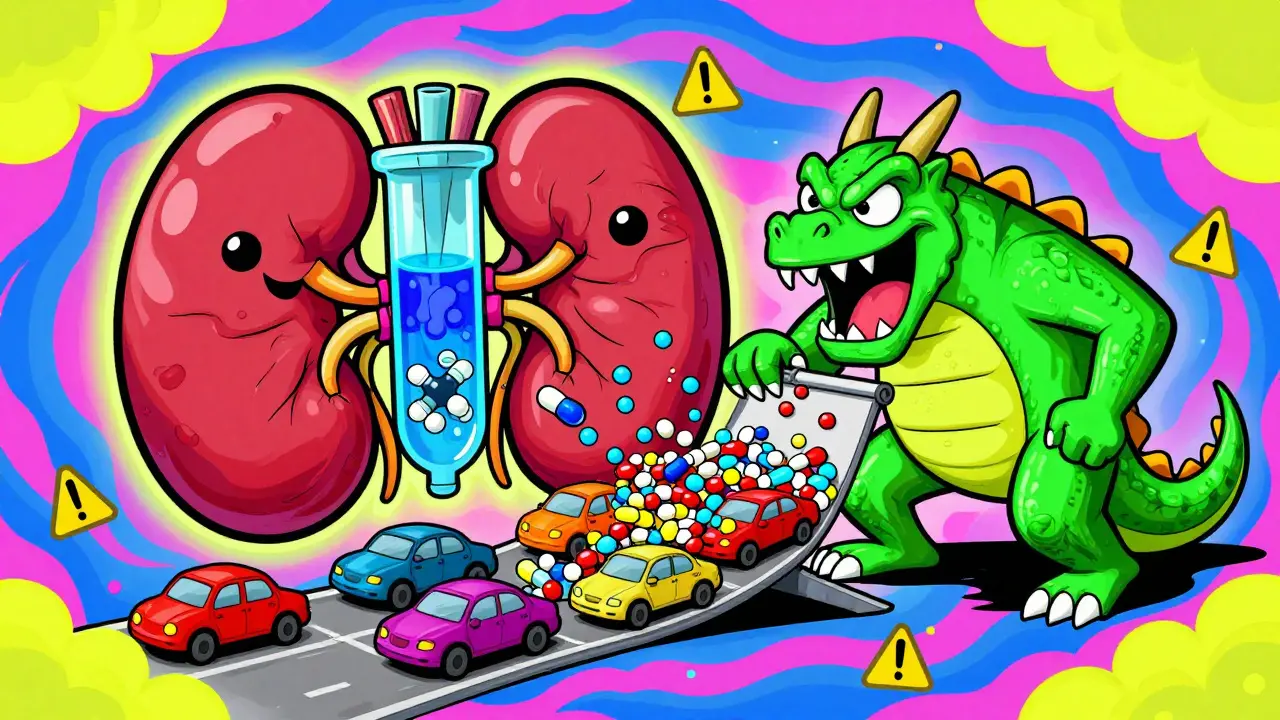
Methotrexate leaves your body through your kidneys. It’s filtered out by tiny tubes in the nephrons, and that process depends on healthy blood flow and specific transporter proteins. NSAIDs - including popular ones like ibuprofen, naproxen, and diclofenac - block prostaglandins, which are natural chemicals that help keep blood flowing to your kidneys. When those prostaglandins drop, your kidneys get less blood. Less blood means less methotrexate gets cleared. Studies show this can reduce methotrexate clearance by 25% to 40%.It’s not just about blood flow. NSAIDs also compete with methotrexate for the same transporters in the kidney tubules. Think of it like two cars trying to use the same narrow exit ramp at the same time. One gets stuck. That’s methotrexate. And when it builds up, your body can’t handle it. Serum levels can rise by 25% to 50% in patients taking both drugs, according to a 2020 study of 127 rheumatoid arthritis patients.
There’s another layer: protein binding. Methotrexate normally sticks to proteins in your blood, keeping most of it inactive. NSAIDs can knock some of it loose, increasing the amount of free, active drug floating around. That’s like turning up the volume on a speaker that’s already too loud. In lab tests, this displacement can raise free methotrexate concentrations by up to 30%.
High-Dose vs. Low-Dose: Big Difference in Risk
Not all methotrexate use is the same. The risk changes dramatically depending on how much you’re taking.High-dose methotrexate - used in cancer treatment, often over 500 mg/m² - is extremely dangerous with NSAIDs. A 2022 meta-analysis found the risk of severe toxicity, including bone marrow failure and acute kidney injury, jumps 4.7 times when NSAIDs are added. The FDA and EMA both warn that NSAIDs should be avoided entirely in high-dose regimens unless absolutely necessary. Even then, methotrexate levels must be checked at 24, 48, and 72 hours after dosing.
For low-dose methotrexate - the kind most rheumatoid arthritis patients take, usually 5 to 25 mg once a week - the picture is more mixed. Some large studies, like one following over 4,000 patients for three years, found no major increase in serious side effects when NSAIDs were used in people with normal kidney function. But here’s the catch: those studies assumed patients were getting regular blood tests. When kidney function is already impaired - say, an eGFR below 60 - the risk triples. A 2021 study showed NSAID use in these patients increased hospitalizations for acute kidney injury by 3.5 times.
Not All NSAIDs Are Created Equal
If you need pain relief while on methotrexate, not every NSAID carries the same risk. Some are worse than others.Ketorolac is the biggest red flag. It’s a potent kidney blood flow reducer and has been linked to methotrexate level spikes of up to 50%. It’s rarely used long-term, but even a few doses can be risky. Diclofenac and naproxen follow close behind, typically increasing methotrexate levels by 30-35%.
Ibuprofen is a bit safer - around a 25-30% increase - and is often the preferred choice if an NSAID must be used. But it’s still not risk-free. Celecoxib, a COX-2 selective NSAID, shows the lowest interaction potential, with increases of only 10-15%. That’s because it doesn’t affect kidney prostaglandins as strongly. Still, it’s not a green light. Even celecoxib can cause problems if your kidneys are already struggling.
Who’s Most at Risk?
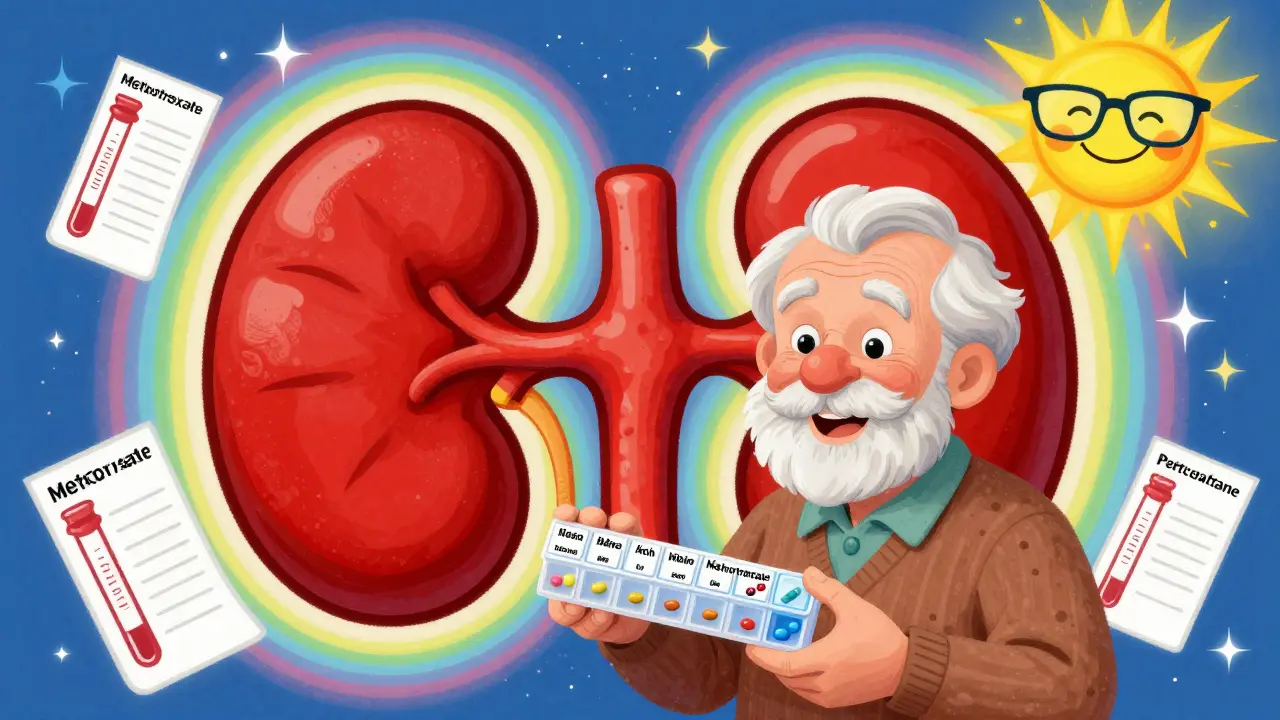
The danger isn’t equal for everyone. Certain people are far more vulnerable.Patients over 65 are at higher risk - their kidneys naturally filter slower, and they often take multiple medications. A 2021 European study found this group had a 2.8-fold higher risk of death when methotrexate and NSAIDs were combined.
Anyone with existing kidney trouble - eGFR under 90 mL/min/1.73m² - should avoid NSAIDs entirely. Even mild impairment (eGFR 60-89) increases risk. The same goes for people with dehydration, heart failure, or liver disease. These conditions stress the kidneys already, and adding an NSAID pushes them over the edge.
Genetics also play a role. About 15% of Caucasians carry a gene variant called SLC19A1 80G>A. People with this variant absorb methotrexate more efficiently and clear it more slowly. When they take NSAIDs, their methotrexate levels rise 40% more than those without the variant. This isn’t routine testing yet, but it’s an emerging area of research.
What Happens When Things Go Wrong?
Methotrexate toxicity doesn’t always come with screaming symptoms. That’s what makes it so dangerous.Early signs are subtle: fatigue, nausea, mouth sores, or a drop in white blood cell count. Many patients don’t realize anything’s wrong until their blood work comes back. One Reddit user shared that after taking naproxen for knee pain, his white blood cell count plunged to 1.8 × 10⁹/L - far below normal. He needed leucovorin rescue therapy for two weeks to recover.
According to FDA data, 78% of serious cases happened because the patient hadn’t had kidney function tested in the past 30 days. Routine blood tests - creatinine and complete blood count - are your best defense. A rise in creatinine of even 0.3 mg/dL within 48 to 72 hours of starting an NSAID is a warning sign. It doesn’t mean you have kidney failure. But it means you need to stop the NSAID and recheck your levels.
How to Stay Safe: Practical Rules
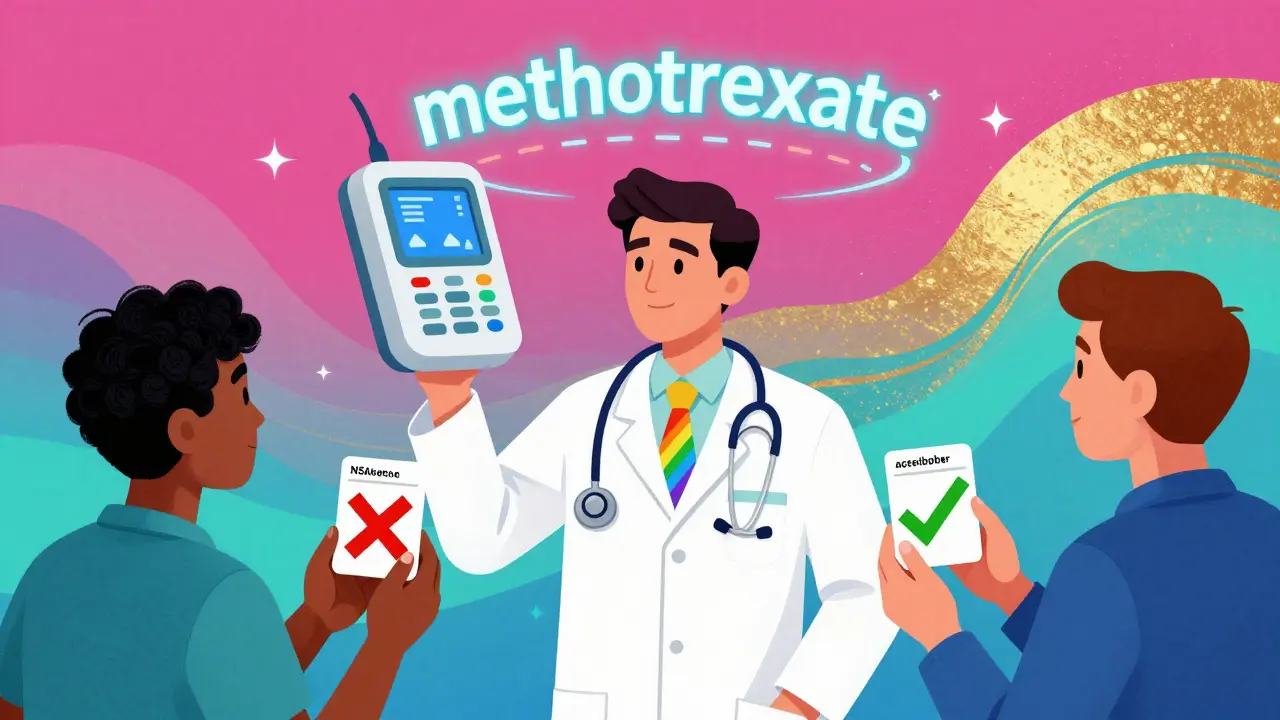
If you’re on methotrexate and need pain relief, here’s what works:- Avoid NSAIDs if your eGFR is below 60. Period. No exceptions.
- If you must use an NSAID, choose ibuprofen or celecoxib. Use the lowest dose for the shortest time possible.
- Space out your doses. Take methotrexate and the NSAID at least 12 hours apart. This reduces peak concentration overlap.
- Test your blood within 48-72 hours of starting an NSAID. Check creatinine and CBC. If creatinine rises, stop the NSAID.
- Never start an NSAID without telling your rheumatologist. Even if you think it’s "just occasional."
For many, acetaminophen (up to 3,000 mg/day) is the safest alternative. It doesn’t affect kidney blood flow or methotrexate clearance. For chronic pain, optimizing your disease-modifying drugs - like adding sulfasalazine or hydroxychloroquine - can reduce the need for painkillers altogether.
Pharmacists Are Your Secret Weapon
Most patients don’t realize pharmacists are trained to catch these dangerous interactions. A 2023 study found pharmacist-led interventions - like flagging prescriptions, educating patients, and reminding doctors to check labs - cut methotrexate-NSAID interaction rates by 63% in Medicare patients.Next time you pick up your methotrexate prescription, ask your pharmacist: "Is it safe to take this with my painkiller?" Don’t wait for them to ask you. They’re trained to spot this. Many don’t because they assume you already know.
What’s Next? Monitoring Tech on the Horizon
Right now, checking methotrexate levels means a blood draw and days of waiting. But that’s changing. Point-of-care devices that can measure methotrexate levels in minutes are in phase 3 clinical trials. Imagine walking into your rheumatologist’s office, getting your NSAID prescription, and having your methotrexate level checked before you leave. If it’s too high, you don’t take the NSAID that day.This technology isn’t available yet, but it’s coming. Until then, the old rules still hold: test early, test often, and never assume it’s "just a little pain."
The Institute for Safe Medication Practices still lists methotrexate-NSAID combinations among the top 10 high-alert drug pairs. That hasn’t changed in years - because the risk hasn’t gone away. It’s not about fear. It’s about awareness. You’re not being paranoid if you ask your doctor about your kidneys. You’re being smart.
Madhav Malhotra
January 11, 2026 AT 12:31Man, this is so important, especially in places like India where people just grab ibuprofen from the corner shop like candy. I’ve seen my uncle take methotrexate and naproxen together for months because his knee hurt - no blood tests, no doctor visits. He ended up in the hospital. Please, if you’re on this med, talk to your pharmacist. They’re the real MVPs.
And hey, acetaminophen is your friend. No drama. Just relief. 🙏
Matthew Miller
January 13, 2026 AT 09:11Ugh. Another ‘awareness’ post. Newsflash: if you’re dumb enough to mix NSAIDs with methotrexate without checking your creatinine, you deserve to be hospitalized. This isn’t rocket science. It’s basic pharmacology. The FDA has been screaming about this for 20 years. Why do we still have to write 10-page essays to get through to people who treat their meds like a buffet? Stop being lazy. Test your kidneys. Or don’t. But don’t act surprised when your WBC drops to 1.8.
Also, celecoxib isn’t safe. It’s just less dangerous. Still toxic. Still risky. Stop pretending there’s a ‘safe’ NSAID here. There isn’t.
Roshan Joy
January 13, 2026 AT 15:26Really appreciate this breakdown - especially the part about SLC19A1 variants. I didn’t know genetics played a role. My mom’s on low-dose MTX and has had two kidney scares in the last 3 years. She’s 71, takes ibuprofen for arthritis, and never got tested. Now I’m going to print this out and hand it to her with a cup of chai.
Also, love that you mentioned pharmacists. They’re so underused. I asked mine last week if my naproxen was okay with my MTX - she said no, and even called my rheum doc to suggest switching to celecoxib. She saved me a trip to the ER. 🙌
Michael Patterson
January 14, 2026 AT 06:46Ok so i was reading this and i think like maybe the real issue is that people just dont care about their health? like why would you take a painkiller without knowing what it does to your kidneys? its not like its a secret. also i think the FDA should just ban all NSAIDs for people on MTX full stop. no exceptions. period. end of story. why are we even having this conversation? also i saw someone say celecoxib is better but that’s just marketing bs. everything is bad. everything hurts your kidneys. just take tylenol and be done with it. also i think doctors are lazy and dont explain this enough. also i think people think they’re invincible until they’re not. like my cousin got dialysis at 52 because he took ibuprofen for 6 months straight. he was 32. he thought he was fine. he was wrong. very wrong. so yeah. just dont. stop. now.
Priya Patel
January 14, 2026 AT 21:37Okay but can we talk about how scary it is that this is still a thing? Like, I’m on MTX for psoriatic arthritis and I used to pop Advil like it was M&Ms. I had no idea. Then my rheumatologist looked at my bloodwork and went ‘…are you taking something?’ I was like ‘uhhh…maybe?’
Now I use acetaminophen, ice packs, and guilt-trip myself into stretching more. Also, I text my pharmacist every time I buy something new. They’re the only ones who actually care. 💕
Priscilla Kraft
January 15, 2026 AT 18:11Just wanted to add that even if you’re young and ‘healthy,’ kidney function can decline quietly. I’m 34, active, no diabetes, no hypertension - but my eGFR was 78 after a bad bout of dehydration and NSAID use. My doctor said, ‘This is why we test.’ I didn’t even know I was at risk.
Also, spacing doses 12 hours apart? Genius. I started doing that and my nausea went away. Small change, huge difference. And yes - pharmacists are angels in white coats. 🙏
Vincent Clarizio
January 16, 2026 AT 00:43Let’s be real - this whole thing is a symptom of a broken healthcare system. We’re told to self-manage chronic pain, but never taught how to safely do it. We’re handed prescriptions like they’re vending machine snacks. And then we’re shocked when we end up in the ER with a creatinine of 3.2? No. The problem isn’t the patient. The problem is that we’ve outsourced responsibility to a system that doesn’t prioritize prevention.
And don’t get me started on the fact that point-of-care methotrexate testing is in phase 3 trials - after 40 years of this being a known interaction. We’re not lagging behind. We’re deliberately ignoring the science until it’s too late.
Also, acetaminophen isn’t perfect. Liver toxicity. But at least it’s not killing your kidneys. So… choose your poison? That’s not a solution. That’s a tragedy dressed up as a recommendation.
Sam Davies
January 17, 2026 AT 13:11Oh look, another ‘educational’ post from someone who clearly didn’t get their MD but thinks they’ve read enough PubMed to save the world.
Let me guess - you also think ‘low-dose’ methotrexate is ‘safe’? Please. It’s still a cytotoxic agent. You’re just dosing it like it’s a vitamin. And celecoxib? That’s the ‘artisanal’ NSAID. The one that costs $200 a month and still doesn’t spare your kidneys. You think you’re being clever by recommending it? You’re just funding Big Pharma’s profit margins.
And yes, pharmacists are ‘secret weapons.’ Because the doctors are too busy checking their emails to care. How touching. The system is so broken, we now rely on retail clerks to prevent death.
Also, ‘just use Tylenol’? Sure. If you want to quietly turn your liver into a brick. What a brilliant trade-off.
Christian Basel
January 19, 2026 AT 10:46MTX-NSAID interaction = Class I drug-drug interaction. Pharmacokinetic competition at OAT3 and BCRP transporters, coupled with renal vasoconstriction via COX-1 inhibition. Elevated unbound fraction due to albumin displacement. Toxicity threshold crossed when AUC exceeds 100 μM·h. eGFR <60 = absolute contraindication per KDIGO guidelines. CBC and CrCl monitoring q48h mandatory. Acetaminophen preferred - non-COX-mediated analgesia. COX-2 selectivity reduces renal impact but does not eliminate risk. Point-of-care LC-MS/MS assays in development - expected commercialization Q3 2026. Until then, vigilance is non-negotiable.
TL;DR: Don’t be an idiot. Test. Don’t guess.
Alex Smith
January 19, 2026 AT 18:35Okay, so I’m a nurse, and I’ve seen this exact scenario play out 17 times. A patient comes in with fatigue, mouth ulcers, and a WBC of 1.2. They say, ‘I just took ibuprofen for my back.’
Here’s the thing - most of them didn’t know they were even at risk. Not because they’re dumb. Because no one told them. Not their doctor. Not their pharmacist. Not the damn pamphlet.
So yeah, this post? It’s not ‘alarmist.’ It’s overdue. And to the people who say ‘just use Tylenol’ - yes. But also, why aren’t we pushing for better DMARDs so people don’t need NSAIDs at all? That’s the real win.
Also, I’ve started handing out printed cards with the ‘5 Rules’ to every MTX patient. It’s dumb. It’s simple. And it works. 🙌
Adewumi Gbotemi
January 21, 2026 AT 18:14Back home in Nigeria, people use painkillers like water. No tests. No doctors. Just pain and prayer. I showed this to my cousin who takes MTX for lupus - he cried. Said he’s been taking diclofenac for 4 years. Now he’s going to the clinic tomorrow. Thank you for writing this. Simple. Clear. Real.
God bless you.
Jennifer Littler
January 21, 2026 AT 18:17Just wanted to say - I’m 28, on MTX, and I used to take naproxen for cramps. Then my creatinine jumped 0.4 in 72 hours. I stopped. No drama. No panic. Just stopped. And now I use heat packs and CBD oil. It’s not perfect. But it’s safer.
Also, I asked my pharmacist about this last month. She didn’t say anything. So I asked again. She looked it up. Then she apologized. That’s the problem. They’re not ignoring you. They’re just overwhelmed.
So ask. Twice. If you have to. You’re worth it.