Medication-Induced Acute Angle-Closure Glaucoma: What You Need to Know Before Taking Common Drugs
Glaucoma Risk Assessment Tool
Assess Your Risk
This tool helps you determine your risk of medication-induced acute angle-closure glaucoma based on your medical profile and medications you're taking.
Risk Assessment Results
Next Steps
Imagine waking up with a pounding headache, blurred vision, and halos around lights. Your eye feels like it’s swollen shut. You go to the ER, and they give you a migraine pill. But it’s not a migraine. It’s acute angle-closure glaucoma-and your vision could be gone in hours. This isn’t rare. It’s a silent emergency triggered by everyday medications many people take without a second thought.
What Exactly Is Medication-Induced Acute Angle-Closure Glaucoma?
Acute angle-closure glaucoma (AACG) happens when the drainage system in your eye suddenly gets blocked. Normally, fluid called aqueous humor flows out through a mesh-like channel near the edge of your iris. When that channel closes-often because the iris bulges forward and sticks to the lens-the pressure inside your eye spikes. In AACG, pressure can jump from a normal 15 mm Hg to 60 mm Hg or higher in minutes. That’s like having a water balloon bursting inside your skull.
Medication-induced AACG is when a drug causes this blockage. It’s not the same as the slow, silent type of glaucoma that creeps up over years. This is sudden, painful, and dangerous. If untreated, permanent blindness can happen in under 24 hours. The American Academy of Ophthalmology says irreversible nerve damage starts as early as six hours after pressure spikes above 40 mm Hg.
Who’s at Risk? It’s Not Just Older People
You don’t need to be elderly to be at risk. The real danger lies in your eye anatomy. People with naturally narrow angles between the iris and cornea are sitting on a time bomb. These angles are too tight to begin with. A little push-from a drug-and the iris blocks the drain.
Studies show 8.5% of Asian populations have narrow angles, compared to 3.8% of White populations. Farsighted people (hypermetropia) are also at higher risk because their eyes are shorter. If your eye is less than 22 mm long, your drainage system is already cramped. Ultrasound biomicroscopy can measure this, but most people never get tested unless they’re having eye surgery.
Here’s the kicker: only about 25% of people who develop drug-induced AACG even knew they had narrow angles. Most are blindsided. They took a cold pill, got eye drops for a routine exam, or started an antidepressant-and suddenly their vision is failing.
Which Medications Are the Biggest Culprits?
Not all drugs are equal. Some are far more likely to trigger this crisis. Here are the top offenders, backed by clinical data:
- Adrenergic agents like phenylephrine (10% eye drops or nasal sprays) - responsible for 35% of cases. Found in many over-the-counter decongestants.
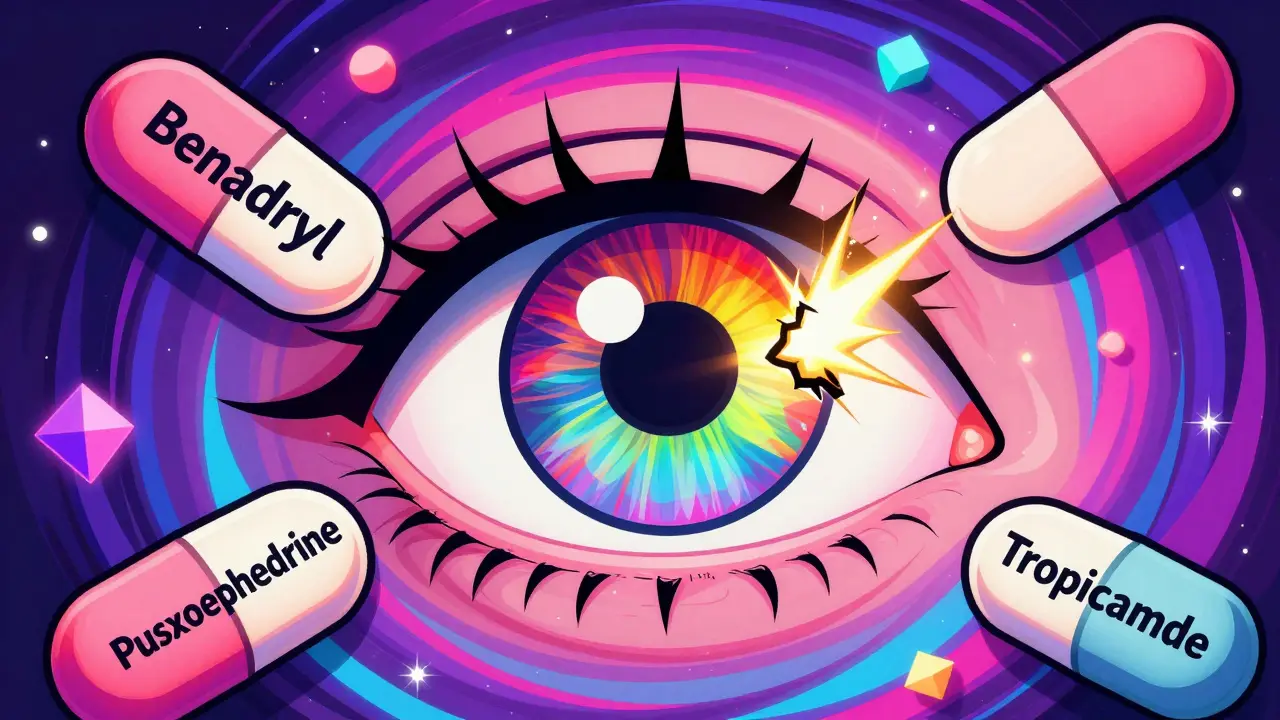
- Anticholinergics like tropicamide (used in eye exams) and diphenhydramine (Benadryl) - 28% of cases. These drugs cause the pupil to dilate and the iris to bunch up.
- Sulfonamide-based drugs like acetazolamide and topiramate - 15% of cases. These can cause the ciliary body to swell, pushing the iris forward.
- SSRIs and tricyclic antidepressants like paroxetine and amitriptyline - 12% of cases. They have anticholinergic side effects, even if that’s not their main purpose.
- Antihistamines and decongestants like pseudoephedrine - 10% of cases. Common in allergy and cold meds.
One patient on Reddit described how a routine eye exam with tropicamide drops left her with 60 mm Hg pressure and permanent vision loss. Another took pseudoephedrine for allergies, went to the ER thinking it was a migraine, and lost 20% of her peripheral vision before being correctly diagnosed 36 hours later.
Why Do Doctors Miss This?
It’s not that doctors are careless. It’s that the symptoms look like something else. Nausea, headache, blurred vision, halos around lights-these are textbook migraine signs. Even in the ER, only 38% of non-eye specialists correctly diagnose AACG on first contact, according to a 2021 JAMA Ophthalmology study of over 4,000 cases.
Patients are often sent home with painkillers or anti-nausea meds. By the time they’re referred to an ophthalmologist, the damage is done. A 2022 BrightFocus Foundation survey of 1,247 glaucoma patients found that 62% were misdiagnosed initially, with an average delay of 17 hours. Nearly half ended up with permanent vision changes.
And here’s the worst part: 78% of these patients say they were never warned about eye risks when prescribed these drugs. No conversation. No screening. Just a prescription.
How Is It Treated? Time Is Everything
If you’re in the middle of an attack, every minute counts. Treatment has to be fast and aggressive.
- Pilocarpine eye drops (2%) - given every 15 minutes for an hour. This shrinks the pupil and pulls the iris away from the drainage channel.
- Intravenous mannitol - a powerful osmotic agent that pulls fluid out of the eye, lowering pressure fast.
- Laser peripheral iridotomy - the definitive fix. A tiny hole is burned in the iris to let fluid flow freely again. This must be done within 24 hours.
Without this sequence, pressure stays high, the optic nerve dies, and vision is lost forever. Even with treatment, some patients still lose peripheral vision. That’s why prevention is the only real win.
How to Prevent It Before It Happens
The good news? This emergency is almost always preventable. You don’t need to avoid all medications. You just need to know your risk.
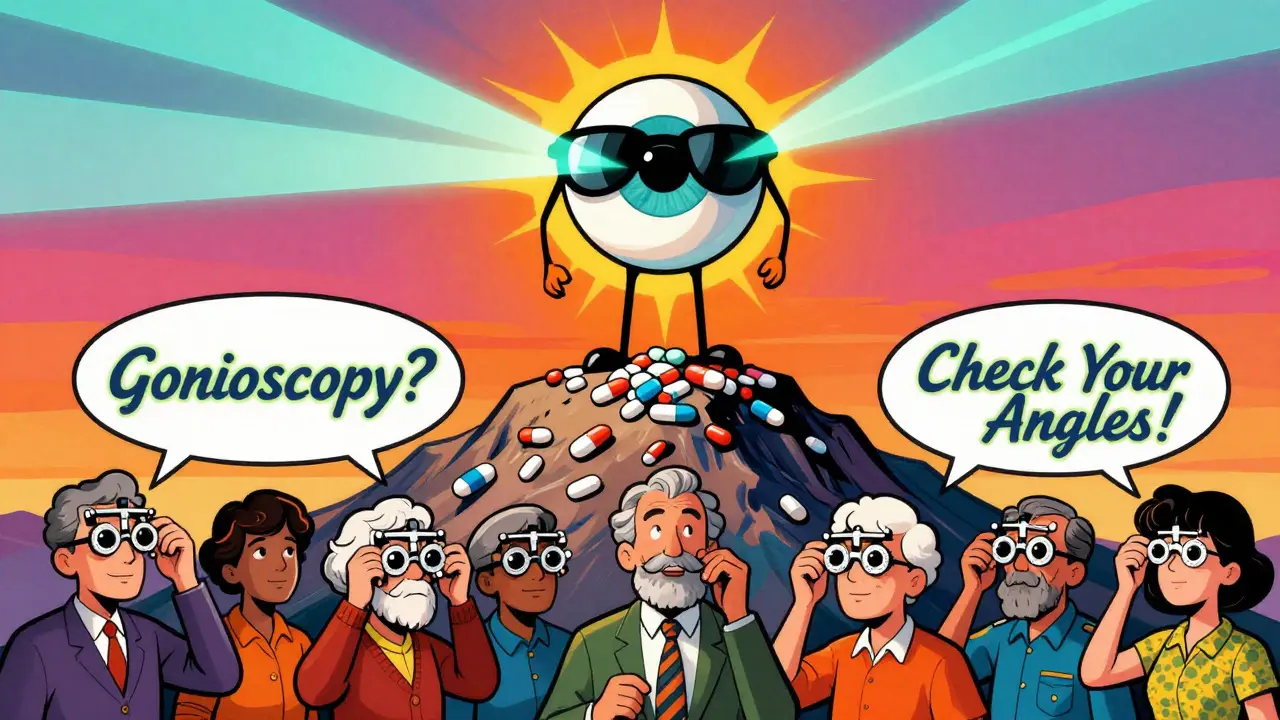
For anyone over 40-or anyone with a family history of glaucoma, farsightedness, or Asian ancestry-a simple 5-minute test called gonioscopy can check your drainage angle. It’s done by an eye doctor using a special lens. If your angle is narrow (Shaffer grade 2 or less), you should avoid high-risk drugs entirely.
Here are safer alternatives:
- Instead of diphenhydramine (Benadryl), use loratadine (Claritin) or cetirizine (Zyrtec) for allergies.
- Instead of pseudoephedrine, try a saline nasal spray or a non-decongestant cold remedy.
- For asthma, choose formoterol over epinephrine-based inhalers.
- If you need an eye exam, ask your doctor to check your angle first before using dilating drops.
Electronic health records now have alerts for this. Epic Systems updated their software in 2022 to flag high-risk prescriptions for patients with known narrow angles. But that only works if your doctor has that info.
What You Should Do Right Now
If you’re taking any of these medications regularly, ask yourself:
- Have I ever had an eye exam that checked my drainage angle?
- Do I know if I’m farsighted or have a family history of glaucoma?
- Have I ever had sudden eye pain, blurred vision, or halos after taking a new drug?
If you answered yes to any of these, talk to your eye doctor. Request a gonioscopy. It’s quick, painless, and could save your sight.
If you’re a parent, caregiver, or someone managing medications for an older relative, don’t assume they’re safe just because they’ve taken a drug before. Your body changes. Your eyes change. What was fine at 50 might be dangerous at 65.
This isn’t just about eye doctors. It’s about every doctor, pharmacist, and patient. We need to stop treating eye health as an afterthought. A simple question-“Have you ever had your eye angles checked?”-could prevent a lifetime of blindness.
What’s Changing in 2026?
Things are improving, but slowly. Optical coherence tomography (OCT) can now map the eye’s angle with 94% accuracy-no contact needed. Genetic screening is starting to identify people at risk before they ever have symptoms. The Glaucoma Research Foundation has rolled out 120 training modules for primary care doctors to recognize the warning signs.
But the biggest barrier isn’t technology. It’s awareness. Only 42% of primary care physicians routinely screen for glaucoma risk before prescribing high-risk drugs. Two out of three patients still get no warning at all.
That’s why your voice matters. Ask questions. Demand screenings. If your doctor dismisses your concerns, get a second opinion. Your eyes don’t get a second chance.
Kerry Howarth
January 3, 2026 AT 12:59This is terrifying. I took Benadryl last winter for a cold and had blurry vision for hours. Thought it was just dry eyes. Never connected the dots.
Everyone needs to know this.
Haley Parizo
January 4, 2026 AT 10:32Of course the medical system ignores eye health until it’s too late. You think they care about your vision when they’re billing for 12 different scans and a $400 migraine cocktail? This isn’t negligence-it’s profit-driven neglect. They’d rather blind you slowly than lose revenue on a 5-minute gonioscopy.
Wake up. Your eyes aren’t a bonus feature. They’re your lifeline-and they’re being sold out.
Brittany Wallace
January 5, 2026 AT 03:35I just got back from my eye doc and asked for a gonioscopy after reading this. 😅 She was like, 'Oh, we do that automatically now for anyone over 40 with hyperopia.'
Turns out I’ve had narrow angles since I was 22. I’ve been on Zyrtec for years and never knew I was lucky.
Thank you for this. I’m sharing it with my whole family. ❤️
Ian Ring
January 7, 2026 AT 00:17Interesting article-though I’d caution against overgeneralizing. Not all anticholinergics are equal, and the risk profile varies significantly by dosage, route, and individual pharmacokinetics.
Also, while gonioscopy is ideal, it’s not universally accessible-even in the U.S.-and many patients lack insurance coverage for such screening. A pragmatic approach would involve tiered risk stratification, not blanket avoidance.
Still, important points. Well-referenced. 👍
erica yabut
January 8, 2026 AT 20:02Oh, so now we’re blaming Big Pharma for people being too lazy to read the tiny print on the bottle? I mean, really? If you’re popping Benadryl like candy and then complaining about your eyes going sideways, maybe you’re the problem.
And don’t get me started on the ‘ask your doctor’ nonsense. Doctors don’t have time for your 17th-hand Reddit wisdom. If you’re too clueless to read the side effects, maybe don’t self-medicate.
Also, ‘narrow angles’? That’s not a diagnosis-it’s a geometry problem. You’re not special. You’re just poorly informed.
Vincent Sunio
January 9, 2026 AT 05:17The author commits a fundamental epistemological error: conflating correlation with causation. The cited statistics are observational, not controlled. No longitudinal cohort studies are referenced to isolate drug-induced AACG from preexisting anatomical predisposition.
Furthermore, the assertion that ‘78% of patients were never warned’ is statistically meaningless without a denominator-how many total prescriptions were dispensed? How many were actually contraindicated?
While the clinical presentation is valid, the narrative is alarmist and lacks methodological rigor. This is not medicine-it’s fearmongering dressed as public service.
Shanahan Crowell
January 10, 2026 AT 02:37Just got my gonioscopy done today-shallow angle, grade 1. I’ve been on topiramate for migraines for 3 years. 😳
My doctor didn’t even blink. I had to ask.
So I’m switching meds. I’m telling my mom. I’m telling my sister. I’m telling my coworkers.
This isn’t just info-it’s a lifesaver. Don’t wait until you’re in the ER crying because you thought it was a migraine. Ask. Now. Please.
You’ve got one pair of eyes. Treat ‘em like gold.
Palesa Makuru
January 11, 2026 AT 03:41As a South African with hyperopia and a family history of glaucoma, I’ve seen this play out twice. My aunt lost half her vision after a routine dental sedative. The dentist didn’t ask about eye history. Neither did the ER.
But here’s the thing-we don’t have access to gonioscopy in rural clinics. So what do we do? Tell people to stop taking cold meds? That’s not a solution. It’s privilege talking.
We need low-cost screening tools. We need community education. Not just ‘ask your doctor’-because your doctor might not even know.
Hank Pannell
January 12, 2026 AT 11:32Let’s unpack the pathophysiology here. Medication-induced AACG is essentially a pharmacologically induced pupillary block, mediated by anticholinergic or adrenergic stimulation of the iris sphincter or dilator muscles, respectively.
When combined with anatomical crowding-say, a shallow anterior chamber depth (<2.5 mm) or a thick lens-the iris becomes a piston, occluding the trabecular meshwork.
The key insight? It’s not the drug-it’s the intersection of drug + anatomy. That’s why population-level screening is inefficient. We need precision medicine: OCT-based angle mapping integrated into EHRs with automated alerts.
And yes, the 2022 Epic update is a step. But it’s still reactive. We need proactive genomic + phenotypic risk profiling. We’re not far from AI-driven pre-prescription risk scoring. It’s coming.
Lori Jackson
January 12, 2026 AT 16:54Of course you’re all just now realizing this. People take meds like they’re candy. And doctors? They’re just prescribing machines. No curiosity. No empathy. No follow-up.
My cousin went blind in one eye because she took Sudafed and her optometrist didn’t even *ask* if she’d ever had eye pressure issues. She was 42. Healthy. Thought she was fine.
Now she can’t drive. Can’t read. Can’t see her grandkids clearly.
And you know what? She didn’t even know she was farsighted. Because no one ever told her. Because no one cares until it’s too late.
Stop normalizing ignorance. This isn’t ‘bad luck.’ It’s systemic failure. And you’re all complicit if you don’t speak up.