Mandatory Substitution Worldwide: How Different Countries Handle Legal Requirements for Substitutes

When a government says you must replace one thing with another - not because it’s better, but because the law demands it - you’re dealing with mandatory substitution. It sounds simple. But across the world, this rule plays out in wildly different ways, affecting banks, mental health patients, chemical companies, and even how businesses operate across borders. This isn’t theory. It’s daily reality for millions.
How Banks Are Forced to Swap Risk
In Europe, financial institutions can’t just treat collateral the way they used to. Since June 2021, the Capital Requirements Regulation (CRR) forced banks to replace exposure to the original borrower in certain repurchase agreements with exposure to the tri-party agent - the middleman handling the deal. This is mandatory substitution in action. The idea? Reduce risk by shifting accountability to a single, regulated entity. But it didn’t come without cost. J.P. Morgan’s internal reports showed a 15-20% spike in operational expenses just to comply. Mid-sized banks spent an average of €1.2 million upgrading systems. The European Banking Authority (EBA) gave guidelines, but they were vague. What counts as “material concern”? Who decides? Institutions scrambled. Meanwhile, the U.S. took a different path. The Federal Reserve, FDIC, and OCC all rejected mandatory substitution in their 2018 rules. They kept internal models. Why? Because they believed standardized rules didn’t capture real risk. The result? A regulatory split between Europe and the U.S. that’s still growing. Firms like Goldman Sachs call substituted compliance a “regulatory unicorn” - something that looked promising in theory but vanished after the 2008 crisis.Mental Health: Who Decides for You?
Now imagine a law that lets someone else make your medical decisions - even if you disagree. That’s mandatory substitution in mental health law. In Ontario, Canada, the Substitute Decisions Act lets family members or guardians step in if a person is deemed incapable. In Victoria, Australia, the Guardianship and Administration Act does something similar. England and Wales use the Mental Capacity Act. Northern Ireland has its own version, passed in 2016. But here’s the twist. The United Nations Convention on the Rights of Persons with Disabilities (CRPD), ratified by 182 countries, says these laws violate human rights. Article 12 says everyone has the right to make their own choices, even if they’re not perfect. The CRPD Committee says substitute decision-making is discrimination. But Canada, Australia, and the UK all signed with reservations - meaning they didn’t fully agree. Ontario’s system is considered one of the most rights-focused, but even there, frontline workers say supported decision-making (where help is offered, not forced) is hard to apply to people with severe cognitive impairments. Since 2015, coercive interventions dropped 12% in Ontario as support models expanded. But it’s not enough. The UK’s 2023 Mental Health Act reform aims to cut compulsory treatment by 30%, but implementation is delayed until 2026. Meanwhile, in places like the U.S., substitute decision-making remains the norm.
Chemicals: The Hidden Rule That’s Changing Products
If you’ve bought shampoo, paint, or electronics in the last decade, you’ve felt the impact of mandatory substitution in environmental law. The EU’s REACH regulation requires companies to replace “substances of very high concern” - things like certain phthalates, flame retardants, or carcinogens - with safer alternatives. It’s not optional. If you want to sell in the EU, you must prove you’ve tried to substitute. BASF, a global chemical giant, says it cut substances of very high concern in its products by 23% since 2016. But small businesses? They’re drowning. One SME reported spending €47,000 per year just on compliance. The European Chemicals Agency (ECHA) rejects 62% of initial applications because companies don’t show enough proof of viable alternatives. The process takes 18 months on average. Sweden and NGOs like ChemSec created voluntary lists - the SIN List - to warn companies early. But the EU is moving to make substitution mandatory even for restricted chemicals by 2025. The global market for safer alternatives is now $14.3 billion. Companies are investing more in R&D, but the burden falls hardest on those with the least resources.Why the World Can’t Agree
Why does one region force substitution and another doesn’t? It’s not about safety. It’s about control. The EU uses mandatory substitution as a tool to enforce uniform standards. The U.S. prefers flexibility, trusting institutions to manage risk themselves. In mental health, countries like Canada and Australia are slowly shifting toward supported decision-making, but legal systems built on paternalism are hard to change. The CRPD’s ideal - full autonomy - clashes with decades of medical and legal practice. The result? Regulatory arbitrage. After Brexit, 22% of EU-based financial firms moved tri-party repo operations to London to avoid mandatory substitution. Multinational chemical companies now maintain separate product lines - one for the EU, one for everywhere else. This isn’t just legal complexity. It’s economic strategy.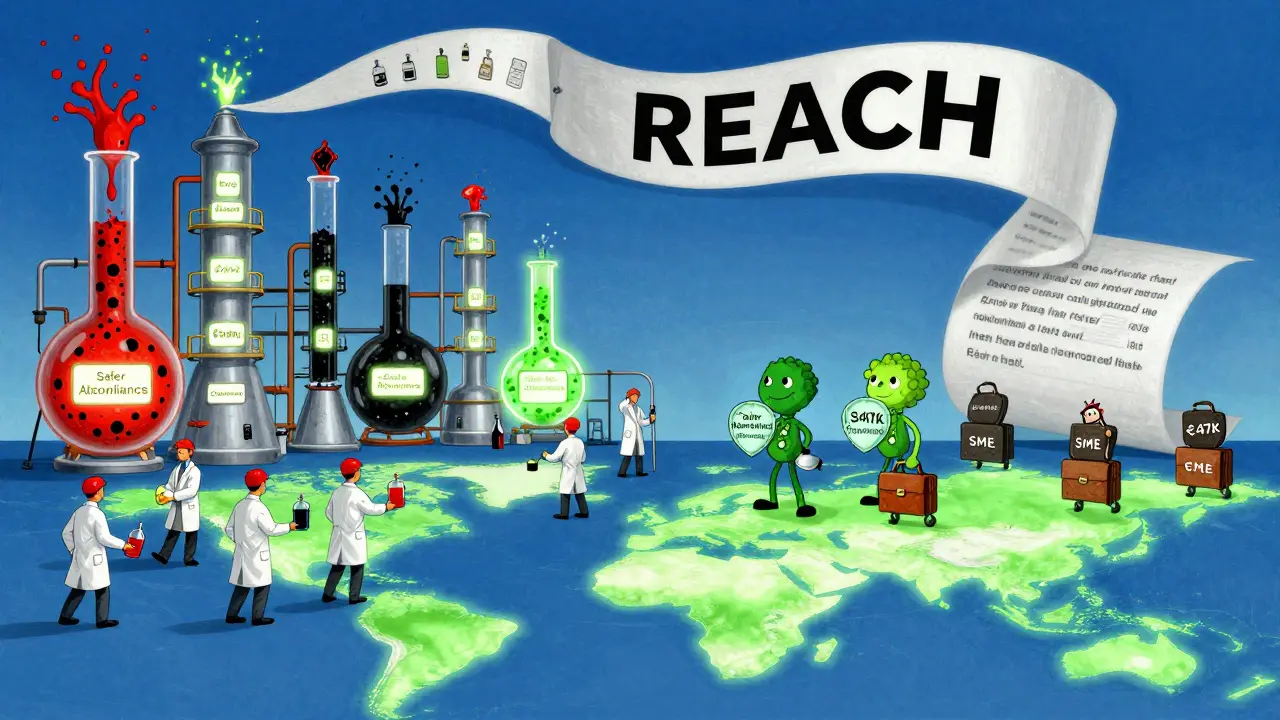
What’s Next?
Looking ahead, financial rules will keep diverging. The Basel Committee’s 2023 update kept substitution optional. Europe held firm. The gap is widening. In mental health, the pressure from the CRPD will grow. More countries will face lawsuits over forced guardianship. And in environmental law, the EU’s 2022 Chemicals Strategy means substitution will become even more embedded - not just for authorization, but for all restrictions. The global market for compliance tech is now $2.1 billion, and it’s growing fast. There’s no universal answer. What works in Frankfurt doesn’t work in Chicago. What protects a patient in Toronto might trap one in London. Mandatory substitution isn’t a single rule. It’s a mirror - showing how each society balances safety, freedom, and control.What You Need to Know
- If you’re in finance: Mandatory substitution in the EU means higher costs and stricter reporting. U.S. firms have more flexibility - but less alignment.
- If you’re in healthcare: Supported decision-making is the future, but it’s not yet the norm. Legal guardianship is still widespread.
- If you’re in manufacturing: REACH compliance isn’t optional. If you sell in Europe, you must prove you’ve tried to substitute hazardous chemicals - or lose access.
- If you’re a policymaker: The tension between global standards and local law is real. Harmonization is possible, but only if you accept that one size won’t fit all.
What does mandatory substitution mean in banking?
In banking, mandatory substitution means financial institutions must replace exposure to a borrower in certain repurchase agreements with exposure to the tri-party agent - the third party managing the transaction. This rule, part of the EU’s Capital Requirements Regulation (CRR), became mandatory in 2021 to reduce systemic risk. It’s not required in the U.S., where regulators prefer internal risk models.
Is mandatory substitution legal in mental health?
Yes, in many countries. Laws in Ontario, England, Wales, and Australia allow courts or guardians to make medical decisions for people deemed incapable. But the UN’s Convention on the Rights of Persons with Disabilities says this violates human rights. Countries like Canada and Australia signed the treaty but kept their substitute decision-making systems, creating legal tension.
How does REACH force companies to substitute chemicals?
Under the EU’s REACH regulation, companies must apply for authorization to use substances of very high concern (SVHCs). To get approval, they must prove they’ve tried to find safer alternatives and that no suitable substitute exists. If a substitute is available, they must switch. Failure means the substance can’t be sold in the EU. This has led to a 23% drop in SVHCs in products from major manufacturers like BASF since 2016.
Why did the U.S. reject mandatory substitution in finance?
U.S. regulators believed standardized substitution rules didn’t accurately reflect real risk. They trusted large banks to use internal models that account for complex portfolios. The Federal Reserve and OCC argued that forcing all firms to use the same method would create false security. This approach kept U.S. rules flexible but created a gap with Europe’s more rigid system.
Are there global trends moving toward more substitution?
Yes - but unevenly. In environmental law, over 40 countries now have substitution rules modeled after REACH. In finance, the EU is doubling down, while the U.S. holds firm. In mental health, the trend is slowly shifting toward supported decision-making, especially in countries under pressure from the UN. But full global alignment is unlikely. Each region prioritizes different values: control, flexibility, rights, or safety.
sue spark
December 15, 2025 AT 11:32It's wild how one region's safety net becomes another's cage
Europe forces change because they fear chaos
US lets banks breathe because they trust experience
Neither is right
Both are just reflections of what each society fears most
Billy Poling
December 17, 2025 AT 00:37It is imperative to recognize that the regulatory divergence between the European Union and the United States in the context of mandatory substitution is not merely a technical discrepancy but rather a profound philosophical chasm rooted in divergent epistemological frameworks regarding risk assessment and institutional trust; whereas the EU employs a precautionary principle predicated upon standardized, externally verifiable metrics to mitigate systemic vulnerability, the U.S. adheres to a principle of functional autonomy wherein institutions are entrusted with the discretion to calibrate risk models based on internal data, proprietary analytics, and historical performance - a model which, while potentially more adaptive, also introduces opacity and heterogeneity that may, paradoxically, amplify latent systemic fragility in the absence of uniform benchmarks.
James Rayner
December 17, 2025 AT 06:09There’s something deeply human about how we assign control…
When we make someone else decide for us - whether it’s a bank’s collateral or a patient’s treatment - we’re not just changing rules, we’re changing relationships.
Europe says: ‘Let’s put a wall between you and the risk.’
America says: ‘Let’s trust you to walk the edge.’
But who gets to decide who’s worthy of trust?
And who gets left behind when the system decides they’re too broken to choose?
It’s not about chemicals or compliance.
It’s about who we believe deserves autonomy.
And that… that’s the real regulation.
😭
Dave Alponvyr
December 17, 2025 AT 21:53So let me get this straight - you’re telling me a shampoo company has to spend $47k a year to prove they tried to make their product less toxic?
And we wonder why everything costs more now?
Also… why is the EU the world’s overlord of soap?
Cassandra Collins
December 19, 2025 AT 17:37REACH isn't about safety it's about the UN and the EU pushing a globalist agenda to control what we buy
They don't care if the alternatives are worse they just want you dependent on their rules
And the mental health laws? Same thing
They're not helping people they're taking away your rights under the guise of 'protection'
Watch them come for your meds next
They already know what's best for you
And you're not allowed to disagree
Joanna Ebizie
December 20, 2025 AT 00:04Ugh. Of course the EU is forcing everyone to switch stuff. They’re always trying to make the whole world look like Frankfurt.
Meanwhile in the US we just let people figure it out - like adults.
Why do we keep pretending their way is better? It’s just bureaucracy with a fancy name.
Elizabeth Bauman
December 21, 2025 AT 05:45Europe wants to control everything - your shampoo, your money, even your thoughts if you’re 'incapable'
That’s not regulation, that’s socialism with a lab coat
Meanwhile America stays free because we don’t let bureaucrats decide what’s best for us
And if you think the UN knows better than we do… you haven’t been paying attention
They’re not here to help - they’re here to take
Dylan Smith
December 22, 2025 AT 20:55Why do we keep pretending substitution is about safety when it's really about power
Who gets to say what's safe
Who gets to decide who's capable
Who gets to profit from the compliance industry
It's not a technical problem
It's a social hierarchy dressed up as law
And we're all just trying to survive it
Mike Smith
December 23, 2025 AT 09:10Let us not overlook the fact that mandatory substitution, while burdensome, reflects a societal commitment to collective welfare - whether in finance, healthcare, or environmental stewardship. The cost of compliance, while significant, must be weighed against the potential harm of inaction. Institutions that resist adaptation risk obsolescence; those that embrace it, leadership. The path forward is not uniformity, but thoughtful evolution - grounded in evidence, tempered by ethics, and guided by the enduring principle that progress demands sacrifice. Let us not mistake inconvenience for oppression.
Ron Williams
December 24, 2025 AT 00:00It’s funny how the same word - substitution - means totally different things depending on where you are
For some, it’s protection
For others, it’s control
For businesses, it’s cost
For patients, it’s dignity
For regulators, it’s power
And for the rest of us? Just another thing we’re expected to understand without being told why it matters
Maybe the real question isn’t how to fix the rules
But who gets to write them next