Language Access for Medication Counseling: What You Need to Know About Interpreter Rights
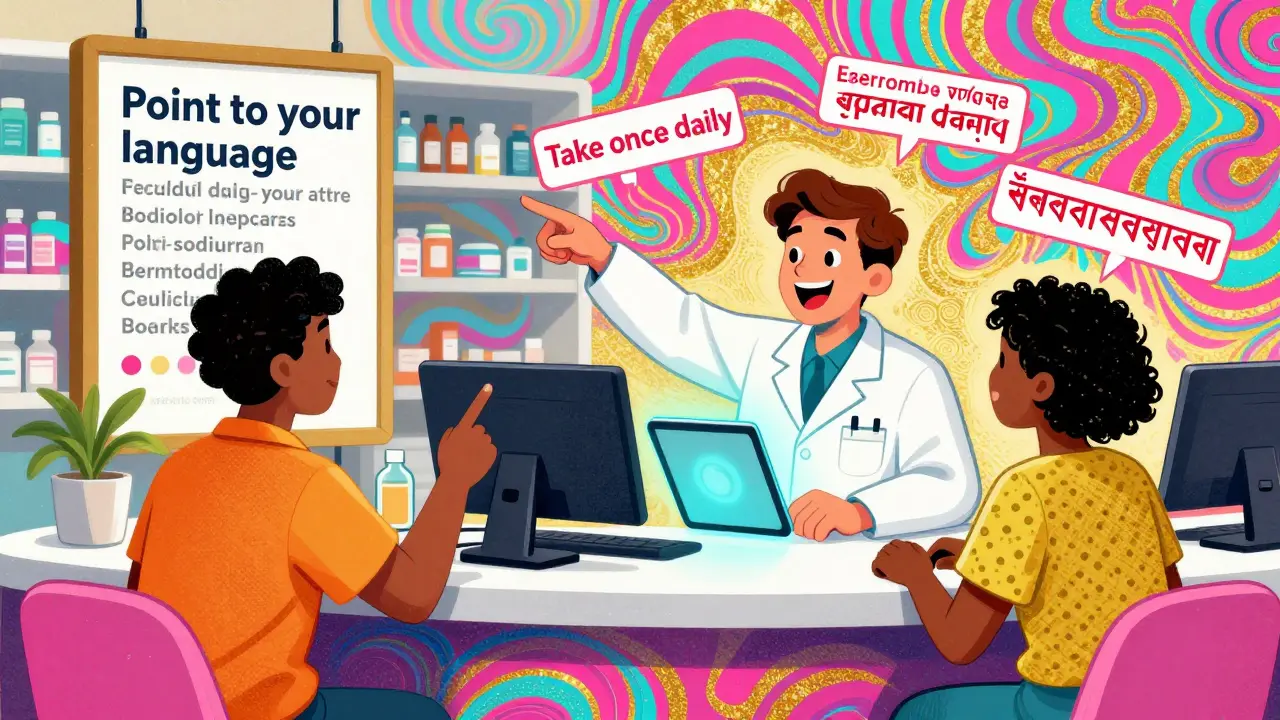
Every year, thousands of people in the U.S. end up in the emergency room because they didn’t understand their medication instructions. Not because they were careless. Not because they didn’t care. But because the pharmacist spoke English, and they spoke Spanish, Bengali, Mandarin, or another language - and no one offered help. This isn’t a rare mistake. It’s a systemic failure - one that federal and state laws now require pharmacies to fix.
Why Language Access Isn’t Optional
If you’ve ever picked up a prescription and read the tiny print on the label, you know how confusing it can be. Now imagine trying to read that same label in a language you barely understand. That’s the reality for more than 25 million Americans who are Limited English Proficient (LEP). The U.S. Census Bureau estimates that 8.5% of the population falls into this group. And without proper language support, they’re at higher risk for dangerous mistakes: taking too much, skipping doses, mixing drugs, or avoiding medication entirely out of fear. The law doesn’t let pharmacies ignore this. Since 2010, Section 1557 of the Affordable Care Act has required any healthcare provider receiving federal funding - including pharmacies - to provide meaningful access to LEP patients. But it wasn’t until July 5, 2024, that the rules got teeth. Now, providers can’t ask patients to use family members as interpreters unless the patient specifically asks for it. And interpretation services must be available 24/7 for emergencies.What Exactly Are Interpreter Rights?
Your right to an interpreter isn’t a favor. It’s a legal requirement. When you walk into a pharmacy and the staff sees you’re struggling with English, they must offer help - immediately. That help can come in three forms: in-person interpreters, phone interpreters, or video interpreters. All must be qualified, meaning they’re trained in medical terminology, not just bilingual. A qualified interpreter knows the difference between “take once daily” and “take every 12 hours.” They understand what “may cause drowsiness” means for someone driving to work. They don’t guess. They don’t paraphrase. They translate accurately. New York State’s SafeRx regulations, among the strictest in the country, go even further. They require pharmacies to:- Provide free oral interpretation for all medication counseling
- Translate prescription labels, warning labels, and instructions into the patient’s language
- Post clear signs near the counter that say “Point to your language” - in multiple languages
- Document your language preference in your medical profile
How Do Pharmacies Actually Provide These Services?
You might think every pharmacy has a Spanish-speaking pharmacist on staff. But that’s not realistic. There are over 60,000 pharmacies in the U.S., and no single pharmacy can hire interpreters for every language. So how do they do it? Most use contracted services like LanguageLine Solutions, TransPerfect, or American Language Services. These companies provide phone or video interpreters on demand - often within 30 seconds. A pharmacist taps a button, connects to a trained interpreter, and the conversation flows in real time. For written materials, pharmacies use translation software approved by regulatory bodies. But here’s the catch: machines can’t replace humans for medication instructions. A computer might translate “take with food” as “take together with meal.” But what if the patient only eats once a day? What if they’re diabetic? A human interpreter asks follow-up questions. A machine doesn’t. In New York, pharmacies must also translate auxiliary warnings - not just the main label. That means phrases like “May cause dizziness,” “Do not drink alcohol,” or “Store in refrigerator” must appear in the patient’s language. Many states don’t require this. New York does.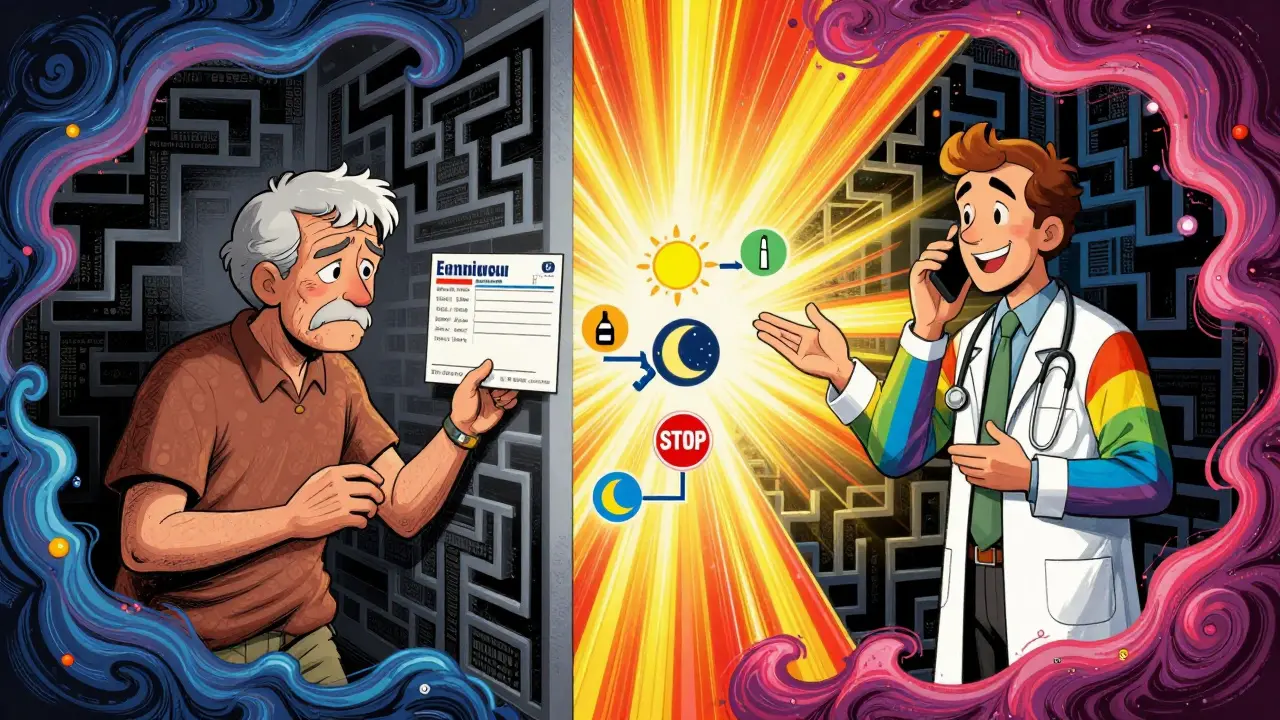
What’s the Real Impact?
Numbers don’t lie. Between 2010 and 2020, New York City saw a 28% drop in medication-related emergency visits among LEP patients. Why? Because they finally had someone who could explain it to them. A 2018 study in the Journal of the American Medical Informatics Association found that when professional interpreters were used, medication errors dropped by 67%. That’s not a small win. That’s life-saving. One pharmacist in the Bronx, u/NYCPharmTech, shared on Reddit in July 2024: “Since we started using the interpreter service properly, we’ve had zero medication errors tied to language. Not one.” Patients notice too. On Yelp, chain pharmacies in NYC average 4.2 out of 5 stars for language services. Comments like “The pharmacist spoke to me in Tagalog and made sure I understood” or “They printed my instructions in Arabic - I cried” are common. But it’s not perfect. A Chinese-speaking patient in Queens wrote on Google Reviews in June 2024: “They have the signs, but no one showed me how to use the phone interpreter. I left without help.” That’s the gap between policy and practice.Challenges and Gaps in Implementation
The biggest problem? Consistency. Chain pharmacies - CVS, Walgreens, Rite Aid - have the budget, training, and tech to comply. In New York, 92% of them have full systems in place. But independent pharmacies? Only 67%. Many can’t afford the monthly fees for interpretation services. Some don’t know the rules. Others assume a bilingual employee is enough. That’s dangerous. A pharmacy tech who speaks some Spanish isn’t a qualified interpreter. They might miss critical details. They might not know how to explain drug interactions. They might not know the law. And what about languages not on the list? New York State limits pharmacies to offering services in the top seven languages spoken by 1% or more of the population in their area. That’s based on U.S. Census data. But demographics shift fast. In a neighborhood where Somali or Haitian Creole speakers have grown rapidly since 2020, the law might not catch up for years. Dr. John Prince of the National Community Pharmacists Association called this a “one-size-fits-all” problem. “If your community has 500 Bengali speakers and 300 Nepali speakers, but the law only requires Bengali, what happens to the Nepali patient?”
What You Can Do as a Patient
You don’t have to wait for a pharmacy to help you. You have rights.- Point to the sign. If you see “Point to your language,” point to your language. That’s all it takes.
- Ask for an interpreter. Say: “I need a professional interpreter to explain my medicine.” You don’t need to ask nicely. You’re entitled to it.
- Don’t accept family members. Unless you specifically want your child or cousin to interpret, say no. They might miss important details.
- Check your label. If it’s only in English and you don’t understand it, ask for a translated copy.
- Report problems. If you’re ignored, call the New York State Office of Language Access Services (1-800-688-8814) or file a complaint with the U.S. Department of Health and Human Services.
The Future of Language Access
The rules are getting stronger. By June 2025, every federally funded healthcare provider - including pharmacies - must have a written language access plan. By 2026, Medicare and Medicaid providers must be fully compliant. The FDA is also testing standardized pictograms on medication labels - icons that show when to take a pill, what to avoid, and warning signs. These could help even if interpretation isn’t available. AI translation tools are being tested in pharmacies. But experts agree: machines can’t replace humans for medication counseling. Not yet. Not when lives are on the line. The bottom line? Language access isn’t about politics. It’s about safety. It’s about dignity. It’s about making sure that whether you speak English, Urdu, or Hmong, you get the same chance to understand your medicine - and stay healthy.Frequently Asked Questions
Do I have to pay for an interpreter at the pharmacy?
No. By law, interpretation services for medication counseling must be free. You cannot be charged for an interpreter, whether they’re in person, on the phone, or via video. This applies to all pharmacies that accept federal funding - which includes most pharmacies in the U.S.
Can I use my child or friend as an interpreter?
You can choose to, but the pharmacy cannot require it. Federal rules prohibit providers from asking LEP patients to bring family members as interpreters - unless you specifically request it. Using a child or untrained person increases the risk of miscommunication, especially with complex medication instructions. Professional interpreters are trained to handle medical terms accurately and confidentially.
What if my language isn’t listed on the pharmacy’s sign?
Even if your language isn’t shown on the “Point to your language” sign, you still have the right to an interpreter. Pharmacies are required to provide services for any language, even if it’s not among their top seven. Ask for the phone or video interpreter service - they’re legally obligated to connect you. If they refuse, report it to the Language Access Help Desk at 1-800-688-8814.
Are pharmacies required to translate all written materials?
Yes - but only the key documents. Under New York State law and federal ACA rules, pharmacies must translate prescription labels, warning labels (like “May cause drowsiness”), and medication counseling instructions. They don’t have to translate brochures, flyers, or general health information unless those materials are part of your medication care plan.
How do I know if the interpreter is qualified?
A qualified interpreter has passed a certification in medical terminology and ethics. They won’t just speak two languages - they’ll know terms like “anticoagulant,” “adverse reaction,” and “dosage interval.” If you’re unsure, you can ask the pharmacist: “Is this interpreter certified for medical use?” Most pharmacies will confirm this without hesitation. If they can’t answer, that’s a red flag.
What if I’m in a state that doesn’t have strict language laws?
Even in states without specific pharmacy rules, federal law still applies. If a pharmacy accepts Medicare, Medicaid, or any federal funding - which nearly all do - they must provide meaningful language access under Section 1557 of the Affordable Care Act. You still have the right to an interpreter. You just might need to ask more firmly.
Shane McGriff
January 20, 2026 AT 21:55I’ve seen this firsthand. My abuela got her blood pressure meds last week, and the pharmacist didn’t even look up. She was nodding like she understood, but I could tell she was lost. We had to call my cousin who speaks Spanish to translate the label. That’s not acceptable. Everyone deserves to know what they’re putting in their body. No excuses.
Pharmacies need to stop treating language access like a bonus feature. It’s a lifeline.
Jacob Cathro
January 20, 2026 AT 23:43lol so now we gotta pay for 300 different interpreters for every corner store pharmacy? Next they’ll mandate a translator for every emoji on the label. ‘Take 1 pill 🌞 = morning, 🌙 = night, 🚫🍷 = no wine, 🤕 = if dizzy, 🧠 = brain not included.’
This is what happens when bureaucrats think ‘equity’ means ‘every language ever spoken on Earth.’
Emily Leigh
January 21, 2026 AT 13:39Okay but… isn’t this just another way for the government to make people feel guilty for not being perfect? Like, sure, interpreters are great… but what if I just… don’t care? What if I’m tired of being told I’m a bad person for not speaking English? What if I just want to get my meds and go?
Also, why do we assume everyone wants an interpreter? Maybe some people just want to figure it out themselves. Isn’t that… autonomy?
Also, who’s paying for this? I’m pretty sure my taxes already bought me a lifetime supply of ‘mandatory kindness.’
Carolyn Rose Meszaros
January 21, 2026 AT 22:27OMG this is so important!! 😭 I work at a clinic and we had a woman from Nepal who cried because she finally got her diabetes instructions in Nepali. She said she’d been skipping doses for months because she was too scared to ask. This isn’t policy-it’s humanity.
Also, can we just agree that using kids as interpreters is a terrible idea? 😅 I’ve seen a 9-year-old try to explain ‘anticoagulant’ to their mom. No. Just no.
Greg Robertson
January 22, 2026 AT 22:38I think most pharmacists want to help. It’s just that the system doesn’t always make it easy. I’ve seen places with the signs up but no one trained to use the video system. It’s frustrating for everyone.
Maybe the real fix isn’t more rules, but more support for small pharmacies. They’re not trying to ignore people-they just don’t have the bandwidth.
Nadia Watson
January 23, 2026 AT 12:45Language access is not a privilege. It is a fundamental component of equitable healthcare delivery. The failure to provide qualified interpretation services constitutes a violation of civil rights under Title VI of the Civil Rights Act, as amended by Section 1557 of the Affordable Care Act.
Moreover, the use of untrained individuals as interpreters introduces significant risks of miscommunication, which may result in adverse drug events, non-adherence, and increased hospitalization rates. These are not hypotheticals. They are empirically documented phenomena.
It is incumbent upon regulatory bodies to enforce compliance uniformly across all jurisdictions, regardless of demographic shifts or fiscal constraints. The cost of inaction is measured in lives.
Additionally, the reliance on machine translation for pharmaceutical instructions remains scientifically indefensible. Human judgment, contextual awareness, and ethical responsibility cannot be algorithmically replicated.
Courtney Carra
January 25, 2026 AT 01:10So… we’re making pharmacies into UN interpreters now? 🤔
But like… if we’re gonna do this, why stop at pharmacies? Shouldn’t DMVs have interpreters for every dialect? Shouldn’t my dog walker be certified in 17 languages? What’s next? Mandatory sign language for all vending machines?
It’s not about access. It’s about performance. We’re turning healthcare into a Broadway show where everyone gets a standing ovation… even if they didn’t ask for it.
thomas wall
January 25, 2026 AT 20:07This is precisely the kind of overreach that erodes the integrity of professional standards. In the United Kingdom, we understand that language proficiency is a personal responsibility. If one chooses to reside in an English-speaking nation, one ought to acquire a functional command of the language. To mandate linguistic accommodation across every corner pharmacy is to infantilize the population and incentivize linguistic isolation.
Moreover, the notion that a pharmacy must be equipped to serve every conceivable language-many spoken by fewer than a dozen individuals in a given county-is not only impractical, it is absurd. The law should not be bent to accommodate the consequences of poor integration.
What is next? Mandatory translation of all public signage into every language spoken by tourists? The slippery slope is not hypothetical-it is already in motion.
Paul Barnes
January 25, 2026 AT 23:46Correction: The FDA isn't testing 'standardized pictograms'-they're piloting a new labeling standard called 'Medication Iconography v2.1,' which is currently in Phase 3 trials across 12 states. The study is double-blind, randomized, and controlled. The results are expected in Q3 2025. The article is misleading.
Manoj Kumar Billigunta
January 27, 2026 AT 16:41My cousin in Mumbai uses medicine without any label. He just remembers what the doctor said. People in India don’t need fancy interpreters. They just need good doctors.
Maybe instead of translating labels, we should fix the system so people don’t need so many pills in the first place.
Also, why is this only about pharmacies? What about doctors? Hospitals? Why pick on the pharmacy?
Andy Thompson
January 28, 2026 AT 06:54So now the government is forcing pharmacies to hire translators so people who won’t learn English can get their meds? 😂
Next they’ll mandate bilingual ATM machines and Uber drivers who speak Klingon. This is cultural surrender. We’re not a multilingual zoo. We’re America. Learn the language or stay home.
Also, who funded this? Soros? The UN? Why is no one asking where the money comes from?
sagar sanadi
January 30, 2026 AT 03:19Wait so if I speak Bengali and my pharmacy has a sign for Bengali but I don’t point to it… I’m the problem? What if I’m shy? What if I’m scared? What if I just want to be invisible?
Also, if they’re so serious about this, why aren’t they translating the instructions for the interpreter? Like… what if the interpreter messes up? Who’s interpreting the interpreter? 🤔
kumar kc
January 31, 2026 AT 09:53This is common sense. No one should die because they didn’t understand a pill bottle.