Kidney Disease and Medication Accumulation: How Toxic Buildup Can Harm You
Kidney Medication Safety Checker
Check Your Medication Safety
Enter your eGFR and medication name to see if it's safe for your kidney function.
When your kidneys aren’t working right, your body can’t flush out medicines like it should. That means drugs stick around longer-sometimes dangerously so. For someone with chronic kidney disease (CKD), even a normal dose of a common painkiller can become a silent threat. This isn’t theoretical. It’s happening right now to millions of people who don’t realize their meds are slowly poisoning them.
Why Kidneys Matter More Than You Think
Your kidneys don’t just make urine. They filter about 30% of all medications you take. They break down others, tweak their chemistry, and push the leftovers out through your pee. When kidney function drops-say, from an eGFR of 90 down to 40-your body loses its ability to clear those drugs. The result? Toxic buildup. And it doesn’t take long for this to turn serious.One in four American adults has some level of CKD. Many don’t even know it. By the time symptoms show up, the damage is often advanced. That’s why medication mistakes are so dangerous: people take the same pills they always did, never realizing their kidneys can’t keep up.
Medications That Can Turn Deadly in CKD
Not all drugs are equal when your kidneys are failing. Some are fine. Others? They’re landmines.NSAIDs like ibuprofen, naproxen, and diclofenac are the most common culprits. These over-the-counter pain relievers cut off blood flow to the kidneys by blocking protective chemicals called prostaglandins. In someone with an eGFR below 60, this triples the risk of sudden kidney injury. One Reddit user shared how their creatinine jumped from 1.8 to 3.2 after taking standard ibuprofen for back pain. They ended up hospitalized for five days. That’s not rare. Studies show 68% of CKD patients report dizziness or confusion from NSAIDs-and 22% needed emergency care.
Metformin, the go-to drug for type 2 diabetes, is another tricky one. It’s safe for most-but not when eGFR drops below 30. That’s when lactic acidosis risk spikes. But here’s the twist: a Cochrane review of 20,000 patients found zero cases of lactic acidosis when doctors followed the rules. The problem isn’t the drug. It’s the dosing.
Sulfonylureas like chlorpropamide and glyburide are even worse. In stage 5 CKD, chlorpropamide’s half-life balloons from 34 hours to over 200 hours. That means one pill can cause low blood sugar for days. Glyburide’s active metabolite sticks around even longer. Patients wake up confused, shaky, or unconscious-sometimes after taking what they thought was a normal dose.
Trimethoprim (found in Bactrim) is another silent killer. When paired with blood pressure meds like ACE inhibitors or ARBs, it can spike potassium levels by 1.2 to 1.8 mmol/L in just 48 hours. High potassium doesn’t just cause muscle cramps. It can stop your heart. And it happens fast.
Aciclovir, used for herpes and shingles, causes crystals to form in kidney tubules when eGFR drops below 50. That leads to crystal nephropathy. In 5-15% of cases, patients develop confusion, seizures, or even kidney failure. The fix? Lower the dose. Or better yet-avoid it entirely if your kidneys are weak.
What About Blood Thinners and Antibiotics?
Newer blood thinners like apixaban and rivaroxaban are often seen as safer than warfarin. But they’re cleared by the kidneys. When eGFR falls below 30, apixaban builds up so much that bleeding risk jumps by 40%. Warfarin, which the liver handles, doesn’t have that problem. So if you’re on a DOAC and your kidney function drops, you’re not just at higher risk-you’re in a danger zone.Vancomycin, a powerful antibiotic, needs careful monitoring. Standard dosing is 15 mg/kg every 12 hours. But when eGFR drops below 30, that same dose becomes toxic. Doctors must stretch the interval to every 48-72 hours and check blood levels closely. Too high? You risk hearing loss or kidney damage. Too low? The infection wins.
Why Doctors Miss This
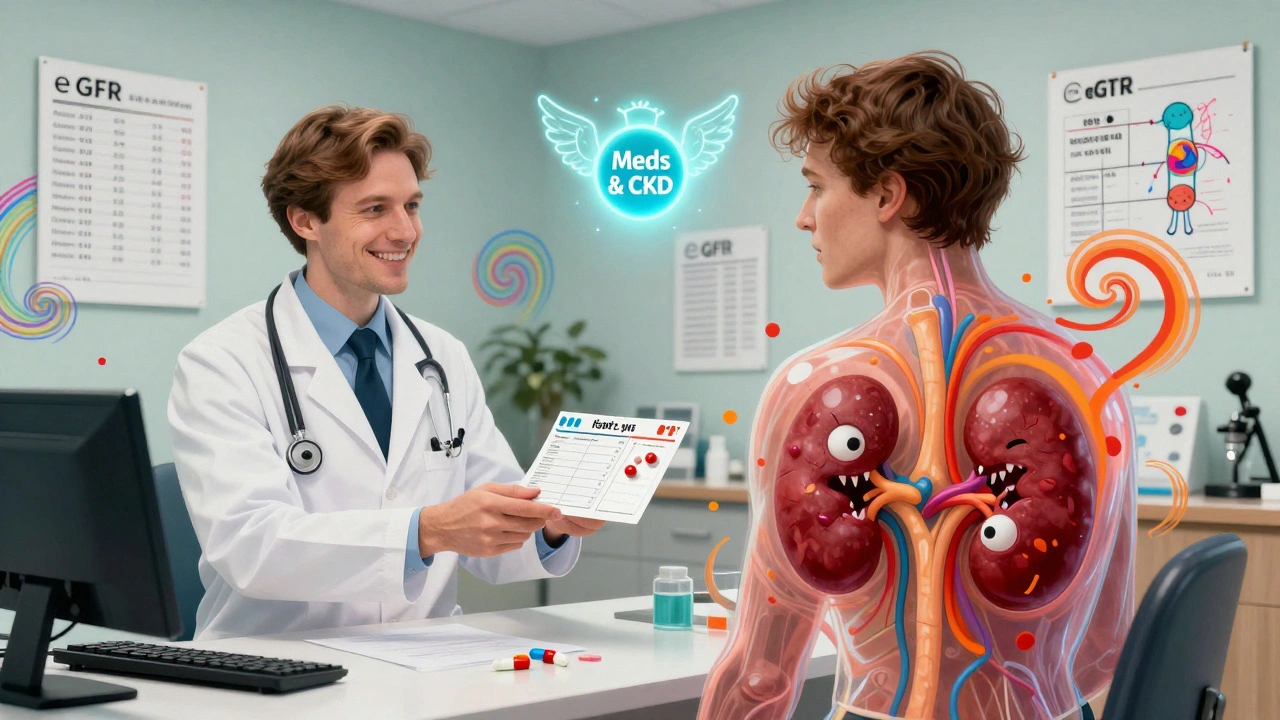
You’d think this is common knowledge. But it’s not.A JAMA Internal Medicine study found that 35% of primary care visits don’t include an eGFR calculation. Doctors look at serum creatinine alone-and that’s not enough. Creatinine can stay normal even when kidney function is dropping. You need the eGFR number to know the real picture.
Another study found that 42% of prescriptions for drugs cleared by the kidneys are given at the wrong dose when eGFR is below 60. That’s nearly half. Why? Time pressure. Lack of training. Outdated guidelines. Or worse-assuming the patient knows to ask.
And then there’s polypharmacy. The average CKD patient takes 10 to 12 medications daily. For diabetes. For high blood pressure. For heart failure. For arthritis. Each one adds another layer of risk. One drug might be fine alone. But mix it with another? That’s when things go sideways.
What You Can Do
You don’t have to wait for a crisis. Here’s how to protect yourself:- Know your eGFR. Ask for it at every visit. Don’t settle for just “your creatinine is fine.”
- Ask about every new prescription. “Is this safe for my kidneys?” “Do I need a lower dose?” “Are there alternatives?”
- Keep a medication list. Include over-the-counter drugs, vitamins, and supplements. Bring it to every appointment.
- Avoid NSAIDs. Use acetaminophen instead for pain. It’s safer for kidneys.
- Use tools like Meds & CKD. This app, developed by Healthmap Solutions, flags risky meds based on your eGFR. Users report 82% better conversations with their doctors.
- Watch for symptoms. Swelling, fatigue, nausea, confusion, or irregular heartbeat? These could be signs of drug toxicity-not just “getting older.”
The Future Is Getting Smarter
There’s hope. In 2023, the FDA approved KidneyIntelX, a tool that uses machine learning to predict your personal risk of drug toxicity. In a study of 10,000 patients, it was 89% accurate. That’s huge.Stanford’s Dr. Richard Lafayette predicts that within five years, electronic health records will auto-flag unsafe prescriptions the moment a doctor types them in. That could cut errors by 75%.
And new drugs like SGLT2 inhibitors (dapagliflozin, empagliflozin) aren’t just for diabetes-they actually protect the kidneys. But even these need dose changes when eGFR drops below 45. So knowing your number still matters.
The Bottom Line
Medication toxicity in kidney disease isn’t a rare side effect. It’s a systemic failure. Millions are at risk. Many are already hurt. But it’s preventable.You don’t need to be a doctor to save your own kidneys. You just need to ask the right questions. Know your eGFR. Review every drug. Speak up. The next time someone says, “It’s just a pill,” remember: in a body with failing kidneys, that pill could be the one that changes everything.
Can I still take ibuprofen if I have kidney disease?
No, it’s not safe. Ibuprofen and other NSAIDs reduce blood flow to the kidneys, which can cause sudden kidney injury-even in people with mild CKD. If your eGFR is below 60, avoid them completely. Use acetaminophen (Tylenol) instead for pain relief, and always check with your doctor before taking any new medication.
How do I know if my medication dose needs to be adjusted for kidney disease?
Your eGFR is the key number. If it’s below 60 mL/min/1.73m², most medications cleared by the kidneys need a lower dose or less frequent dosing. Ask your doctor or pharmacist to review every prescription. You can also use tools like Meds & CKD or the FDA’s drug labeling to check if a medication requires adjustment. Don’t assume your current dose is still safe.
What’s the difference between eGFR and serum creatinine?
Serum creatinine is a single blood test result-it tells you how much waste is in your blood. But it doesn’t tell you how well your kidneys are filtering. eGFR (estimated glomerular filtration rate) uses your creatinine, age, sex, and race to estimate how much blood your kidneys filter each minute. It’s the real measure of kidney function. Many doctors still only check creatinine-but you should insist on seeing your eGFR.
Can metformin cause lactic acidosis in people with kidney disease?
Yes, but only if the dose isn’t adjusted. Metformin is generally safe when eGFR is above 45. It should be reduced when eGFR is between 30 and 44, and stopped entirely when it falls below 30. A major review of 20,000 patients found no cases of lactic acidosis when guidelines were followed. The risk isn’t from the drug-it’s from ignoring dosing rules.
Are there any medications that are safe for all stages of kidney disease?
Yes, some are. Glipizide (a diabetes drug) and warfarin (a blood thinner) are cleared mostly by the liver, not the kidneys, so they don’t need dose changes in CKD. Acetaminophen is safer than NSAIDs for pain. But “safe” doesn’t mean risk-free. Always check with your doctor-even drugs that don’t need adjustment can interact with others or affect your condition differently as kidney function declines.
How often should I get my kidney function checked if I’m on multiple medications?
At least every 3 to 6 months if you have CKD and take 5 or more medications. If you’re newly diagnosed with kidney disease, or if your doctor changes your meds, get tested within 2 weeks. Kidney function can drop quickly, especially with NSAIDs, diuretics, or antibiotics. Regular eGFR checks are the best way to catch problems before they become emergencies.
What should I do if I think a medication is making me feel worse?
Don’t stop taking it suddenly-some drugs need to be tapered. Call your doctor right away. Write down your symptoms: fatigue, swelling, confusion, nausea, irregular heartbeat, or reduced urine output. Bring your full medication list. These could be signs of drug toxicity. Early action can prevent hospitalization or permanent damage.
iswarya bala
December 8, 2025 AT 12:06Olivia Portier
December 8, 2025 AT 19:35Courtney Black
December 10, 2025 AT 05:15Simran Chettiar
December 11, 2025 AT 04:18Shubham Mathur
December 12, 2025 AT 08:24Ruth Witte
December 13, 2025 AT 09:29Lauren Dare
December 15, 2025 AT 04:05Andrea DeWinter
December 16, 2025 AT 12:18precious amzy
December 17, 2025 AT 12:51William Umstattd
December 18, 2025 AT 14:33Tejas Bubane
December 18, 2025 AT 23:01Brianna Black
December 19, 2025 AT 21:27Courtney Black
December 19, 2025 AT 22:37