Hyponatremia and Hypernatremia in Kidney Disease: What You Need to Know
When your kidneys start to fail, even small changes in your body’s sodium levels can become dangerous. Hyponatremia (low sodium) and hypernatremia (high sodium) aren’t just lab numbers-they’re real risks that can lead to falls, confusion, hospital stays, and even death in people with chronic kidney disease (CKD). And yet, most patients and even some doctors don’t fully understand how these two conditions work together in kidney failure.
Why Sodium Goes Wrong in Kidney Disease
Your kidneys are your body’s main sodium regulators. They decide how much salt and water to keep or flush out based on what you eat, drink, and how your hormones signal them. But when kidney function drops-especially below 30 mL/min/1.73m² (Stage 4 or 5 CKD)-this system breaks down.Early on, your kidneys can still handle normal salt intake, but they need to make more urine to do it. As kidney damage worsens, they lose the ability to make either very concentrated or very dilute urine. That means they can’t adjust properly when you drink too much water or eat too much salt. The result? Sodium levels swing out of control.
What makes this worse is that many CKD patients are put on strict diets-low sodium, low potassium, low protein-to manage other problems. But cutting back too much on solutes (like salt and protein) can actually make hyponatremia more likely. Your kidneys need those solutes to pull water out of your body. Without them, water builds up, diluting your sodium.
Hyponatremia: The Silent Threat
Hyponatremia-serum sodium below 135 mmol/L-is the most common sodium disorder in CKD, affecting 60-65% of cases. It’s often called "euvolemic," meaning you don’t look swollen or dehydrated, but your body is holding onto too much water.This happens because:
- Your kidneys can’t excrete free water properly
- Thiazide diuretics (commonly prescribed for high blood pressure) become less effective but still mess with sodium balance
- ADH (the antidiuretic hormone) stays active even when it shouldn’t, forcing your body to keep water
- Dietary restrictions reduce solute intake, making water excretion harder
The symptoms are easy to miss: fatigue, nausea, confusion, headaches. But the risks are serious. Studies show people with CKD and hyponatremia are nearly twice as likely to die compared to those with normal sodium. They’re also more likely to fall, break bones, or develop cognitive decline. In one study, 28% of elderly CKD patients with low sodium had trouble walking-compared to just 12% of those with normal levels.
And here’s the catch: treating hyponatremia the "normal" way can kill you. Rapidly correcting sodium levels in CKD patients can cause osmotic demyelination syndrome-a rare but devastating brain injury. That’s why correction must be slow: no more than 4-6 mmol/L in 24 hours, and never more than 8 mmol/L total in a day.
Hypernatremia: The Overlooked Danger
Hypernatremia-sodium above 145 mmol/L-is less common but just as deadly. It usually happens when someone can’t drink enough water or loses too much fluid. In CKD, this often occurs in older patients who forget to drink, have mobility issues, or are on medications that increase urination.Even though your kidneys are damaged, they still need to concentrate urine to save water. But in advanced CKD, the kidney’s ability to concentrate urine is gone. So if you don’t drink enough, your sodium rises fast.
Signs include extreme thirst, dry mouth, restlessness, and confusion. In severe cases, seizures or coma can follow. Correction must be slow too-no more than 10 mmol/L in 24 hours. Too fast, and your brain swells from sudden water shifts, causing permanent damage.
What makes hypernatremia tricky in CKD is that it often gets missed. Doctors focus on fluid overload in heart failure or edema, but forget that dehydration can still happen-even with swelling.
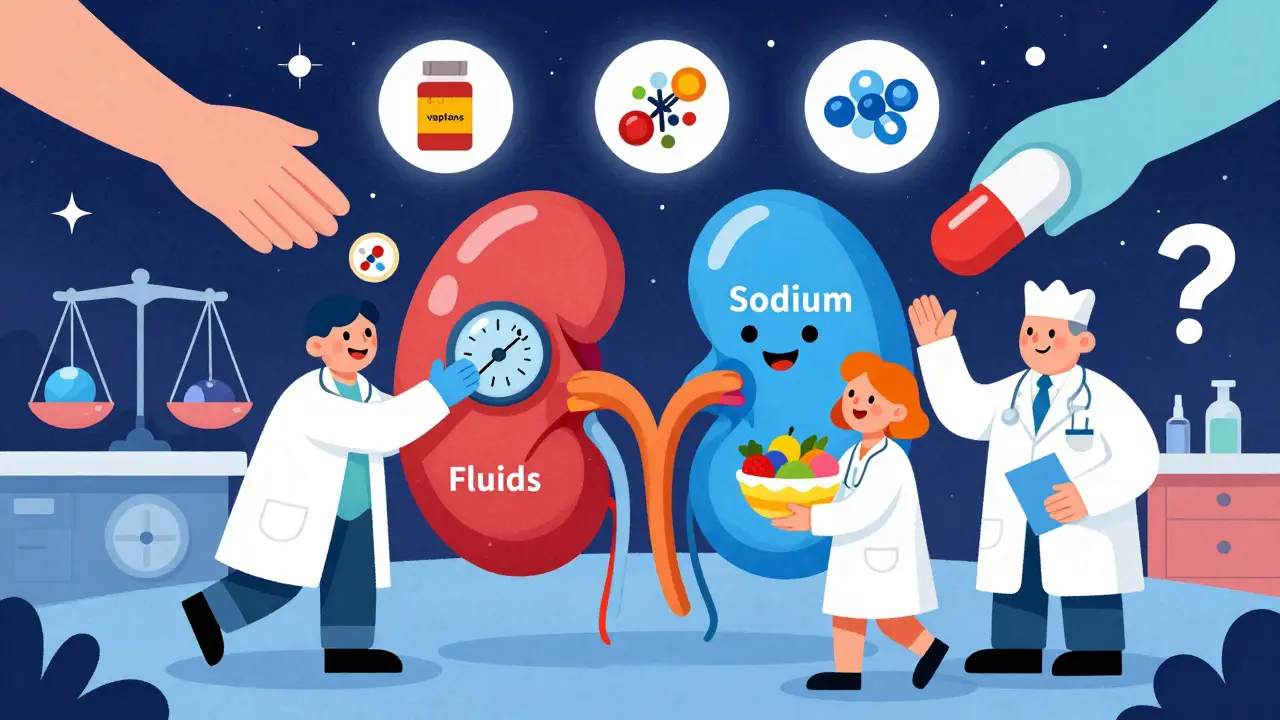
How Fluids and Diet Affect You
Fluid restriction is the first-line treatment for hyponatremia in CKD. But how much? It depends on your kidney function:- Early CKD (Stages 1-2): 1,000-1,500 mL/day
- Advanced CKD (Stages 4-5): 800-1,000 mL/day
But here’s the problem: patients don’t know how to follow these limits. A 75-year-old with CKD might think "low sodium" means no salt at all-so they stop adding salt to food, eat only fruits and vegetables, and drink more water to feel full. That’s a recipe for hyponatremia.
On the flip side, some patients with swelling are told to drink less but don’t realize their thirst is gone because of medications or nerve damage. They stop drinking altogether, leading to hypernatremia.
Studies show that patients who get 3-6 sessions with a renal dietitian are far more likely to manage their fluids and sodium safely. But most don’t get that support. Instead, they’re handed a one-page handout and left to figure it out.
Medications That Make It Worse
Some common drugs are dangerous in CKD:- Thiazide diuretics (like hydrochlorothiazide): These are linked to 25-30% of euvolemic hyponatremia cases in CKD. They’re ineffective when GFR is below 30, but still cause sodium loss. The FDA warns against their use in advanced CKD.
- Vaptans (like tolvaptan): These block ADH and help with hyponatremia-but they’re useless in advanced CKD because the kidneys can’t respond. The European Medicines Agency bans their use in Stage 4-5 CKD.
- NSAIDs (ibuprofen, naproxen): These reduce kidney blood flow and worsen sodium handling. They’re a major cause of acute kidney injury in CKD patients.
Loop diuretics (like furosemide) are safer in advanced CKD because they work even when kidney function is low. But they can still cause dehydration if not monitored closely.
What Works: Smart, Personalized Care
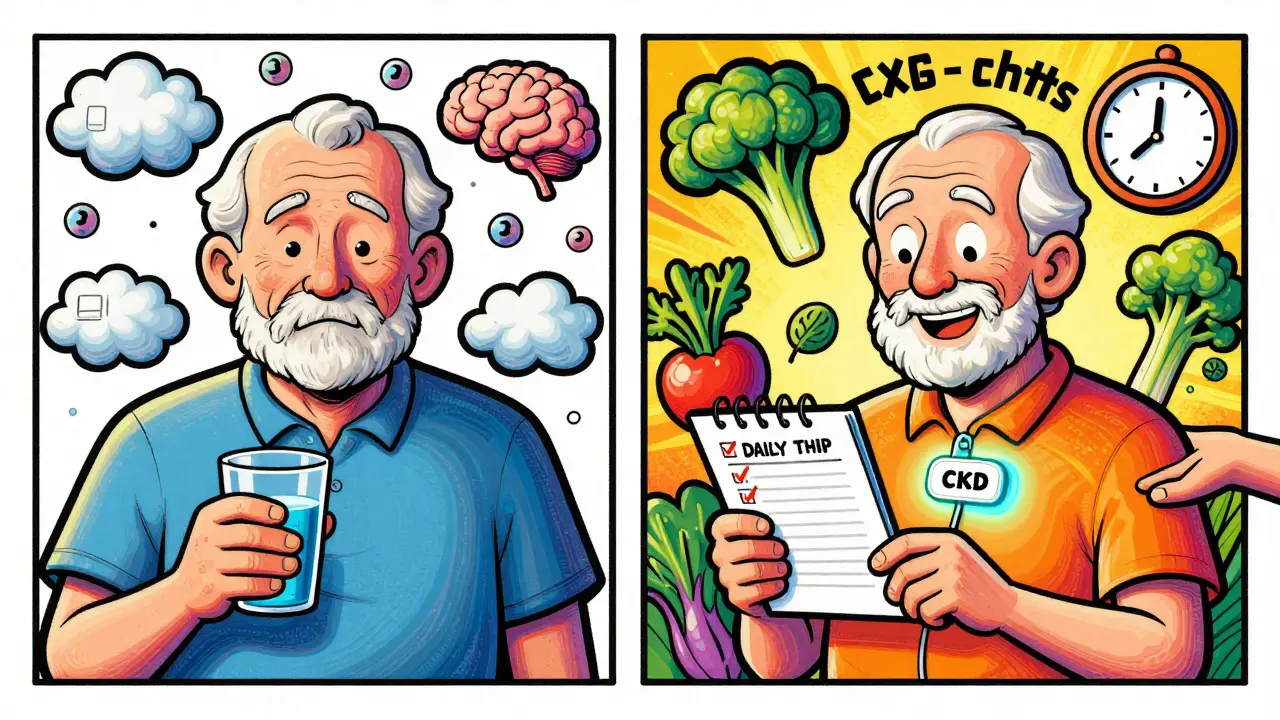
The best outcomes come from teams-not just nephrologists, but dietitians, pharmacists, and primary care doctors working together. One study showed a 35% drop in hospitalizations for sodium disorders when patients had coordinated care.Key strategies:
- Don’t over-restrict sodium. Aim for 2-4 grams/day, not "no salt at all."
- Monitor fluid intake based on your GFR, not a blanket rule.
- Check sodium levels every 3-6 months if you’re in Stage 3 or worse.
- Review all medications with your pharmacist-especially diuretics and painkillers.
- Use a daily log: write down what you drink, eat, and how you feel.
There’s new tech too. In 2023, the FDA approved a wearable patch that measures interstitial sodium levels continuously. It’s not perfect, but it gives real-time data without blood draws. Early results show 85% accuracy compared to lab tests.
What to Do Right Now
If you have CKD:- Ask your doctor: "What’s my current sodium level? Is it stable?"
- Ask your dietitian: "Am I restricting sodium too much? Should I be eating more protein or salt?"
- Ask your pharmacist: "Which of my meds could be causing low or high sodium?"
- Watch for early signs: fatigue, confusion, dizziness, dry mouth, or swelling that changes quickly.
- Keep a fluid diary for a week. You might be surprised how much you’re drinking-or not drinking.
Sodium disorders in kidney disease aren’t about one bad lab result. They’re about a broken system, poorly managed diets, and outdated treatment habits. Fixing them takes awareness, teamwork, and patience-but it can save your life.
Can low sodium cause seizures in kidney disease?
Yes, but it’s rare. Severe hyponatremia (below 120 mmol/L) can cause seizures, confusion, or coma because water moves into brain cells, making them swell. In CKD patients, this risk is higher because their kidneys can’t correct the imbalance quickly. Slow correction is critical to avoid brain damage.
Is drinking more water safe if I have CKD and low sodium?
No. Drinking extra water when you have hyponatremia and CKD makes it worse. Your kidneys can’t flush out the excess water, so sodium gets even more diluted. Fluid restriction is usually the first treatment-even if you feel thirsty. Talk to your nephrologist about your daily fluid limit.
Why do some CKD patients get hyponatremia even when they’re not drinking much?
Because their bodies can’t excrete water properly. Even small amounts of fluid can build up if the kidneys aren’t making dilute urine. This often happens with low-solute diets (too little protein or salt), which reduce the kidney’s ability to push water out. It’s not about how much you drink-it’s about how well your kidneys can handle it.
Can high sodium cause kidney damage?
High sodium doesn’t directly damage the kidneys, but it worsens existing kidney disease. Too much salt raises blood pressure, increases protein in the urine, and speeds up kidney decline. In CKD, your kidneys can’t handle the extra load, so sodium builds up and triggers fluid retention, heart strain, and worsening symptoms.
Should I take salt tablets if I have low sodium with CKD?
Only under medical supervision. In rare cases like salt-wasting syndromes (affecting 5-8% of advanced CKD patients), sodium chloride supplements (4-8 g/day) may be needed. But most hyponatremia in CKD is caused by too much water, not too little salt. Taking salt tablets without knowing the cause can lead to dangerous fluid overload or high blood pressure.
How often should I get my sodium checked if I have CKD?
At least every 3-6 months if you’re in Stage 3 or worse. If you’re on diuretics, have swelling, or are losing weight unexpectedly, check every 1-2 months. Don’t wait for symptoms-hyponatremia often has none until it’s serious.
wendy parrales fong
December 25, 2025 AT 16:05Really appreciate this breakdown. I never realized how tricky sodium balance is with kidney disease. It’s not just 'drink less' or 'eat less salt'-it’s this whole delicate system that breaks down slowly. Makes me think about my grandma’s diet and how confusing all those labels are.
Also, the wearable patch thing? That’s wild. Could be a game-changer for people who can’t get regular blood tests.
Jeanette Jeffrey
December 26, 2025 AT 06:11Ugh. Another ‘educational’ post pretending to be revolutionary. Everyone knows hyponatremia’s dangerous in CKD. The real issue? Doctors still prescribe thiazides like they’re candy. And dietitians? They hand out pamphlets like it’s a kindergarten coloring contest. Stop acting surprised when people die from bad advice.
Also, ‘3-6 sessions with a dietitian’? Good luck getting that on Medicare. This isn’t a solution-it’s a cry for more bureaucracy.
Shreyash Gupta
December 27, 2025 AT 03:00Bro… why is everyone acting like this is new info? 🤔 I’ve been on dialysis for 4 years and my nephrologist told me this in 2020. Also, salt tablets? Lol. I tried that once. Ended up with swollen ankles and a BP of 190/105. 😅
Real talk: the problem isn’t knowledge. It’s access. My doc doesn’t even have time to answer texts. How’s a 70-year-old supposed to log fluids when they can’t even read the app?
Ellie Stretshberry
December 28, 2025 AT 06:03i just want to say thank you for writing this. my mom has stage 4 ckd and we’ve been so confused about fluids and salt. we thought low sodium meant no salt at all, so we stopped using it completely… turns out that was making her hyponatremia worse 😅
we started giving her a tiny pinch on her eggs and she’s been more alert. not saying this is medical advice but… this post helped us feel less lost. thank you.
Zina Constantin
December 29, 2025 AT 05:24This is one of the clearest, most compassionate explanations of sodium dysregulation in CKD I’ve ever read. As someone who’s worked with elderly patients across three continents, I can confirm: the disconnect between medical guidelines and real-life execution is staggering.
What’s missing? Cultural context. In many households, salt isn’t just a seasoning-it’s tradition, memory, safety. Telling someone to stop salting their food is like telling them to stop hugging their children.
We need more than pamphlets. We need storytelling, community health workers, translated visuals, and patience. This isn’t just physiology-it’s human dignity.
Dan Alatepe
December 31, 2025 AT 05:13Y’all ain’t ready for this 😤
My uncle went from ‘just a little tired’ to coma in 36 hours because his ‘healthy’ diet had zero salt and he drank 3 liters of water a day thinking it was ‘cleansing’. He woke up with brain damage. The doctors said ‘it happens’ like it was a glitch in the Matrix.
THIS ISN’T A LAB REPORT. THIS IS PEOPLE DYING BECAUSE NO ONE TOLD THEM THE TRUTH.
Someone needs to make a TikTok about this. Like, NOW. 🚨
Angela Spagnolo
January 2, 2026 AT 00:03...I just read this... and I... I don’t know what to say...
My mom... she’s been on dialysis for six years... and I’ve been so scared to ask the wrong questions...
But now I’m going to print this out... and take it to her next appointment...
Thank you... thank you for writing this...
...I think I finally understand...
...maybe... maybe I’ve been helping her by accident...
...but I didn’t know... I didn’t know...
...I’m so sorry...
...I love you, Mom.
...I’m going to start a fluid log tonight...
...I promise.
Sarah Holmes
January 3, 2026 AT 17:51How is this still an issue in 2025? We have AI-driven hydration monitors, wearable sodium trackers, and yet we’re still handing out one-page PDFs to elderly patients with dementia? This is malpractice disguised as education.
There is no excuse for this systemic failure. Nephrologists, dietitians, and pharmacists are being paid to manage this. If patients are dying from preventable sodium imbalances, it’s not negligence-it’s negligence with a title.
Someone needs to be fired. Someone needs to be sued. And someone needs to stop pretending this is ‘complicated.’ It’s not. It’s criminal.