How to Use Medicare Extra Help to Lower Costs for Generic Prescriptions
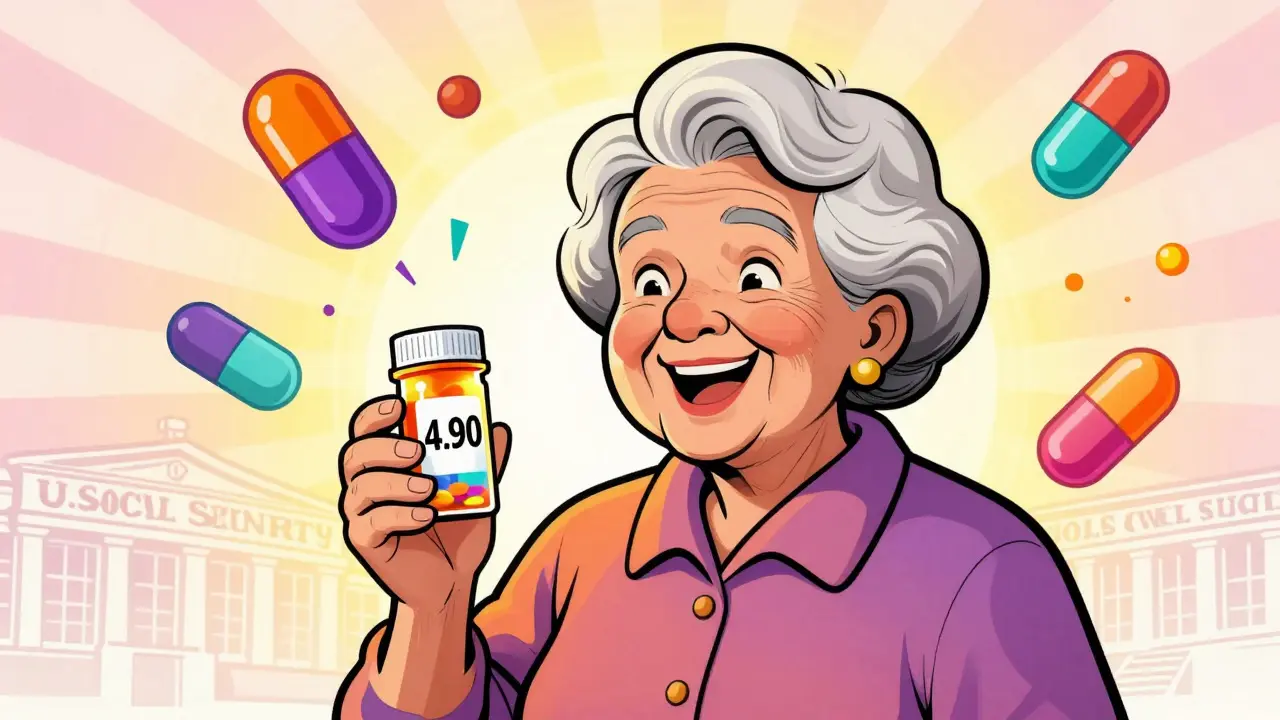
For many seniors on Medicare, paying for daily medications feels like a second mortgage. A blood pressure pill here, a diabetes tablet there - over time, those small copays add up to hundreds, even thousands, of dollars a year. But if your income is limited, there’s a federal program designed specifically to cut those costs to nearly nothing: Medicare Extra Help. It’s not widely advertised, and many people who qualify don’t even know it exists. Yet for those who do enroll, the difference is life-changing.
What Medicare Extra Help Actually Covers
Medicare Extra Help, also called the Part D Low-Income Subsidy (LIS), is a federal program that pays for most of your prescription drug costs under Medicare Part D. It doesn’t just reduce your copays - it wipes out your monthly premium and annual deductible entirely. For generic drugs, you pay no more than $4.90 per prescription in 2025. If you’re also on Medicaid and earn below 100% of the Federal Poverty Level, your copay drops to just $1.60.
Compare that to standard Part D coverage. Without Extra Help, you might face a $595 deductible before your drug coverage even starts. After that, you pay 25% of the drug’s cost. A $50 generic medication? That’s $12.50 out of pocket - and that’s after you’ve paid the full deductible. Multiply that by 12 prescriptions a month, and you’re looking at nearly $750 just in copays, not counting the premium or deductible. With Extra Help, that same person pays $705.60 a year for all their generics - and that’s only because they’re filling 12 prescriptions a month. The deductible and premium? Gone.
Who Qualifies for Extra Help in 2025
Eligibility is based on strict income and resource limits. In 2025, an individual can earn up to $23,475 per year and still qualify. For a married couple living together, the limit is $31,725. These numbers include Social Security, pensions, wages, and other income - but not housing assistance or Medicaid payments.
Resources matter too. You can have up to $17,600 in assets as a single person, or $35,130 as a couple. This includes bank accounts, stocks, bonds, and investment funds. But your primary home, one car, personal belongings, and burial funds up to $1,500 don’t count. That’s important - many people think owning a home or having a small savings account disqualifies them, but it doesn’t.
Automatic enrollment happens if you already get Medicaid, Supplemental Security Income (SSI), or a Medicare Savings Program. If you don’t, you have to apply. You can do it online at SSA.gov, by calling 1-800-772-1213, or by visiting your local Social Security office. Free help is available through State Health Insurance Assistance Programs (SHIPs) in every state.
Why So Many People Miss Out
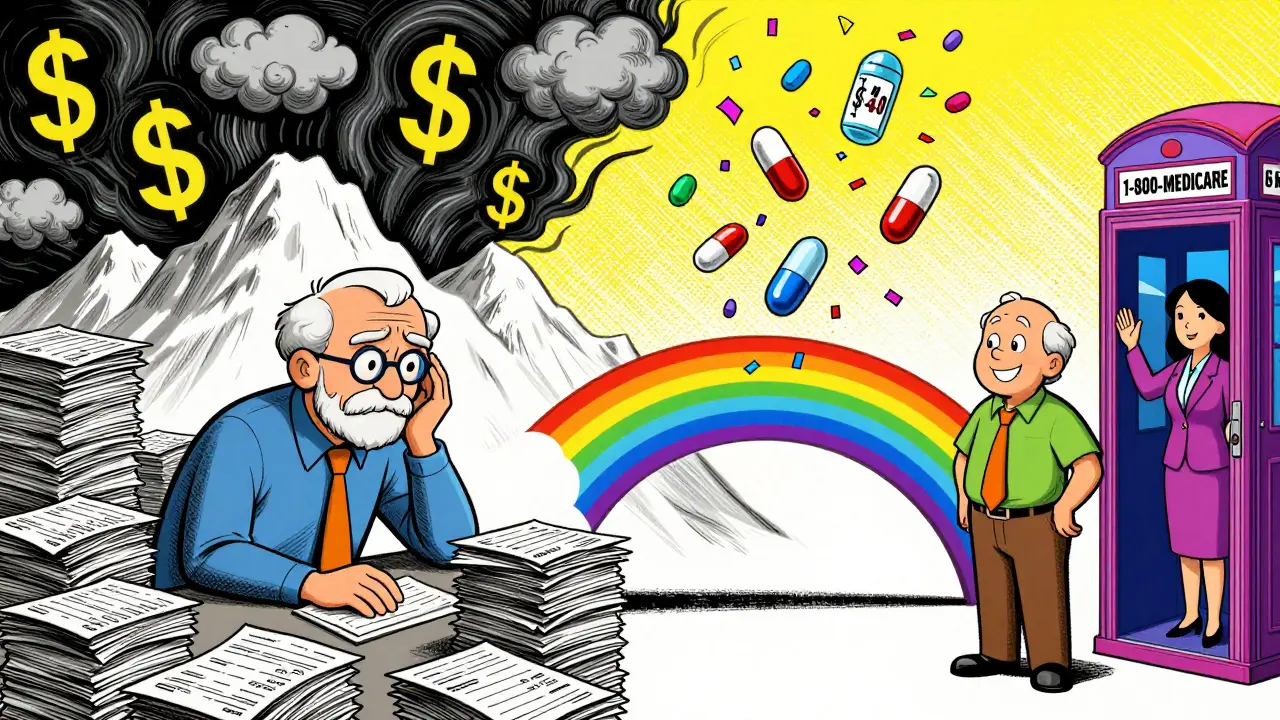
Despite the huge savings, about 37% of people who qualify for Extra Help never enroll. Why? The application is complicated. It asks for detailed financial records - bank statements, tax forms, asset disclosures. Many seniors get overwhelmed by the paperwork. Others think they make “too much” and give up before applying.
Take the story of a 78-year-old widow in Ohio. She received a $500 raise in her Social Security benefit. That pushed her income to $23,700 - $225 over the limit. She lost Extra Help overnight. Her monthly generic medications jumped from $4.90 each to $120. Her total drug bill went from $600 a year to $1,440. She couldn’t afford to refill her heart medication for two months. She ended up in the ER.
This is called the “cliff effect.” The cutoff isn’t gradual. Go $1 over, and you lose everything. Experts like Susan Reinhard from AARP call it a broken system. It doesn’t account for real financial strain - just rigid numbers.
How Extra Help Changes Medication Use
It’s not just about money. It’s about health. Studies show Extra Help beneficiaries take their medications 23% more often than those without it. For people with diabetes, high blood pressure, or heart disease, that means fewer hospital visits, fewer complications, and longer life.
One pharmacist on Reddit shared how a patient stopped taking her blood pressure pills because they cost $30 a month. After getting Extra Help, her copay dropped to $4.90. She filled every prescription. Her blood pressure stabilized. She started walking again.
On the flip side, people who lose Extra Help often skip doses or split pills. Some stop taking them altogether. That’s not laziness - it’s survival. When you’re choosing between insulin and groceries, you pick groceries.
What You Need to Do Every Year
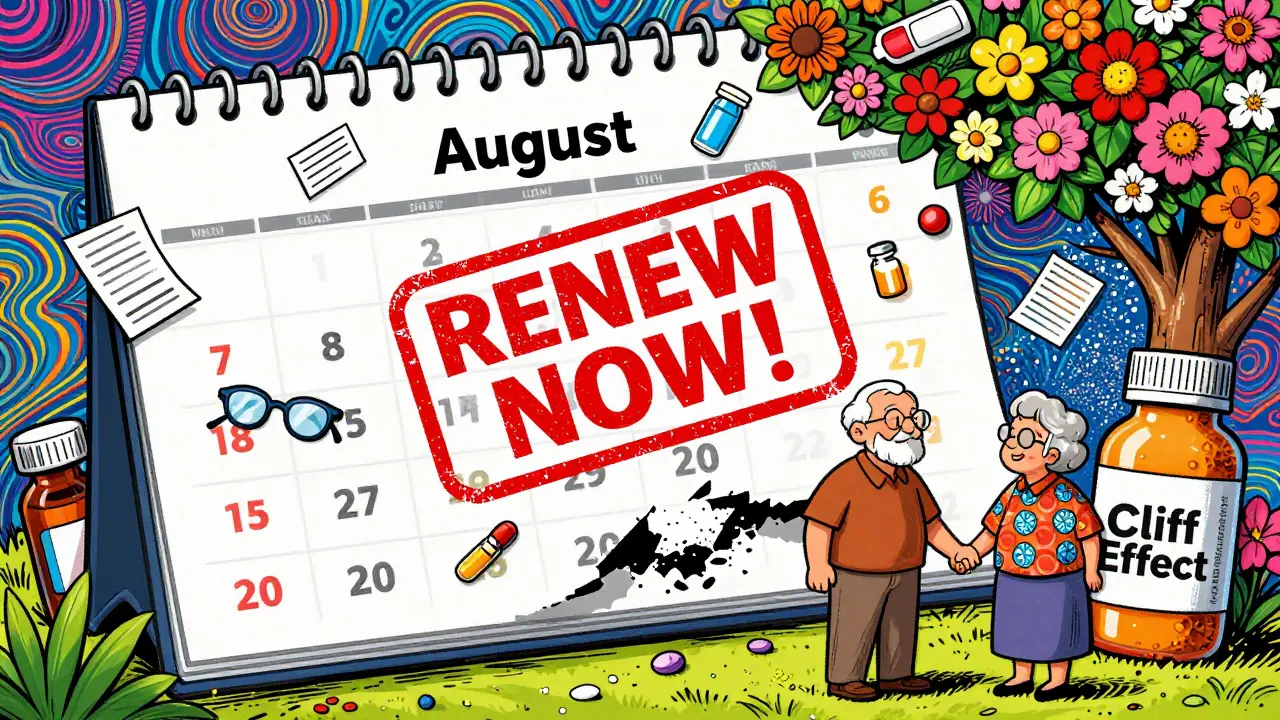
Extra Help isn’t a one-time thing. Every August, you’ll get a form in the mail asking you to reapply for the next year. You have 30 days to return it. If you miss the deadline, your benefits stop on January 1. No warning. No grace period.
Even if your income didn’t change, you still have to submit the form. The government needs to verify your situation. Some people assume they’re automatically renewed - they’re not. This is the most common reason people lose coverage.
Pro tip: Mark your calendar for early August. Set a reminder. Get help from a SHIP counselor if you’re unsure. Don’t wait until the last week.
Can You Switch Plans With Extra Help?
Yes - and you get more freedom than most Part D enrollees. While most people can only change plans once a year during Open Enrollment, Extra Help recipients can switch once a month. That’s huge.
Why? Because formularies change. A drug you need might get moved to a higher tier. A pharmacy in your area might drop out of the network. With Extra Help, you can switch to a plan that covers your meds better - and you can do it anytime.
Just make sure your new plan includes all your prescriptions. And remember: Extra Help works with any Part D plan, as long as it’s Medicare-approved. You’re not locked into one.
What’s Changing in 2025 and Beyond
The Inflation Reduction Act introduced a $35 monthly cap on insulin for all Medicare Part D users in 2025. That’s great news - but if you’re on Extra Help, you were already paying $4.90. So the cap doesn’t change much for you. It does help others who don’t qualify for Extra Help.
There’s also talk of expanding eligibility. The Biden administration proposed raising the income limit to 175% of the Federal Poverty Level - that’s about $28,500 for a single person. If that happens, over a million more seniors could qualify. But as of now, it’s still just a proposal.
For now, the rules stay the same: $23,475 income limit, $17,600 in resources, $4.90 copay for generics. It’s simple. It’s powerful. And it’s available to far more people than realize it.
What to Do Next
If you or someone you know is on Medicare and struggling with prescription costs, don’t assume you don’t qualify. Call 1-800-MEDICARE or visit SSA.gov. Fill out the Extra Help application. Even if you think you’re just over the limit, apply anyway. Sometimes, the SSA can make exceptions based on unusual expenses or medical costs.
And if you’re already enrolled? Don’t forget the annual review. Set a reminder. Ask a family member to help. Keep your documents organized. Your health depends on it.
Medicare Extra Help isn’t a luxury. For millions of seniors, it’s the only thing standing between them and skipping their medications. It’s not perfect - the income cliff is unfair, the paperwork is heavy. But it works. And if you qualify, you owe it to yourself to use it.
Can I get Medicare Extra Help if I have savings in the bank?
Yes, as long as your total countable resources don’t exceed $17,600 for an individual or $35,130 for a couple in 2025. Your primary home, one car, personal items, and up to $1,500 in burial funds don’t count. Bank accounts, stocks, and investment accounts do count. If you’re unsure, apply - the Social Security Administration will review your assets and let you know.
Do I have to reapply for Extra Help every year?
Yes. Every August, you’ll receive a form to renew your Extra Help for the next year. You have 30 days to return it. If you don’t, your benefits will end on January 1. Even if your income hasn’t changed, you must submit the form. Set a reminder or ask a family member to help you.
What if I make a little more than the income limit?
If you exceed the income limit by even $1, you lose Extra Help entirely - no partial benefits. This is called the "cliff effect." But you should still apply. Sometimes, the Social Security Administration can exclude certain income types, like one-time payments or medical expenses. Don’t assume you’re ineligible without checking.
Can I use Extra Help with any pharmacy?
Extra Help works with most pharmacies that accept Medicare Part D, including CVS, Walgreens, Walmart, and many local pharmacies. Your plan’s formulary determines which drugs are covered, but your copay stays at $4.90 for generics no matter which pharmacy you use - as long as it’s in your plan’s network. Always confirm your pharmacy accepts your Part D plan before filling a prescription.
Does Extra Help cover brand-name drugs too?
Yes. While the focus is often on generics, Extra Help also covers brand-name drugs. In 2025, you pay up to $12.15 per brand-name prescription. That’s still far less than the full cost. Many seniors use generics when possible, but if a brand drug is medically necessary, Extra Help helps with that too.
How long does it take to get approved for Extra Help?
It usually takes 3 to 6 weeks after you submit your application. If you’re already getting Medicaid or SSI, you’ll be enrolled automatically. If you apply online or by phone, you’ll get a letter in the mail with your decision. If you’re denied, you can appeal. Don’t give up - many denials are overturned with additional documentation.
Can I get Extra Help if I’m not on Medicaid?
Absolutely. Extra Help is separate from Medicaid. You can qualify for Extra Help even if you don’t get Medicaid, as long as your income and resources are below the 2025 limits. Many people have Extra Help without any other government assistance. Apply using the SSA application - you don’t need to be on Medicaid first.
Marilyn Ferrera
December 31, 2025 AT 21:50Just applied for Extra Help last month-$4.90 for my metformin, lisinopril, and atorvastatin? I cried. Not because I was happy-because I realized I’d been overpaying for five years. Why isn’t this on every Medicare pamphlet?
Branden Temew
January 1, 2026 AT 13:11So let me get this straight: the government will pay for your pills... but only if you’re under a magic number? And if you get a 50-cent raise? Bye-bye insulin. Brilliant. Truly. The American healthcare system: where poverty is a technicality and survival is a loophole.
Frank SSS
January 3, 2026 AT 08:15I love how this post makes Extra Help sound like a miracle. But let’s be real-most seniors can’t even fill out the form. My aunt tried. Got lost on page 2. Her bank statement? She thought ‘assets’ meant her TV. She gave up. Now she’s splitting her blood pressure pills. No joke. This isn’t help-it’s a test you’re designed to fail.
And don’t even get me started on the ‘annual renewal.’ They send the form in August. By then, half the people are on vacation, or in the hospital, or dead.
Paul Huppert
January 3, 2026 AT 14:49My mom got approved last year. She didn’t even know she qualified-thought she made too much because she gets a small pension. Turns out, her savings account was under $10k. The whole process took three weeks. SHIP counselor was a lifesaver. If you’re even a little unsure, just apply. No harm in trying.
Hanna Spittel
January 5, 2026 AT 10:09OMG this is so TRUE!!! 😭 I knew someone was scamming us but I didn’t know it was the GOVT 😳 They want you to fail so they can say ‘look how bad Medicare is!’ 💸 #MedicareScam #ExtraHelpIsALie
Brady K.
January 5, 2026 AT 22:03Let’s stop pretending this is ‘help.’ It’s damage control. The system is broken-$23k income cap? In 2025? That’s not poverty-that’s a joke. We’re rewarding people for staying poor. And if you dare earn more than $225 above that? Congrats, you’re now a criminal for wanting to live. This isn’t policy. It’s psychological warfare.
And yes-switching plans monthly? That’s the only smart part. Use it. Exploit it. Because if you’re not gaming the system, you’re losing.
Kayla Kliphardt
January 7, 2026 AT 16:35I’ve been on Extra Help for three years. I never thought I’d qualify. My husband passed last year, and I thought my Social Security bump disqualified me. But I applied anyway. They counted my house, my car, my cat’s vet bills. I didn’t even know vet bills counted as medical expenses. They approved me. I’m still in shock.
John Chapman
January 7, 2026 AT 21:22STOP WAITING. Seriously. If you’re on Medicare and taking any meds, APPLY TODAY. 🚨 I helped my neighbor last week-he was gonna wait till August. His pills were $110/month. After Extra Help? $4.90. He cried. I cried. We hugged. This isn’t bureaucracy-it’s life or death. Do it. Now.
Urvi Patel
January 9, 2026 AT 19:41