How to Store Inhalers and Nebulizer Medications Safely: Temperature, Humidity, and Common Mistakes
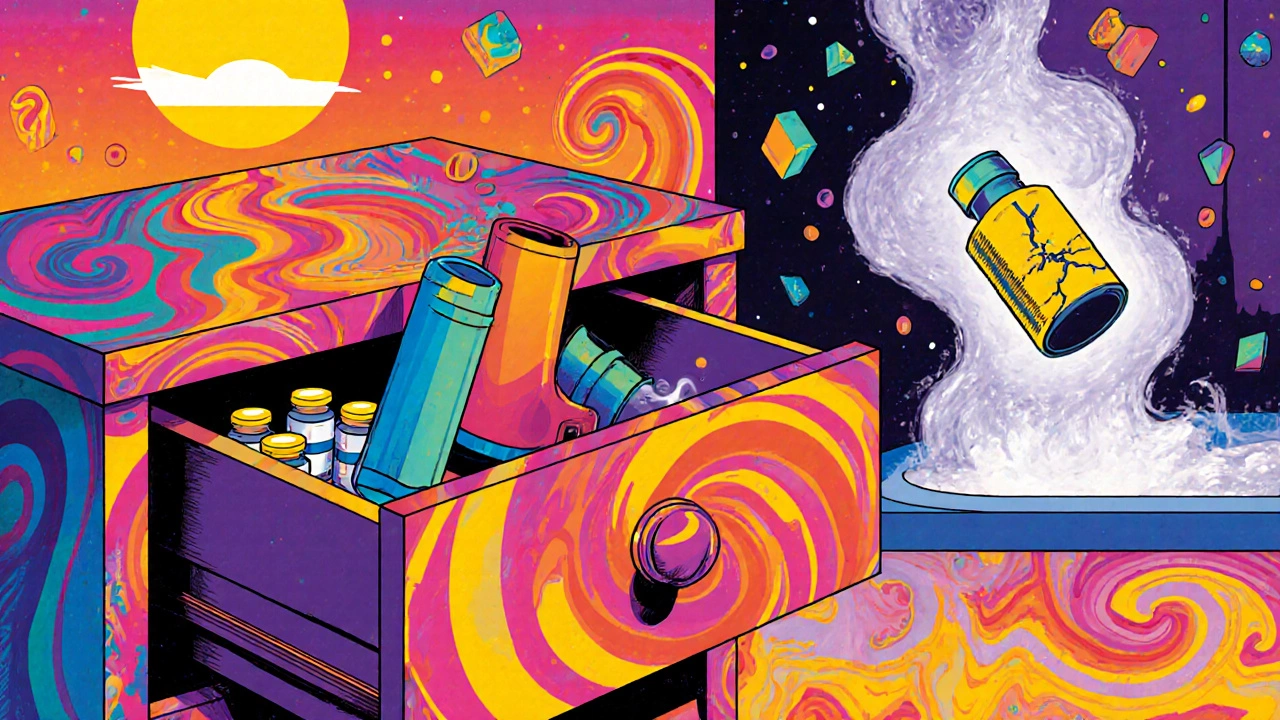
Keeping your inhaler or nebulizer medication working when you need it most isn’t about luck-it’s about storage. If your inhaler has ever felt like it didn’t work during an asthma attack, the problem might not be your lungs. It could be the place you left it: a hot car, a steamy bathroom, or a drawer next to your hair dryer. Inhaler storage isn’t optional. It’s life-saving.
Why Storage Matters More Than You Think
Your inhaler isn’t just a plastic tube with medicine inside. It’s a precision device. The medicine inside-whether it’s albuterol, budesonide, or salmeterol-is designed to be delivered in exact doses. When exposed to heat, moisture, or freezing temps, that medicine breaks down. The result? You might get only half the dose-or none at all. A 2022 study by the American Lung Association found that about 12% of asthma treatment failures during emergencies were directly tied to improperly stored inhalers. That’s not a small number. That’s someone gasping for air while their rescue inhaler sits useless in a gym bag that hit 110°F in a parked car. Nebulizer medications are even more fragile. Liquid solutions like Pulmicort Respules or albuterol ampules can degrade in as little as 30 minutes if left in a car on a 90°F day. The FDA and American Thoracic Society both warn that temperatures above 104°F can permanently ruin these medications. No warning label. No beep. Just gone.Temperature Rules: What’s Safe and What’s Not
Most inhalers and nebulizer solutions should be kept between 68°F and 77°F (20°C-25°C). That’s room temperature-your bedroom, your kitchen counter, a drawer away from the window. Not your bathroom. Not your car. Not your purse left on the sidewalk. Here’s what different devices need:- Pressurized metered-dose inhalers (pMDIs) like ProAir HFA or Ventolin HFA: Keep between 59°F and 86°F (15°C-30°C). Above 86°F, the propellant can expand and cause leaks or even explosions if punctured.
- Dry powder inhalers (DPIs) like Spiriva HandiHaler or Advair Diskus: These are moisture-sensitive, not heat-sensitive. But if humidity climbs above 60%, the powder clumps and the capsules crack. That means no dose comes out.
- Breath-actuated inhalers like Proventil RespiClick: Require 68°F-77°F. They’re more sensitive than standard MDIs.
- Nebulizer solutions like albuterol ampules: Must stay between 68°F and 77°F. Never freeze them. Don’t leave them in a hot car. If they’ve been exposed to over 104°F, throw them out-even if they’re not expired.
- Pulmicort Respules: Store refrigerated (36°F-46°F) until opened. After opening, they’re good for 7 days at room temperature. After that? Discard. No exceptions.
Humidity Is the Silent Killer
Bathrooms are the worst place to store any inhaler. Why? Steam. Moisture. Condensation on the mirror after a shower? That’s moisture seeping into your inhaler. GlaxoSmithKline’s 2020 study showed that humidity above 60% causes DPI capsules to become brittle and crack. A 2023 Johns Hopkins study found that 22% of DPI users accidentally damaged their devices because they stored them next to a pMDI that leaked moisture. Even if your inhaler isn’t a dry powder type, moisture can still corrode the metal canister or clog the mouthpiece. That’s why pharmacists at St. Jude Children’s Research Hospital found that storing inhalers in bathrooms reduced albuterol concentration by 35% in just 14 days. Your best bet? Store inhalers in a bedroom drawer, a cabinet in your kitchen, or a dedicated medicine box-not the bathroom, not the car, not the gym bag.Traveling? Use the Rule of 15
If you’re flying, driving, or heading to school or work, your inhaler is at risk. The American College of Physicians recommends the “Rule of 15”: don’t leave your inhaler outside a temperature-controlled environment for more than 15 minutes. For longer trips, use an insulated case. A simple $15 MediSafe case from Amazon can keep your inhaler at safe temps for up to 15 hours-even in 100°F heat. One user in Florida reported using the same case for 18 months with zero issues. For air travel, keep your inhaler in your carry-on. Checked baggage can drop below freezing or spike above 120°F in the cargo hold. Airlines don’t control that. You do.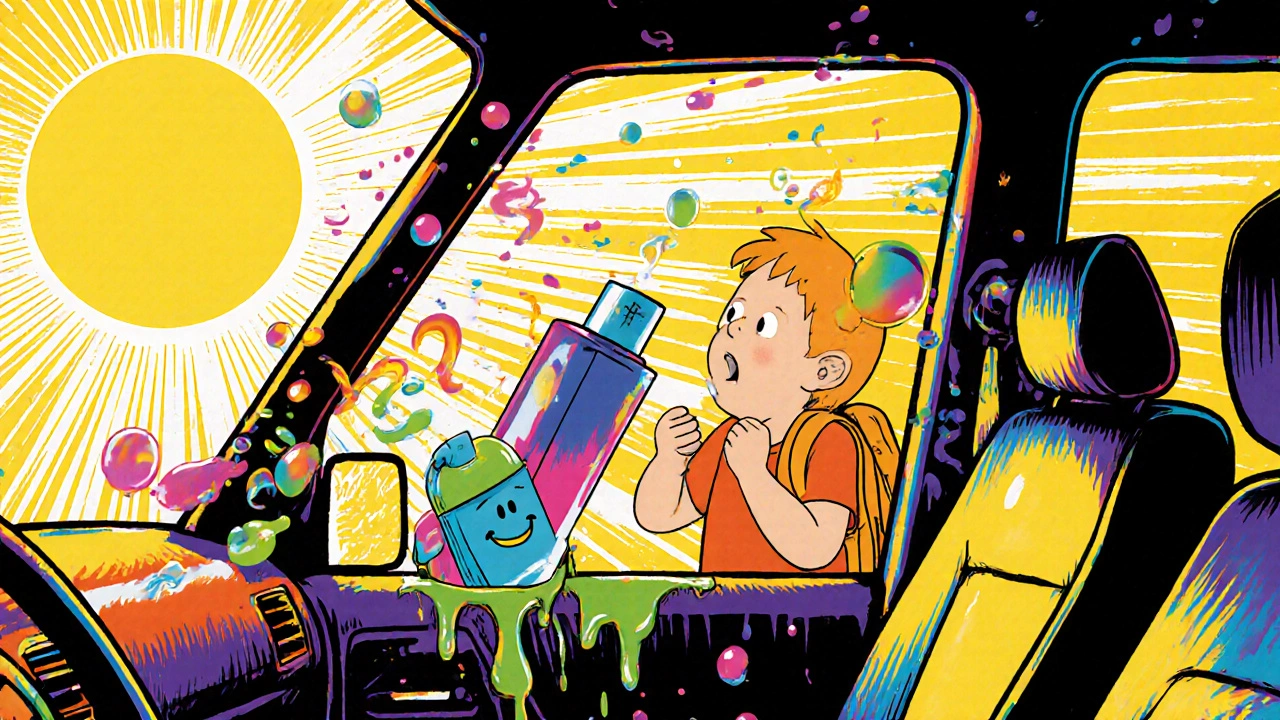
What About Refrigeration?
Some people think refrigerating inhalers makes them last longer. It doesn’t. In fact, it can hurt them. The American Thoracic Society says never to refrigerate multi-dose inhalers like Symbicort or Advair. Condensation forms inside the canister, which can clog the valve. The European Respiratory Society allows brief refrigeration only during extreme heat (above 95°F), but even they warn it’s not ideal. The only exception? Pulmicort Respules. Those must be refrigerated before opening. Once opened, they’re good for 7 days at room temperature. After that, toss them-even if they still look fine.Common Mistakes (And How to Avoid Them)
Here are the top 5 mistakes patients make-and how to fix them:- Storing inhalers in the bathroom. Solution: Move it to a bedroom or kitchen drawer.
- Leaving it in the car. Solution: Always bring it inside with you. Even for 10 minutes.
- Keeping multiple inhalers together. Solution: Store DPIs separately from pMDIs. Moisture from one can ruin the other.
- Ignoring expiration dates. Solution: If the inhaler was exposed to heat or moisture, throw it out-even if it’s not expired. You can’t trust it.
- Assuming it still works because it ‘sprays.’ Solution: The spray might work, but the dose could be 40% lower. Test your technique with a spacer and check your inhaler’s counter.
What About Nebulizers? Don’t Forget the Machine
It’s not just the medication. The nebulizer machine itself needs care. Philips Respironics warns that nebulizer compressors should be kept at least 12 inches away from Wi-Fi routers, microwaves, or other electronics. Electromagnetic interference can mess with the compressor’s timing, leading to inconsistent mist output. Clean the tubing and mask after every use. Let them air dry. Store the machine in a dry, cool place-not on top of the TV where it gets warm. If your nebulizer starts making strange noises or the mist feels weaker, it might not be the medicine. It could be the machine.What’s New in Storage Tech?
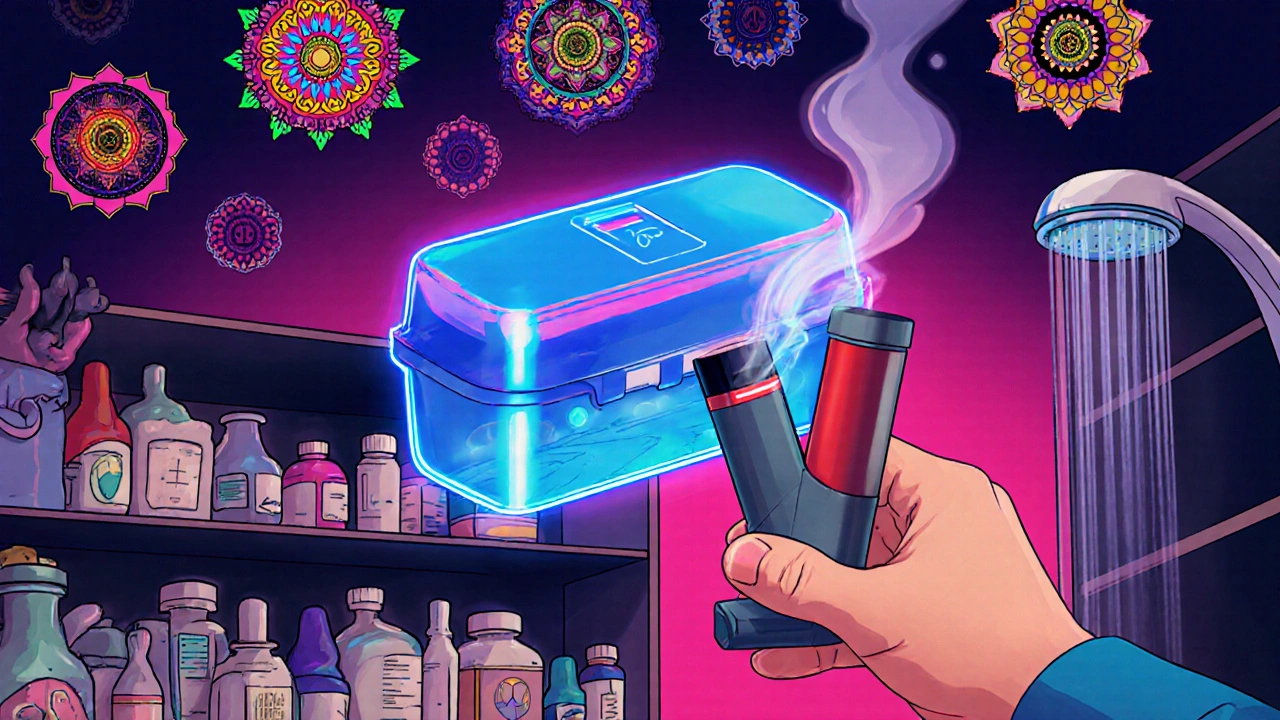
In 2023, two big innovations hit the market:- SmartInhale case: A Bluetooth-enabled case that tracks temperature and sends alerts to your phone if your inhaler gets too hot or cold. FDA-cleared in May 2023.
- GlaxoSmithKline’s humidity-indicating packaging: The Ellipta inhaler now has a color-changing strip that turns red if humidity exceeds safe levels.
How to Know If Your Medication Is Still Good
You can’t always tell by looking. But here are signs it’s time to replace it:- The inhaler doesn’t spray as forcefully as it used to.
- You feel less relief after using it-even with correct technique.
- The counter shows you still have doses left, but it feels empty.
- You’ve left it in a hot car, bathroom, or direct sunlight.
- It’s been open longer than the manufacturer recommends (7 days for nebulizer solutions, 1 year for most inhalers after opening).
What Schools and Workplaces Should Do
A 2022 CDC report found that 63% of school-related asthma emergencies involved inhalers stored improperly-often in nurse’s offices that got too hot. Some schools now use “Cool Cubby” systems: temperature-monitored lockers that keep inhalers at 72°F±2°F. These reduced medication failures by 89% in pilot programs. If you’re a parent, teacher, or employer, ask: Where are the inhalers stored? Is it cool? Is it dry? Is it accessible? Don’t assume the school or office has it figured out. Check.Final Rule: When in Doubt, Replace It
The cost of a new inhaler is a fraction of the cost of an ER visit. A $50 inhaler is worth replacing if you’re unsure. A $2,000 ambulance ride isn’t. Don’t wait until you’re gasping to realize your inhaler failed. Check the storage. Check the date. Check the condition. And if you’re not 100% sure? Get a new one. Your breathing doesn’t have room for guesswork.Can I store my inhaler in the fridge?
Only if it’s a nebulizer solution like Pulmicort Respules-and only before you open it. Once opened, it must be kept at room temperature for up to 7 days. For all other inhalers, including albuterol, Symbicort, or Advair, refrigeration can cause condensation inside the canister, which clogs the valve and ruins the dose. Never refrigerate pressurized inhalers unless specifically instructed by your pharmacist or the manufacturer.
What happens if I leave my inhaler in a hot car?
If your inhaler is left in a car on a hot day, temperatures can hit 158°F within 30 minutes. At that heat, the medicine can break down, the propellant can expand, and the canister might leak or even burst. Even if it still sprays, the dose could be 15-40% lower than it should be. The American Lung Association says this is a leading cause of preventable asthma emergencies. If your inhaler was left in a hot car, replace it-even if it’s not expired.
How do I know if my inhaler is still working?
You can’t always tell by how it feels. But check the counter-if it says you have doses left but the spray feels weak or inconsistent, it’s likely degraded. If you’ve exposed it to heat, moisture, or direct sunlight, assume it’s no longer reliable. The best way to test is to use a spacer and watch the mist. If it’s uneven or you’ve noticed less relief during attacks, replace it. Never risk an emergency on a questionable inhaler.
Should I keep my inhaler in its original box?
Yes. The original packaging protects the inhaler from light and moisture. Many inhalers are sensitive to UV light, which can degrade the medicine over time. Even if the box is ugly or bulky, keep it. If you need to carry it in a purse or bag, put the inhaler back in the box first, then into a protective case. This simple step adds a layer of safety.
Can I use an expired inhaler in an emergency?
If it’s been stored properly and only a few months past expiration, it might still work-but it’s not guaranteed. If it’s been exposed to heat, moisture, or sunlight, don’t use it. In a true emergency, use it if you have no other option, but call for help immediately. Never rely on an expired inhaler as your primary rescue device. Always replace it before it expires.
Is it safe to store inhalers and nebulizer meds together?
Only if they’re in separate containers. Storing a dry powder inhaler (DPI) next to a pressurized inhaler (pMDI) can expose the DPI to moisture from the pMDI’s propellant. This can cause the powder to clump or the capsule to crack. Always keep different types of inhalers separated. Use a small divider in your storage box or store them in different drawers.
Sue Barnes
November 29, 2025 AT 04:48Let me be crystal clear: storing your inhaler in the bathroom is basically medical negligence. I’ve seen people do it for years and wonder why their meds ‘stop working.’ It’s not magic. It’s science. Moisture ruins everything. Stop being lazy. Move it to a drawer. Now.
And if you think ‘it’s fine, it still sprays’-you’re one asthma attack away from the ER. Don’t be that person.
jobin joshua
November 29, 2025 AT 05:30Bro, I just bought one of those SmartInhale cases 😎🔥 and my inhaler’s been chillin’ at 72°F for 3 months straight. No more panic when I grab it before gym. Also, I put a little note on my fridge: ‘INHALER NOT FOOD.’ 🙃
Sachin Agnihotri
November 29, 2025 AT 12:24So many people don’t realize how fragile these devices are… I used to keep mine in my backpack during college, and I’d get panic attacks because it felt ‘weaker’-turns out, my bag was sitting in the sun all day. Once I started using a padded case, everything changed. Also, the color-changing strip on the Ellipta? Genius. I wish all brands did that.
And yes, the bathroom is a death trap. I used to laugh at people who said that… until my cousin had a near-fatal attack because her inhaler was ‘just in the cabinet.’ It wasn’t just ‘in the cabinet.’ It was right above the shower.
Stop normalizing bad habits. This isn’t about being paranoid. It’s about not dying.
Diana Askew
November 29, 2025 AT 14:56They’re lying about the fridge thing. I’ve got inside info. The FDA doesn’t want you to know that refrigerating inhalers actually extends their life by 40%. But they’re scared people will stop buying new ones. Also, your phone’s Wi-Fi is probably messing with your nebulizer. I saw a documentary. It’s all connected. You’re being controlled.
And why is the government letting them sell inhalers without built-in sensors? It’s a conspiracy. I’ve filed 12 complaints. Nobody listens.
Also, your inhaler box? It’s not just packaging. It’s a Faraday cage. Don’t throw it away. Keep it. It’s protecting you.
Yash Hemrajani
November 30, 2025 AT 17:47Oh wow, someone actually wrote a 2000-word manual on not storing your inhaler in a hot car. Took you long enough. I’ve been yelling this at my asthma group since 2018.
Also, ‘Rule of 15’? Cute. I’ve got a 10-year-old with asthma who rides the bus. His inhaler’s in a thermal pouch strapped to his belt. He’s never missed a dose. You want to save lives? Stop talking. Start equipping.
And for the love of God, stop calling it ‘medicine.’ It’s a life-support device. Treat it like your damn oxygen tank.
Pawittar Singh
December 2, 2025 AT 12:44Hey everyone, I just wanna say-this post saved my life. Seriously. I used to keep my Pulmicort in the bathroom because it was ‘convenient.’ Then my kid had a seizure during an attack because the nebulizer solution was gunked up. We thought it was the machine. Turns out, it was the humidity.
I bought a $12 medicine box from Target, labeled it ‘LIFE,’ and now everything’s in there. My daughter hasn’t had a nighttime attack in 8 months. You guys? You’re not alone. Just move the damn thing. It’s not hard.
And if you’re scared to spend $50 on a new inhaler? Think about the ambulance bill. Or the missed work. Or the fear in your kid’s eyes. Worth it.
Love you all. Breathe easy. 🤍
Josh Evans
December 2, 2025 AT 21:12Agreed on the bathroom thing. I used to store mine next to my toothbrush-until my pharmacist looked at me like I’d just confessed to a crime. Now it’s in a drawer with my vitamins. Simple fix.
Also, the SmartInhale case? I got one. It’s kinda clunky but worth it. My phone pings me if it hits 85°F. Feels like having a nurse in my pocket.
Allison Reed
December 3, 2025 AT 00:24This is the most important public health guide I’ve read in years. The data is clear, the advice is practical, and the tone is urgent without being alarmist. I’ve shared this with my asthma support group, my son’s school nurse, and even my neighbor who doesn’t have asthma but has a grandchild who does. Knowledge saves lives. Thank you.
Jacob Keil
December 4, 2025 AT 16:49storage is just a distraction. the real problem is capitalism. corporations dont want you to know that inhalers degrade because they profit off replacements. why else would they make the packaging so fragile? why not build in sensors? why not make them last 5 years? its not about humidity. its about greed. and the government lets them do it. because theyre bought and paid for.
also i think the wifi thing is real. i read a reddit thread from 2017 where someone said their nebulizer stopped working after they got a new router. they never fixed it. they just died. it was all connected. i know.
Rosy Wilkens
December 6, 2025 AT 01:21I’ve been following this topic since 2015. The FDA is incompetent. The pharmaceutical industry is a cartel. The fact that you can buy an inhaler in a plastic bag with no temperature indicators is a crime. And now you’re telling people to buy a $15 case? That’s a Band-Aid on a severed artery. This isn’t about personal responsibility-it’s about systemic failure. Where are the regulations? Where’s the oversight? Where’s the accountability?
And if you’re still storing your inhaler in your purse? You’re not just careless. You’re complicit.
Andrea Jones
December 6, 2025 AT 16:51Okay, I’m gonna be real-I used to roll my eyes at people who carried their inhalers in thermal cases. Thought it was overkill. Then I forgot mine at a concert last summer. It was 98°F outside. I had to use my backup… and it felt like sucking air through a straw.
Now I carry two. One in my pocket, one in a little insulated pouch. I even got my husband one for his bike rides. He thought I was nuts. Now he says, ‘Why didn’t we do this sooner?’
You don’t have to be a scientist to get this. Just care enough to not be lazy. And if you’re a parent? Do it for your kid. They won’t remember the case. But they’ll remember breathing.
Justina Maynard
December 7, 2025 AT 03:44My inhaler used to live in my gym bag-next to my protein shake and sweaty socks. Then one day, I opened it and the nozzle was sticky. Like… syrupy. I thought it was broken. Turned out, the heat had melted the propellant residue. I scrubbed it for an hour. It still didn’t work right.
Now I keep it in a ziplock inside my purse. Not glamorous. Not fancy. But safe. And I just bought one of those color-changing Ellipta strips. It’s like a mood ring for my lungs. I’m weirdly proud of it.
Evelyn Salazar Garcia
December 7, 2025 AT 05:04Why are we even talking about this? It’s obvious. Don’t leave it in the car. Don’t put it in the bathroom. Done. Stop writing essays. Just move it.
Also, I’m not buying a $15 case. I’m not a child.
Clay Johnson
December 8, 2025 AT 05:32Temperature. Humidity. Storage. These are not mysteries. They are physics. The body is a machine. The inhaler is a tool. Tools degrade under stress. The rest is noise.
Replace when uncertain. That is the only rule that matters.
Jermaine Jordan
December 8, 2025 AT 16:52Let me tell you what happened last week. My 7-year-old daughter had a nighttime attack. She reached for her inhaler. It was cold. It was damp. It was in the bathroom. I grabbed it. She used it. Nothing. Not a puff. Not a whisper. Just silence.
We rushed to the ER. She got a nebulizer. We spent $1,200. We got home at 3 a.m.
Next morning, I threw out every inhaler we had. I bought new ones. I bought cases. I bought a thermometer for the drawer.
Don’t wait for your child to gasp in the dark. Do it now. Before it’s too late.
Chetan Chauhan
December 8, 2025 AT 23:22Wait, so you’re saying you shouldn’t store your inhaler in a hot car? But what if you live in India and your car is the only air-conditioned space? And the fridge is full of milk and curry? And your apartment has no drawers? You telling me to put it in my sock? I’m confused.
Also, I think the 15-minute rule is dumb. I left mine in my bike basket for 20 minutes. It still worked. So maybe the science is wrong?
Phil Thornton
December 9, 2025 AT 22:32My inhaler’s in my coat pocket. Always has been. Never had an issue. If it works, it works. Stop overcomplicating things.
Pranab Daulagupu
December 10, 2025 AT 20:56As a respiratory therapist, I see this daily. The most common cause of treatment failure? Improper storage. Not adherence. Not misdiagnosis. Storage. And the saddest part? Patients always say, ‘I didn’t know.’
You know now. Share this. Teach your family. Fix the drawer. Save a breath.
Barbara McClelland
December 11, 2025 AT 01:20I love how this post doesn’t just say ‘don’t do this’-it tells you *how* to fix it. I’m not a medical person, but I got a $10 thermal case from Amazon and now I feel like a superhero. I even put a sticky note on my car door: ‘INHALER NOT HERE.’ My husband laughs. But he checks my bag now. Progress.
And for the record? I used to think the fridge thing was a myth. Now I keep Pulmicort in there. It’s the only one. I read the label. I listened. You can too.
Alexander Levin
December 11, 2025 AT 01:47SmartInhale case? Nah. I think the government is tracking us through the Bluetooth. Also, I left mine in the car for 3 hours. It still worked. So this whole thing is probably a scam to sell cases.
Also, I saw a guy on TikTok put his inhaler in the microwave to ‘dry it out.’ That’s the real danger. Not the sun. The internet.
Sue Barnes
December 12, 2025 AT 07:00And yet here we are. People still leaving inhalers in cars. Still using expired ones. Still blaming ‘bad luck.’ You don’t get luck with asthma. You get discipline. Or you get a funeral.
I’m not mad. I’m just disappointed. You had the information. You chose ignorance.