How to Get Clear Medication Instructions When You're Confused
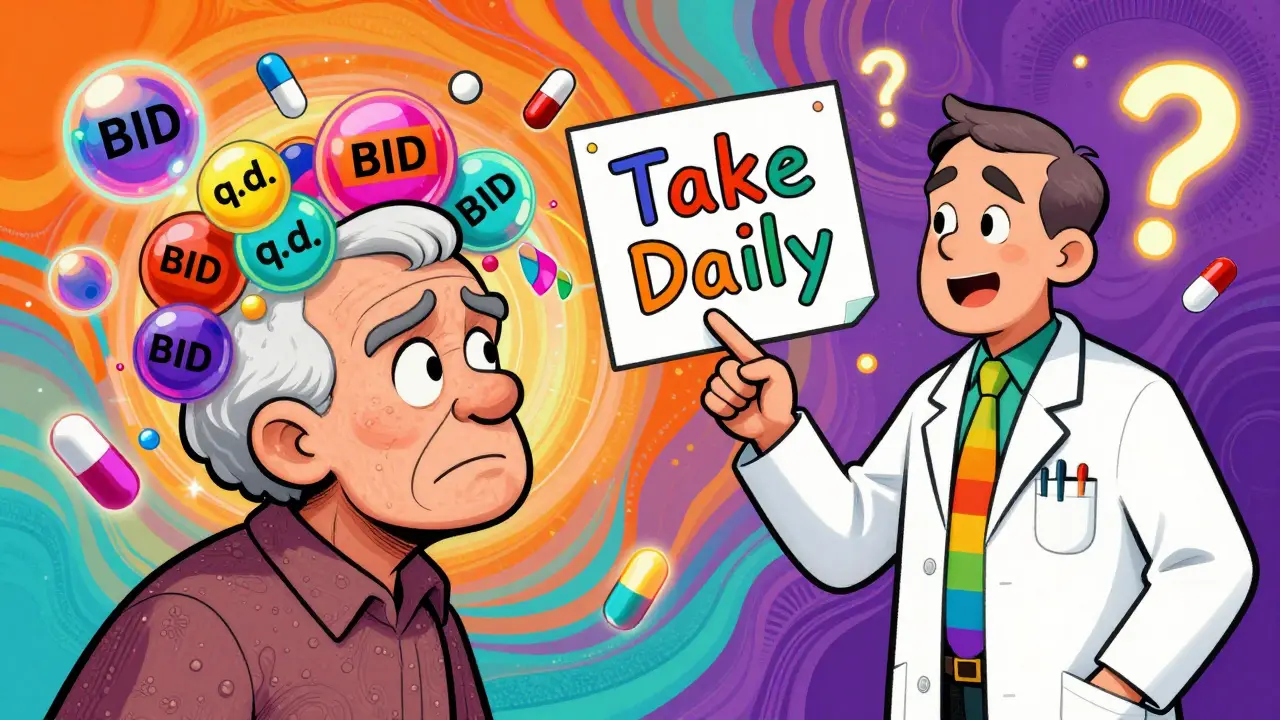
Ever stared at a prescription label and thought, Wait, what does this actually mean? You’re not alone. Millions of people in the U.S. take three or more medications every day, and unclear instructions are one of the most common reasons people mess up their doses-sometimes with dangerous results.
The problem isn’t always bad handwriting or typos. It’s often hidden in tiny details: abbreviations like "q.d." instead of "daily," doses written as "5 mg/kg/d," or instructions that say "take as needed" without explaining what "needed" actually means. These aren’t just annoyances. According to the Institute for Safe Medication Practices, unclear medication directions contribute to over 1.5 million preventable injuries every year in the U.S.
What Makes Medication Instructions Confusing?
Medication instructions can be confusing for several reasons, and most of them are avoidable. The FDA and other safety groups have been pushing for clearer labeling for decades, but inconsistencies still slip through.
One big issue is abbreviations. "Q.d." might look like a harmless shortcut, but it can be mistaken for "QID" (four times a day). The same goes for "IN," which could mean intranasal-or be confused with "IV" (intravenous) or "IM" (intramuscular). That’s why experts now insist on writing out full terms: "daily," "intranasal," "twice a day." No shortcuts.
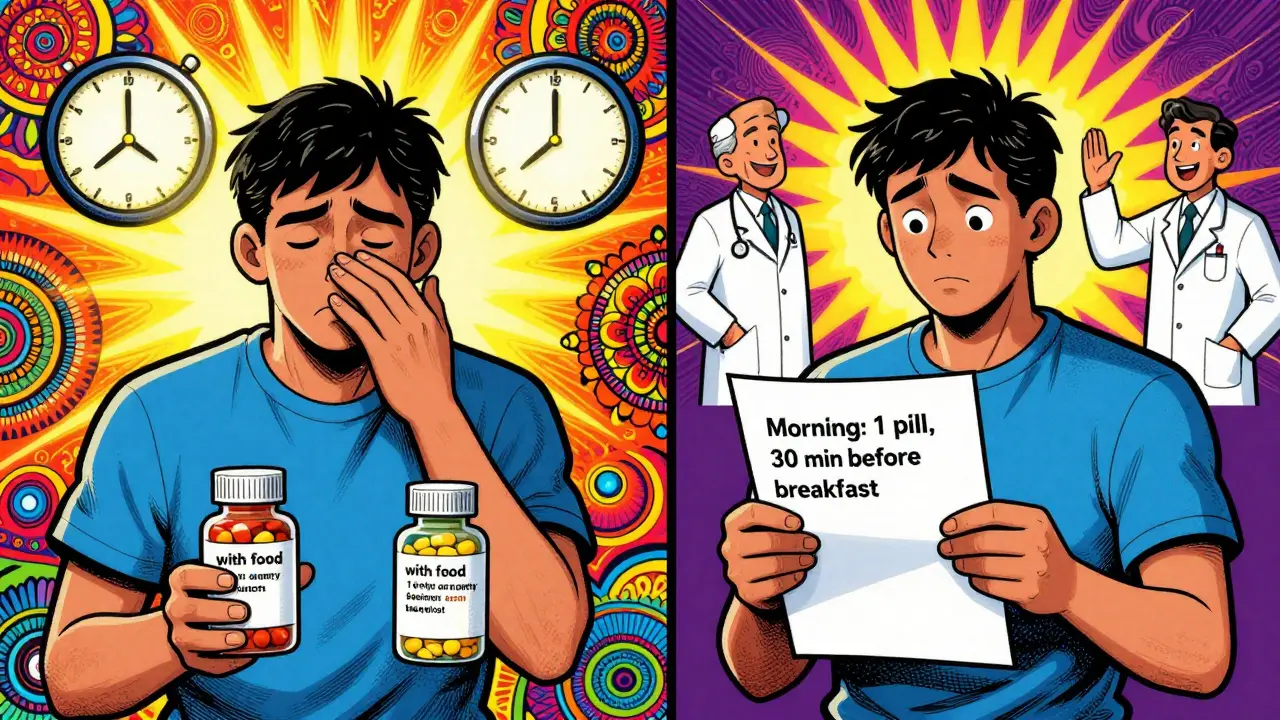
Another problem is inconsistent instructions from different manufacturers. Take a common drug like metformin. One brand might say "take with food," while another says "take 30 minutes before meals." Neither is wrong, but if you switch brands without checking, you might get side effects-or worse, reduced effectiveness. The National Institutes of Health (NIH) specifically warns that these differences can affect how well a drug works, especially for high-risk medications like blood thinners or epilepsy drugs.
And then there’s "as needed." That phrase sounds simple, but it’s one of the most dangerous. "Take one tablet as needed for pain" doesn’t tell you if you can take it every hour, every four hours, or if there’s a daily limit. A pharmacist at Massachusetts General Hospital says patients often assume "as needed" means "whenever I feel like it." That’s not safe. You need to know the maximum daily dose and how far apart doses should be spaced.
When Do You Need to Ask for Clarification?
You don’t need to wait until you’ve made a mistake to ask for help. If any part of your medication instructions feels vague, unclear, or contradictory, ask right away. Here are five clear signs you need to speak up:
- You’re not sure what time of day to take the medication.
- The label says "take with food," but your doctor said "on an empty stomach."
- You’ve switched brands and the instructions changed.
- You’re supposed to take it "twice daily," but you don’t know if that means morning and night-or 8 a.m. and 8 p.m.
- You’re told to take it "as needed," but no one told you how much is too much.
For example, cholesterol-lowering drugs like statins are usually taken at bedtime because your liver makes the most cholesterol overnight. If you take it in the morning, you might not get the full benefit. But if you’re not told that, you won’t know.
Same goes for antibiotics. Some need to be taken every 8 hours to keep a steady level in your blood. Others work best on an empty stomach. Mixing those up can make the treatment fail-or lead to antibiotic resistance.
How to Get Clear Answers from Your Pharmacist or Doctor
Asking for clarification isn’t being difficult. It’s being smart. And you don’t need to sound like a medical expert to do it right.
Here’s what to say:
- "Can you explain how to take this? I want to make sure I’m doing it right."
- "The label says ‘take as needed.’ Can you tell me exactly when and how often?"
- "I used to take this drug from Company A, and now I’m getting it from Company B. The instructions are different. Which one should I follow?"
- "Is there a maximum number of doses I can take in a day?"
- "Should I take this with food, or on an empty stomach?"
Don’t be shy. Pharmacists are trained to explain this stuff. In fact, the National Coordinating Council for Medication Error Prevention and Reporting (NCC MERP) says it’s their job to make sure you understand the name, purpose, and effects of every medication you’re given.
For complex regimens-like taking Depakote 500 mg "one tab po q am for 1 week, then BID"-ask for it to be written out in plain language: "Take one pill every morning for one week. After that, take one pill in the morning and one in the evening."
What’s the Difference Between a Medication Guide and Regular Instructions?
Not every drug comes with a Medication Guide. The FDA only requires them for about 200 high-risk medications-like isotretinoin (Accutane), opioids, oral contraceptives, and certain antidepressants. These are printed handouts you get when you pick up the prescription, and they include serious risks, warning signs, and what to do in an emergency.
But here’s the catch: Medication Guides are only required in outpatient settings like pharmacies. In hospitals or nursing homes, staff are supposed to explain the medication verbally, but they don’t have to hand you a printed guide. That means if you’re discharged from the hospital, you might get a prescription without a guide-and no one tells you the risks.
Always ask: "Does this drug come with a Medication Guide?" If they say no, ask anyway. Some pharmacies keep extra copies on hand.
What to Do If Instructions Conflict Between Brands
Generic drugs are supposed to be identical to brand-name versions. But when it comes to instructions? Not always.
For example, one manufacturer of levothyroxine (a thyroid drug) says to take it on an empty stomach, 30 to 60 minutes before breakfast. Another says "take at least 4 hours before or after other medications." Both are technically correct, but they’re not the same.
The NIH recommends that if you notice differences like this, you should talk to your doctor. Don’t guess. Don’t assume. Ask: "Which version of the instructions should I follow? Is one more effective or safer for me?"
Some doctors use electronic systems that pull in instructions from all manufacturers of a drug. But not all do. If your pharmacy or doctor doesn’t mention the differences, bring it up. It’s your health on the line.
Tools and Tips to Stay on Track
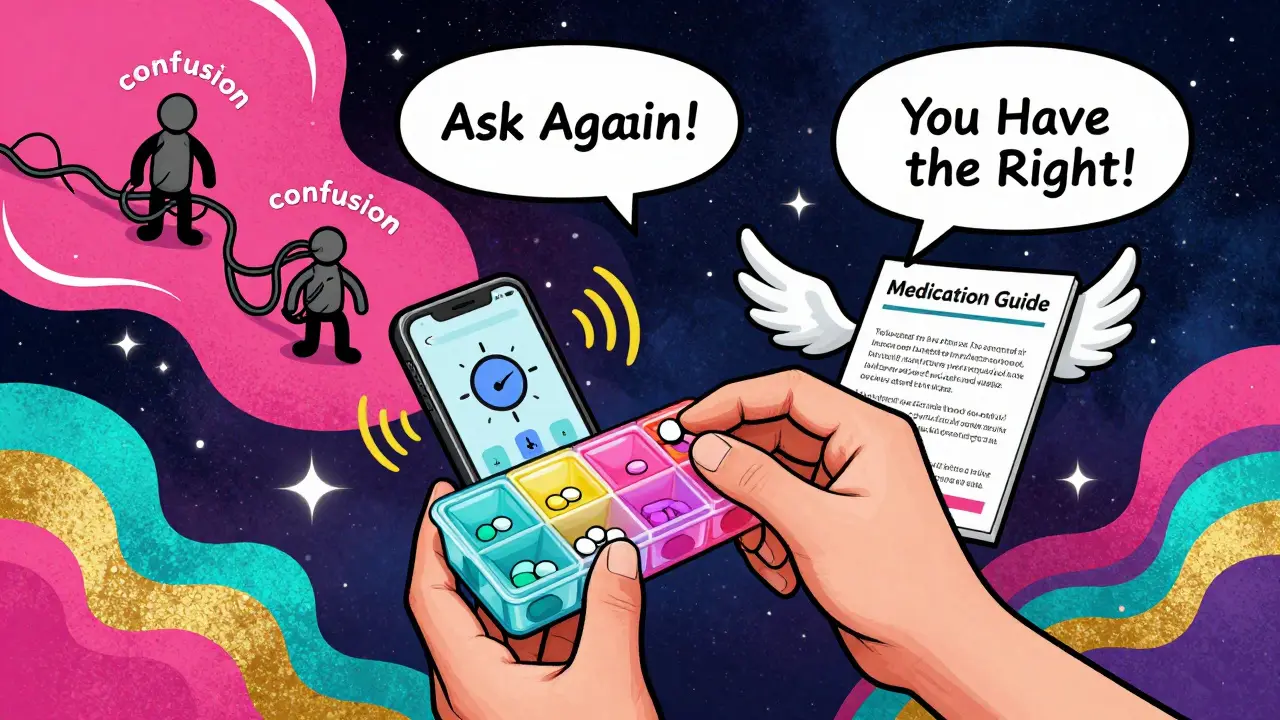
Even with perfect instructions, remembering when to take your meds is hard. The CDC recommends using tools to help:
- Set phone alarms for each dose.
- Use a pill organizer with labeled compartments.
- Keep a written log of what you took and when.
- Ask a family member to remind you if you’re forgetful.
For medications that need precise timing-like insulin or heart drugs-use a timer app that alerts you exactly 12 hours apart. If you’re supposed to take something twice daily, 8 a.m. and 8 p.m. is better than 7 a.m. and 9 p.m.
And always double-check what you pick up at the pharmacy against your prescription. The Montana Department of Public Health says this step is critical. If the pill looks different or the label says something new, don’t take it until you’ve called your doctor or pharmacist.
Why This Matters More Than You Think
Medication errors aren’t just about forgetting a pill. They’re about taking the wrong dose, at the wrong time, for the wrong reason. That’s how people end up in the ER-or worse.
One study found that patients who asked for clarification about their meds had 40% fewer adverse events than those who didn’t. That’s not a small number. It’s life-changing.
Clear instructions aren’t just a nice-to-have. They’re a safety requirement. And you have the right to understand exactly what you’re taking-and why.
If you’re ever unsure-ask. Again. And again. Until you’re 100% clear. Your body will thank you.
What should I do if my medication instructions change when I refill my prescription?
If the instructions on your new refill look different from your last one-even if it’s the same drug-don’t assume it’s a mistake. Call your pharmacy or doctor right away. The manufacturer might have changed the label, or your doctor might have updated your dose. Never switch without confirming. Write down both versions and compare them side by side.
Can I ask my pharmacist to write out my medication instructions in plain language?
Yes, absolutely. Pharmacists are trained to help patients understand their prescriptions. Ask them to rewrite confusing abbreviations like "q.d." as "daily," or "BID" as "twice a day." You can also ask them to explain timing, food interactions, and side effects in simple terms. Many pharmacies have patient education sheets available for common drugs.
Are generic drugs always the same as brand-name drugs in how they’re taken?
The active ingredient is the same, but instructions can vary between manufacturers. One brand might say to take it with food, another says on an empty stomach. These differences can affect how well the drug works or whether you get side effects. Always check the label of your specific brand and ask your doctor or pharmacist if you’re switching between generics.
What if I’m taking multiple medications and the instructions conflict?
Conflicting instructions are common when you’re on several drugs. For example, one might say "take with food," another says "take 2 hours before eating." Talk to your pharmacist or doctor and ask them to create a simple schedule that works for all your meds. They can help you space them out safely and avoid interactions.
How do I know if a medication guide is required for my drug?
Medication Guides are required only for about 200 high-risk drugs approved by the FDA, such as opioids, isotretinoin, and certain blood thinners. If you’re unsure, ask your pharmacist: "Does this drug come with a Medication Guide?" If they say no, request one anyway-some pharmacies keep extra copies. If you’re prescribed a new drug, always ask if there’s a guide and if you can get a copy.
Aliza Efraimov
December 28, 2025 AT 23:52I used to skip my blood pressure meds because the label said 'take as needed' and I thought 'needed' meant 'when I feel dizzy.' Turns out, it meant 'take every day, even if you feel fine.' I almost ended up in the ER. Don't be like me. Ask. Ask again. And then ask your pharmacist to write it in crayon if you have to.
Pharmacists aren't just people who hand out pills-they're your secret health superheroes. I once had one sit with me for 20 minutes to draw me a schedule with emojis. Yes, emojis. I now have a little heart next to my insulin and a skull for my warfarin. It works.
If you're confused, you're not dumb. The system is broken. And if they act annoyed when you ask? That's their problem, not yours.
Nisha Marwaha
December 30, 2025 AT 22:18From a clinical pharmacology standpoint, the ambiguity in pharmaceutical labeling stems from a lack of standardization in the RxNorm taxonomy and inconsistent application of the USP Medication Labeling Guidelines. Abbreviations like 'q.d.' and 'BID' are deprecated by the Institute of Medicine due to their high error potential, yet they persist due to legacy EHR integrations and vendor inertia.
Moreover, the FDA's Medication Guide requirement is contingent upon Risk Evaluation and Mitigation Strategies (REMS), which are only triggered for high-risk agents with a narrow therapeutic index-hence the variance in guidance between generic manufacturers due to differing bioequivalence thresholds and excipient profiles.
Patients must be empowered to request a Medication Therapy Management (MTM) session, which is covered under Medicare Part D for polypharmacy patients. This is not optional-it's a safety imperative.
Tamar Dunlop
January 1, 2026 AT 00:03As someone who moved from Canada to the U.S. and had to navigate a completely different system, I can say with absolute certainty: no one should ever feel ashamed to ask for clarification. In Canada, pharmacists routinely sit down with patients, review every medication, and even call the doctor if something doesn’t make sense. Here? You’re lucky if they hand you the bottle without sighing.
I once had to explain to a pharmacist that 'take as needed' meant nothing to me unless I knew the maximum daily dose and the minimum time between doses. She looked at me like I was speaking French. I spoke French. She still didn’t get it.
Don’t accept 'that’s just how it is.' You have a right to be safe. And if they won’t help? Find another pharmacy. Your life is worth more than their indifference.
David Chase
January 2, 2026 AT 03:59THEY GIVE YOU A PRESCRIPTION AND EXPECT YOU TO BE A MEDICAL EXPERT??!!??
MY GRANDMA TOOK HER ANTICOAGULANT WITH GRAPEFRUIT JUICE BECAUSE THE LABEL SAID ‘TAKE WITH FOOD’ AND SHE THOUGHT JUICE WAS FOOD 😭
WE NEED A NATIONAL LAW THAT FORCES PHARMACISTS TO EXPLAIN EVERYTHING IN SIMPLE ENGLISH OR GET FIRED. LIKE. NOW. 🇺🇸🔥 #MedicationSafety #StopTheNonsense
Kevin Lopez
January 2, 2026 AT 16:03Abbreviations are a known hazard. Q.d. = QID. BID = twice daily. TID = three times. QHS = bedtime. These are not ambiguous-they’re standardized. If you can’t read them, you’re not the victim. You’re uneducated.
Pharmacists aren’t babysitters. If you need someone to spell out 'take one pill twice a day,' maybe you shouldn’t be managing your own meds.
Use a pill organizer. Set alarms. Read the guide. Or get a caregiver. Simple.
Duncan Careless
January 3, 2026 AT 06:36I’ve worked in pharmacy for 18 years, and honestly? The most common issue isn’t the labels-it’s the silence. Patients are terrified to ask questions. They think they’ll sound stupid. Or they assume the doctor already explained it.
But here’s the thing: if you’re unsure, you haven’t been explained it.
I always tell patients: 'If you’re wondering, someone else is too. Ask.' No judgment. No rush. We’re here to help.
And yes, we can write it out. In big letters. With arrows. I’ve done it. You’re not a burden. You’re a person.
Samar Khan
January 4, 2026 AT 21:45My cousin took 4 doses of Tylenol in 2 hours because the bottle said 'as needed' and she was 'needing' it real bad 😭
Then she blamed the pharmacy. Bro. It’s not the label’s fault you have no common sense 🤦♀️
Maybe stop taking meds like they’re candy? 🤡
Russell Thomas
January 6, 2026 AT 09:50Oh wow. A whole article about people being too lazy to read the damn label.
Let me guess-you also can’t tell the difference between 'before meals' and 'with meals'?
Maybe the problem isn’t the instructions. Maybe it’s that people think medicine is a magic potion that works no matter how you take it.
Here’s a radical idea: read the damn thing. Or hire someone to read it for you. Or stop taking pills if you can’t handle it.
Stop treating your body like a toddler that needs a bedtime story.
Nicole K.
January 7, 2026 AT 18:38This is why we need to stop giving meds to people who can’t read. Seriously.
If you can’t understand 'take once a day,' you shouldn’t be allowed to have a prescription.
My uncle died because he took his heart pill with grapefruit juice. He didn’t ask. He didn’t read. He just guessed.
People like this are why healthcare costs are so high.
Stop blaming the system. Start taking responsibility.
And if you need someone to hold your hand? Get a family member to help. Or don’t take the pill. Either way, don’t put everyone else at risk.