How to Create a Medication Plan Before Conception for Safety

Planning for pregnancy isn’t just about taking prenatal vitamins or tracking ovulation. If you’re on any medication - even over-the-counter pills, supplements, or herbal remedies - your body needs time to adjust before conception. Why? Because the most critical window for fetal development happens before you even know you’re pregnant. Major organs like the heart, brain, and limbs form between weeks 3 and 8. By the time a home pregnancy test turns positive, that window is already closing. That’s why a preconception medication plan isn’t optional - it’s essential.
Why Timing Matters More Than You Think
Most women don’t realize they’re pregnant until after week 4 or 5. But by then, the embryo has already started forming its spine, eyes, and heart. If you’re taking a drug that can cross the placenta - like certain seizure meds, acne treatments, or mood stabilizers - you could be exposing your baby to risks without ever knowing it. According to the American College of Obstetricians and Gynecologists (ACOG), nearly half of all pregnancies in the U.S. are unplanned. That means a lot of women are unknowingly taking medications during this sensitive period. The good news? You can prevent most of these risks if you plan ahead.What Medications Should You Review?
Don’t just think about prescription drugs. Your preconception checklist should include:- All prescription medications (even for chronic conditions like epilepsy, diabetes, or depression)
- Over-the-counter painkillers (like ibuprofen or naproxen)
- Supplements (vitamins, fish oil, herbal teas)
- Acne treatments (especially isotretinoin)
- Thyroid meds, blood thinners, and immunosuppressants
Folic Acid: The One Supplement Everyone Needs
Folic acid isn’t just for women with high-risk pregnancies. It’s for every woman of childbearing age. The World Health Organization recommends 400 mcg daily for all women aged 15-49. But if you have certain conditions - like epilepsy, diabetes, or a previous baby with a neural tube defect - you need more. ACOG and the Centre for Effective Practice suggest 4-5 mg daily in those cases. Why? Because folic acid reduces the risk of spina bifida and anencephaly by up to 70%. And since neural tube closure happens by week 6, waiting until you’re pregnant to start taking it is too late.High-Risk Medications to Avoid Before Conception
Some drugs are simply too dangerous to use during early pregnancy. Here are the big ones:- Valproic acid - linked to facial deformities, heart defects, and intellectual disability
- Lithium - increases risk of Ebstein’s anomaly (a heart defect)
- Topiramate - raises risk of cleft lip/palate
- Methotrexate - causes severe birth defects and miscarriage
- Isotretinoin (Accutane) - causes skull, eye, and heart defects; requires 1 month of contraception after stopping
- Cyclophosphamide - can permanently damage ovaries

Thyroid and Blood Sugar: Hidden Risks
Many women don’t realize that uncontrolled thyroid disease or diabetes can be just as risky as dangerous medications. If your TSH (thyroid-stimulating hormone) level is above 2.5 mIU/L before pregnancy, your risk of miscarriage increases by 60%. That’s why doctors recommend adjusting your levothyroxine dose before conception - not after. Same goes for blood sugar. Women with type 1 or type 2 diabetes need to get their HbA1c below 6.5% before trying to get pregnant. High glucose levels during early pregnancy can cause heart defects, brain abnormalities, and even stillbirth.What About Mental Health Meds?
Stopping antidepressants or anti-anxiety meds might sound scary - and sometimes it is. But untreated depression during pregnancy carries its own risks: preterm birth, low birth weight, and postpartum depression. The key is choosing the right drug. SSRIs like sertraline and citalopram are considered low-risk. Avoid paroxetine - it’s linked to a slightly higher risk of heart defects. Never stop your meds cold turkey. Work with your psychiatrist and OB-GYN to taper slowly and switch if needed.How Long Before Conception Should You Start?
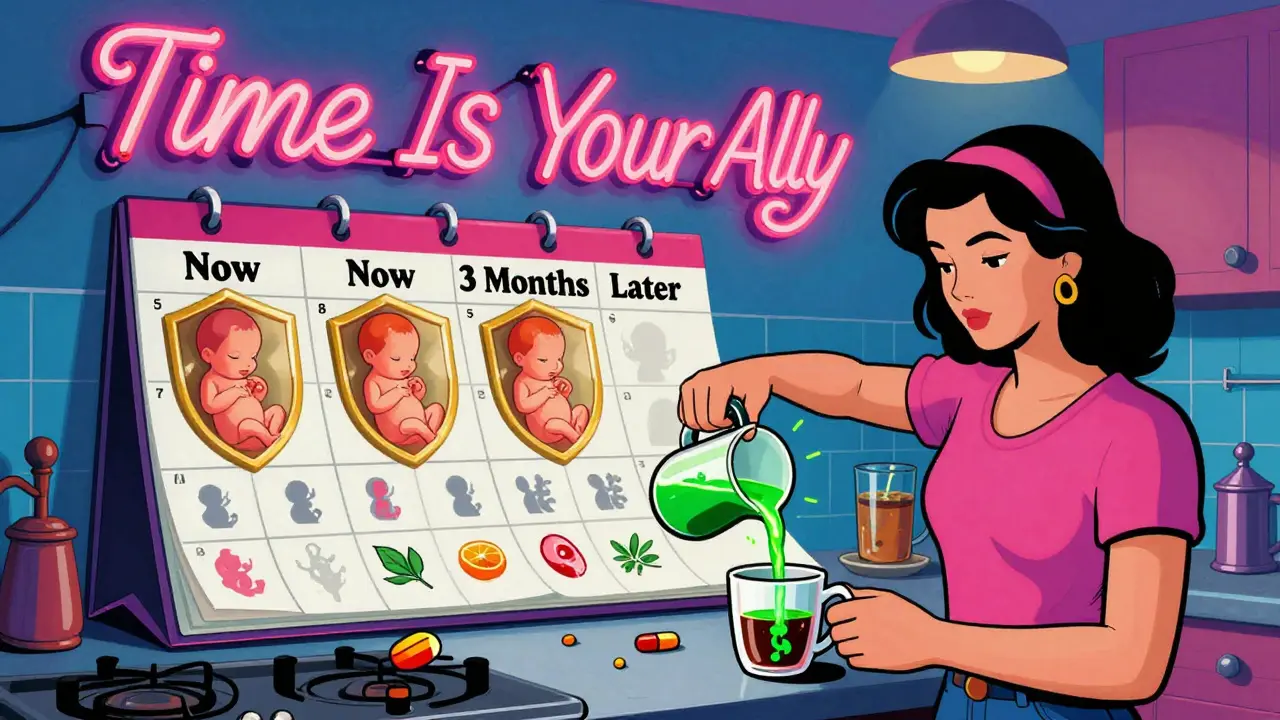
The gold standard? Start at least 3 to 6 months before you plan to conceive. Why? Because:- Some drugs need 3 months to fully clear (like methotrexate)
- Switching meds takes time to find the right dose
- Chronic conditions like lupus or asthma need stabilization
- Contraception may need to change - especially if you’re on seizure meds that reduce birth control effectiveness
Who Should You Talk To?
This isn’t a one-doctor job. You need a team:- Your OB-GYN - to coordinate everything
- Your specialist - neurologist, endocrinologist, psychiatrist, rheumatologist
- Your pharmacist - they know drug interactions better than anyone
What If You’re Already Pregnant?
If you just found out you’re pregnant and haven’t reviewed your meds yet - don’t panic. But don’t wait either. Call your doctor immediately. Some changes can still be made safely in early pregnancy. Folic acid can still help. Some meds can be switched. But the clock is ticking. The first 8 weeks are the most critical. Every day counts.Real-World Barriers - And How to Overcome Them
The system isn’t perfect. Only 38% of women with chronic conditions get proper preconception counseling. Why? Because doctors are busy. Insurance doesn’t always cover it. Women don’t know they need it. But here’s the thing: you don’t need to wait for the system to catch up. Take action now. Schedule a preconception visit. Bring your pill bottles. Ask your pharmacist to check for interactions. Use apps like Luma Health’s Preconception Navigator (FDA-approved since 2023) to scan your meds against teratogen databases.What’s Next?
The future of preconception care is personalized. The NIH’s PharmaTox study (launched in 2023) is testing how your genes and metabolism affect how drugs impact your baby. But right now, the best tool you have is time - and knowledge. Plan ahead. Review every pill. Talk to your team. Don’t wait for pregnancy to find you.Do I need to stop all my medications before getting pregnant?
No. Many medications are safe during pregnancy - including thyroid meds, certain antidepressants, and insulin. The goal isn’t to stop everything, but to replace risky ones with safer alternatives before conception. Always consult your doctor before making any changes.
How long before trying to conceive should I start planning?
At least 3 to 6 months. Some medications, like methotrexate or isotretinoin, require months to fully leave your system. This timeframe also allows your body to stabilize chronic conditions like diabetes or epilepsy before pregnancy.
Is folic acid really that important if I’m not planning to get pregnant?
Yes. Since nearly half of pregnancies are unplanned, the World Health Organization recommends 400 mcg of folic acid daily for all women aged 15-49. It’s a simple, low-cost way to prevent serious birth defects - even if you’re not actively trying.
Can I keep taking my anxiety or depression meds?
Many are safe. Sertraline and citalopram are considered low-risk. Paroxetine should be avoided due to a small heart defect risk. Never stop cold turkey - work with your psychiatrist to switch or adjust doses safely before conception.
What if I’m on birth control and want to get pregnant?
If you’re on hormonal birth control, you can stop it and try to conceive right away. But if you’re on seizure meds like carbamazepine, your birth control might not work well - ask your doctor about backup methods. Also, give yourself time to adjust your body before trying to conceive.
Anil bhardwaj
February 23, 2026 AT 01:39Man, I wish I knew this stuff before I got my wife pregnant. We were just winging it, thought vitamins were enough. Turns out her ibuprofen for migraines was a no-go. Docs never mentioned it. We got lucky, but holy crap, this is serious stuff.
Southern Indiana Paleontology Institute
February 23, 2026 AT 23:36So let me get this straight… you’re telling me my buddy who took Accutane 3 years ago and then popped a baby out? That’s a miracle. Or a lottery win. Either way, he’s lucky. Shoulda been banned from human reproduction.
lela izzani
February 24, 2026 AT 16:16This is so important. I’m a nurse and I see women come in after 8 weeks with a list of meds they’ve been on since puberty. They’re terrified. The good news? Most risks are preventable. The bad news? Nobody talks about it until it’s too late. Please, if you’re in your 20s-40s and not on birth control, talk to your pharmacist. Seriously.
Joanna Reyes
February 26, 2026 AT 10:00I spent six months working with my endocrinologist and psychiatrist to switch from lithium to lamotrigine and from paroxetine to sertraline. It was exhausting. I had panic attacks over dosage changes. I lost sleep. But I also had a healthy baby girl with no defects. If you’re on mood stabilizers or anticonvulsants, don’t assume your OB-GYN knows the nuances. Find a maternal-fetal medicine specialist. Bring your pill bottles. Take notes. This isn’t optional-it’s your baby’s first line of defense.
Nerina Devi
February 28, 2026 AT 04:28As someone from India who moved to the US, I can tell you this advice is universal. In my village, women take herbal teas for ‘cleaning’ before pregnancy. Some are safe. Some are toxic. No one checks. I started a small group in my community to help women review their meds with a pharmacist. We call it ‘Prep for Baby.’ It’s not glamorous, but it saves lives.
Dinesh Dawn
February 28, 2026 AT 10:23My cousin took Depakote for seizures and got pregnant without telling anyone. Baby had a cleft palate. She’s still blaming herself. This post? It should be on every OB’s waiting room wall. And in every pharmacy. And on TikTok. Someone needs to make a viral video about this.
Vanessa Drummond
March 1, 2026 AT 14:57Let’s be real. Most women are just told ‘take folic acid’ and left alone. Meanwhile, their 10-pill-a-day routine includes Tylenol PM, melatonin, and a ‘natural’ supplement that’s actually St. John’s Wort. That’s a drug interaction waiting to explode. Your doctor doesn’t have time. Your pharmacist? They’re overworked. YOU have to be the detective. Write it down. Google it. Ask twice.
Nick Hamby
March 1, 2026 AT 18:30The ethical weight of this issue is profound. We speak of reproductive autonomy, yet the biological reality is that a woman’s body becomes a vessel for another life before she even knows it. The autonomy to choose is real-but so is the responsibility to inform. Preconception care isn’t medical paternalism; it’s epistemic justice. Knowledge is the first act of love for the unborn. And if we value life, we must prioritize preparation over assumption.
kirti juneja
March 1, 2026 AT 18:50Y’all are making this sound like a war zone. It’s not. It’s just… planning. Like packing a suitcase for a trip you didn’t know you were taking. You don’t just grab socks and hope. You check the weather. You pack sunscreen. You bring the right shoes. Your meds? Same thing. I started a checklist: meds, supplements, tea, even that ‘herbal detox’ I was drinking. Turns out it had goldenseal. Big no-no. Now I help my friends do it. It’s not scary. It’s just smart.
Haley Gumm
March 3, 2026 AT 15:08Wow. This is such a well-researched post. I’m genuinely impressed. I wonder how many women die because they didn’t know this? Or have kids with disabilities they could’ve prevented? The system is failing. And honestly? It’s not just about meds-it’s about who gets access to care. This post is a luxury for people with good insurance and a doctor who cares. For most? It’s a fantasy.
Gabrielle Conroy
March 3, 2026 AT 22:42YES YES YES! Folic acid is NON-NEGOTIABLE! I took 5mg daily because I had a previous neural tube defect pregnancy. My second child? Perfect. No issues. And I started it 8 months before trying. I also switched my blood pressure med from lisinopril to methyldopa. My OB said, ‘Most people don’t know this.’ But now I tell everyone. Seriously, if you’re a woman, take folic acid. Every. Single. Day. Even if you’re not trying. It’s like brushing your teeth for your baby’s brain.
Spenser Bickett
March 5, 2026 AT 22:18So let me get this straight… we’re supposed to stop taking our meds, which keep us alive, just because some baby might be born with a cleft palate? Cool. So next time I get a cold, I’ll just die quietly so the fetus doesn’t have to deal with a 0.0001% risk. Thanks for the guilt trip, Dr. Google.
Christopher Wiedenhaupt
March 7, 2026 AT 19:34It is imperative that individuals who are contemplating conception undertake a comprehensive review of all pharmaceutical agents currently in use, including over-the-counter compounds and botanical supplements. The teratogenic potential of certain substances necessitates a proactive, multidisciplinary approach to preconception counseling. Delay in intervention may result in irreversible fetal anomalies. The data is unequivocal. Action is required.