How to Ask About Drug Interactions When Getting a New Prescription
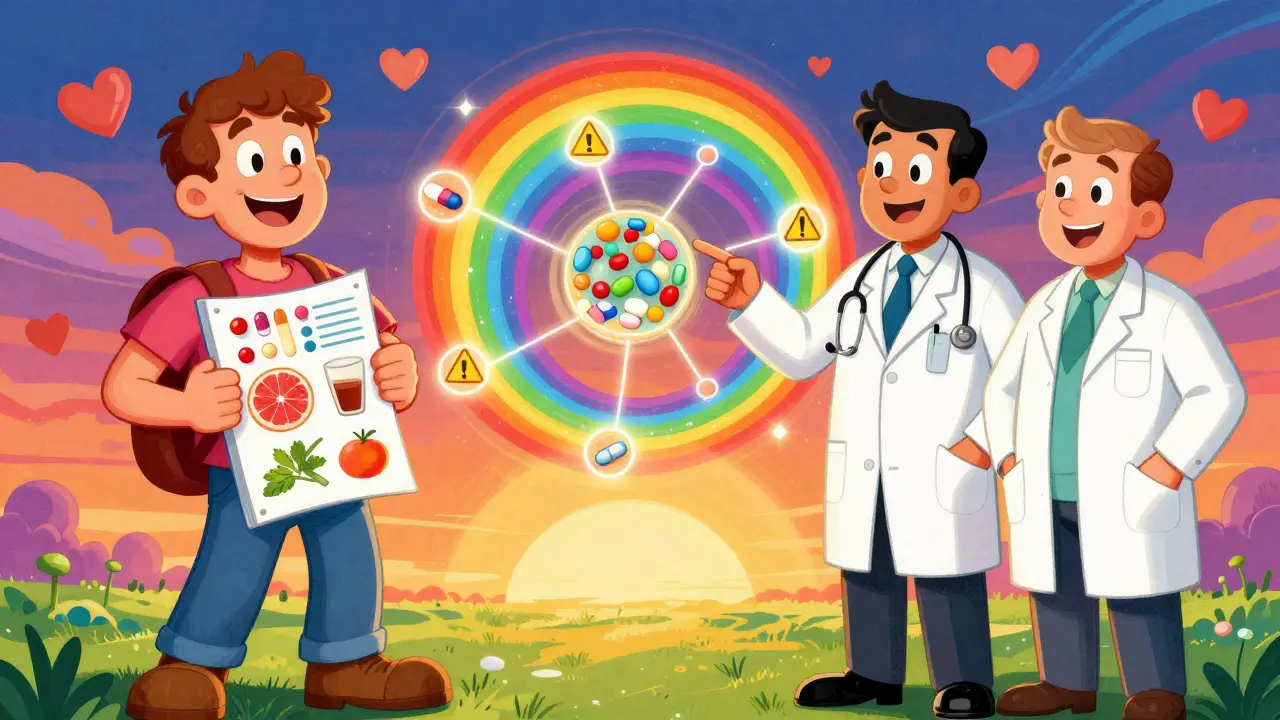
Getting a new prescription can feel overwhelming. You’re already juggling symptoms, doctor’s notes, and maybe even insurance paperwork. But one question you must ask - and ask clearly - is: Will this medicine interact with anything else I’m taking? It’s not just a formality. It’s a life-saving conversation.
Every year in the U.S., drug interactions send over 1.3 million people to the emergency room. That’s not a small number. It’s not something that happens to "other people." It happens to people who didn’t ask the right questions. The FDA says 83% of serious drug interactions could be avoided with better communication. You don’t need to be a medical expert. You just need to know what to say.
Why Drug Interactions Are More Common Than You Think
Most people think drug interactions only happen between two prescription pills. That’s not true. Interactions can happen between:
- Two or more prescription drugs
- A prescription and an over-the-counter medicine (like ibuprofen or cold pills)
- A medication and a vitamin or herbal supplement (like St. John’s wort or fish oil)
- A drug and a food or drink (like grapefruit juice or alcohol)
- A medication and a health condition you already have (like high blood pressure or kidney disease)
Here’s the reality: nearly half of all American adults take at least one prescription drug. One in five take three or more. And one in eight take five or more. The more medications you’re on, the higher the chance something will clash. A simple antacid can block your thyroid medicine. An antibiotic can make your blood thinner dangerously strong. A decongestant can spike your blood pressure if you already have hypertension.
These aren’t rare cases. In 2022, the FDA recorded over 12,000 serious adverse events linked to drug interactions. Anticoagulants, diabetes meds, and heart medications were the top culprits. One patient on warfarin started taking ciprofloxacin - a common antibiotic - and ended up in the ER with severe internal bleeding. That interaction is well-known. It’s listed in every drug guide. But it still happened because no one asked.
The Seven Questions You Need to Ask
Don’t just nod and say "thanks" when the doctor hands you the prescription. Take five minutes and ask these seven questions. Write them down if you have to. Bring a list. Use your phone. Don’t rely on memory.
- Will this interact with any of my other medications, supplements, or vitamins? This is the most important. Don’t just say "I take a few things." List them all - even the ones you think are "harmless," like magnesium or melatonin.
- Should I avoid any foods, drinks, or alcohol while taking this? Grapefruit juice can ruin the effect of statins. Alcohol can make sedatives dangerous. Even dairy can interfere with antibiotics.
- What side effects should I watch for, and which ones mean I need to call a doctor right away? Dizziness? Nausea? That’s normal. But chest pain, trouble breathing, or unusual bruising? That’s not. Know the red flags.
- Will this make my existing health conditions worse? If you have kidney disease, heart failure, glaucoma, or asthma, some meds can make it worse. Tell your doctor your full history - not just the big stuff.
- Can I take this with my other prescriptions at the same time? Some meds need to be spaced out. Others should never be taken together. Timing matters.
- Why this drug and not another one for my condition? There might be a safer option that doesn’t interact with your current meds. Always ask if there’s an alternative.
- Do you use pharmacogenetic testing? Could my genes affect how I process this drug? This is newer, but growing fast. Some people metabolize drugs slowly or quickly because of their DNA. Companies like Genomind now offer tests that show how your body handles specific meds. It’s not routine yet - but it’s worth asking.
Your Medication List Is Your Best Tool
Doctors and pharmacists can’t check for interactions if they don’t know what you’re taking. Most medication errors happen because someone forgot to mention an OTC pill or a supplement.
Here’s what to include on your list:
- All prescription drugs (name, dose, frequency)
- All over-the-counter medicines (painkillers, cold meds, antacids)
- All vitamins, minerals, and supplements (even if you only take them "sometimes")
- All herbal products (turmeric, echinacea, ginseng, etc.)
- Alcohol, tobacco, or recreational drug use
Keep two copies: one at home, one in your wallet or phone. Update it every time you start or stop something. Bring it to every appointment - even if you’ve been there before. Your meds change. Your list should too.
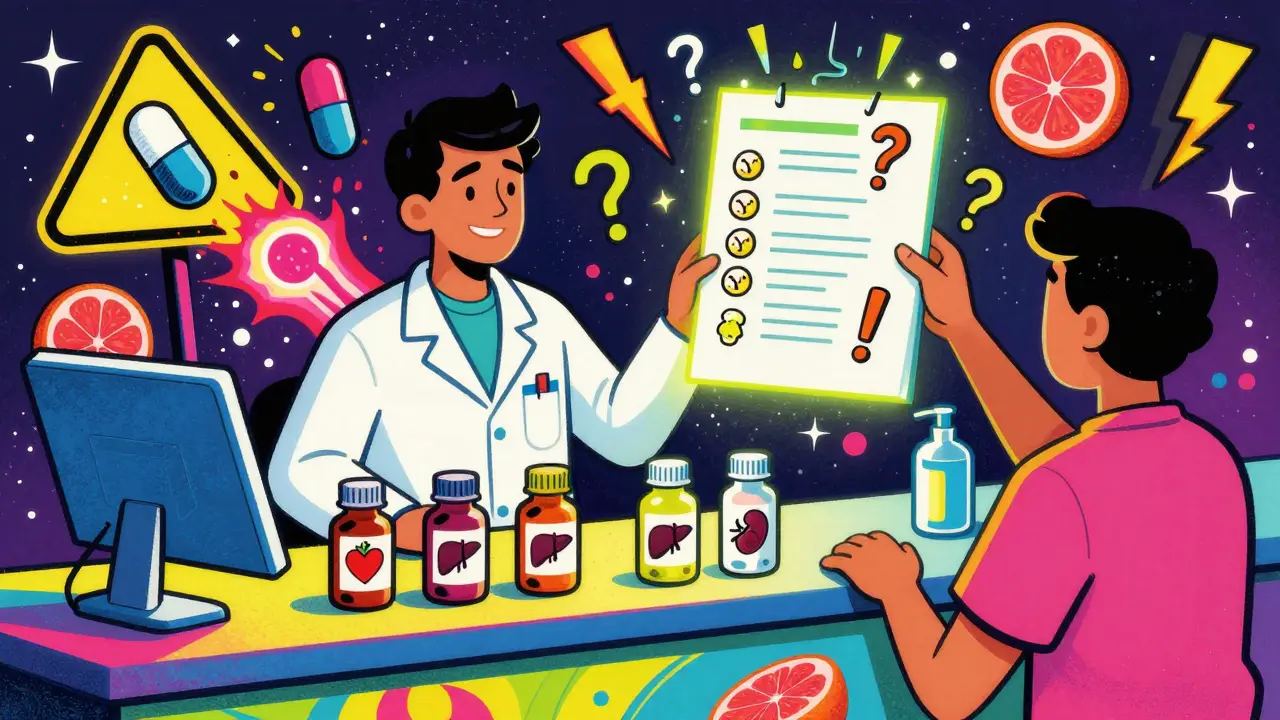
Pharmacists are your secret weapon. They’re trained specifically to catch interactions. In fact, 92% of pharmacists screen every prescription for potential clashes before they hand it over. If you’re unsure, ask your pharmacist: "Can you check this against everything else I take?" Show them your list. Bring the actual bottles if you can. They’ll catch things your doctor might miss.
What Pharmacists Can Do That Doctors Can’t
Doctors see dozens of patients a day. They’re focused on diagnosis and treatment. Pharmacists? They’re focused on safety. They have access to databases with over 24,000 prescription drugs, 4,000 supplements, and 800 foods - all checked for interactions. WebMD’s tool is public, but pharmacy systems are far more advanced.
Major pharmacy chains now use clinical decision software that flags dangerous combos in real time. If your new prescription clashes with your statin, your blood pressure med, and your fish oil? The system will alert the pharmacist. They’ll call your doctor. They might suggest a different dose, a different drug, or a different schedule.
Don’t wait for them to ask. Say: "I’m on a few things. Can you double-check this with my full list?" Most pharmacists will be happy to help. They’re paid to keep you safe.
What to Do If You’re Already Taking Something Risky
What if you’ve already started the new med and you’re worried? Don’t stop it cold. That can be dangerous too.
Call your pharmacist or doctor. Say: "I just started [medication name] and I’m on [other med]. I’m concerned about possible interactions. Can we review this?" Most interactions don’t cause immediate harm - but they can build up. Catching them early matters.
Some dangerous combos include:
- Calcium supplements with thyroid medicine (Synthroid) - take them at least 4 hours apart
- Ciprofloxacin with warfarin - increases bleeding risk
- Pseudoephedrine (in cold meds) with high blood pressure - can spike BP dangerously
- NSAIDs (like ibuprofen) with kidney disease or heart failure - can worsen function
If you’re on any of these, get it checked now. Don’t wait for symptoms.

The Future: Genetic Testing and Personalized Meds
It’s not science fiction anymore. In 2023, 28% of new drug approvals included pharmacogenetic info - up from just 5% in 2015. That means your genes are starting to guide which drugs you get.
Some people break down certain meds too fast - so the drug doesn’t work. Others break them down too slow - so they build up to toxic levels. Pharmacogenetic testing can show this before you even take the pill. It’s not for everyone yet, but if you’re on multiple meds, have had bad reactions before, or have a chronic condition, it’s worth asking about.
Companies like Genomind offer tests that map your genes to your meds, showing both drug-drug and gene-drug interactions in one report. Your doctor might not bring it up, but you can: "Do you offer genetic testing to help choose safer meds?"
Bottom Line: Speak Up, Even If It Feels Awkward
You’re not being difficult. You’re being smart. You’re not wasting their time - you’re saving your life.
Doctors and pharmacists aren’t mind readers. They need your help. The system is designed to catch errors - but it still needs you to give the right information.
Next time you get a new prescription, don’t just take it. Ask. List. Check. Follow up. It’s the simplest, most effective way to avoid a trip to the ER. And it costs nothing but a few minutes of your time.
Aboobakar Muhammedali
December 21, 2025 AT 07:53I used to ignore this stuff until my dad ended up in the ER after mixing his blood thinner with turmeric capsules. He thought "natural" meant "safe." It didn't. Now I print out his med list every time we go to the doctor. Even the gummy vitamins. Even the ones he only takes when he remembers.
It's not paranoia. It's survival.
And yeah I cried when the pharmacist caught the interaction before it happened. So what.
anthony funes gomez
December 22, 2025 AT 18:38The pharmacokinetic and pharmacodynamic interplay between CYP450 substrates and inhibitors is grossly underappreciated by laypersons-yet it's the primary mechanistic driver behind iatrogenic polypharmacy adverse events. The FDA's 83% statistic is misleading without context: it assumes perfect adherence to reporting protocols, which in real-world primary care settings is closer to 32%.
Moreover, the reliance on pharmacogenetic testing as a panacea ignores population-level genetic heterogeneity-especially in admixed populations where CYP2D6*10 and *17 alleles are prevalent but rarely screened.
Bottom line: your list is necessary but insufficient. Demand a clinical pharmacist consult-not just a checkbox.
Laura Hamill
December 23, 2025 AT 01:28THEY DON'T WANT YOU TO KNOW THIS BUT PHARMACISTS ARE PAID BY BIG PHARMA TO HIDE THE TRUTH!!!
They're all in on it. Grapefruit juice? That's just the tip. The real danger is the 5G towers syncing with your meds to make you sick so they can sell you more pills. I saw it on a video. They even use the same colors as the FDA logo to trick you.
And don't get me started on vaccines and blood thinners...
PS: I'm not crazy. I read the comments.
PPS: 🤫💊👁️
Alana Koerts
December 23, 2025 AT 01:53This post is 90% obvious. Everyone knows you should tell your doctor what you're taking. The other 10%? It's just rehashing FDA warnings. Why is this even a thing? People are lazy. They don't read labels. That's not a systemic problem-it's a personal failure.
Also, why are we still talking about grapefruit? It's 2024. We have apps that scan barcodes now.
Stop glorifying ignorance.
James Stearns
December 24, 2025 AT 14:10It is my profound conviction that the modern medical establishment has, through a combination of systemic neglect and institutional complacency, rendered the patient an afterthought in the pharmacological decision-making process.
One must, therefore, assume the burden of epistemic authority over one’s own physiology-a duty not lightly undertaken, yet indispensable to the preservation of life.
One does not simply "ask" about interactions. One initiates a formal pharmacological audit, complete with documentation, timestamped records, and, if necessary, notarized affidavits.
And if your pharmacist hesitates? Demand a supervisor. Do not accept a smile. Demand a protocol.
Guillaume VanderEst
December 25, 2025 AT 09:50I used to think this was overkill until my cousin took lisinopril with a daily beetroot shot and ended up in the hospital with a BP of 60/40. He swore he "only took it for the glow."
Now I keep a laminated card in my wallet with my meds, allergies, and my doctor’s direct line.
Also, I bring my actual pill bottles to every appointment. People think I’m weird. I think they’re dumb.
And yeah, I’ve had pharmacists thank me for it. That’s the weirdest part.
Dominic Suyo
December 25, 2025 AT 15:04Let’s be real: the only reason this post even exists is because people treat their prescriptions like candy. "Oh, I took two because I felt a little off."
And then they wonder why they’re dizzy or bleeding from the nose.
Meanwhile, the FDA’s "1.3 million ER visits" number is basically just the cost of doing business in a country where people think "natural" means "no side effects."
Also, St. John’s wort? That shit turns SSRIs into a rave. I’ve seen it. It’s not pretty.
Alisa Silvia Bila
December 26, 2025 AT 07:20My grandma took 11 meds. She didn’t know half of them. I made her a color-coded chart with pictures. She still forgets sometimes. But now she knows to say "check it" before taking anything new.
It’s not rocket science. Just care.
And if you’re embarrassed? Good. That means you’re paying attention.
Marsha Jentzsch
December 28, 2025 AT 01:36I’ve been saying this for YEARS and no one listens. You think your doctor knows what you’re taking? HA.
My sister took omeprazole with her thyroid med and didn’t realize it until her TSH hit 80. She was falling asleep at her desk. The doctor blamed her "stress."
It’s not your fault. It’s the system. They don’t care. They’re rushing. They’re tired. They’re on commission.
And now I carry a binder. With tabs. And highlighters.
And I cry every time I have to explain it again.
It’s exhausting. But I won’t stop.
💔💊
Hussien SLeiman
December 29, 2025 AT 00:03Look, I get it. You want to feel empowered. But let’s be honest-this whole "ask seven questions" thing is just a marketing tactic from some wellness influencer who got paid by a pharmacy chain.
Doctors don’t have time for this. Pharmacists are overworked. And if you bring a list, they’ll just sigh and say "thanks" while filing it under "unusual patient."
Meanwhile, your real risk isn’t drug interactions-it’s being labeled "difficult" and getting skipped over next time.
So maybe don’t bother. Just pray.
mary lizardo
December 29, 2025 AT 19:36There are multiple grammatical inconsistencies in this article. For instance, "You’re already juggling symptoms, doctor’s notes, and maybe even insurance paperwork"-the Oxford comma is omitted, which is unacceptable in formal discourse.
Additionally, "One in eight take five or more" should be "One in eight takes five or more." Subject-verb agreement error.
And why is "pharmacogenetic" hyphenated in one instance and not in another?
These are not trivial. They reflect a lack of editorial rigor-and if you can’t get the language right, how can we trust the medical advice?
jessica .
December 30, 2025 AT 06:21THEY’RE LYING ABOUT THE INTERACTIONS. THE REAL DANGER IS THE MICROCHIPS IN THE PILLS THAT SEND DATA TO THE GOVT.
That’s why they want you to list everything. So they can track you.
And grapefruit? That’s just a distraction. The real killer is the fluoride in the water. It messes with your liver so the meds don’t work right.
Also, my cousin’s neighbor’s dog got sick after the vet gave it a pill. Coincidence? I think not.
👁️💊🇺🇸
Connie Zehner
December 31, 2025 AT 08:36I took 14 meds last year. I didn’t know half of them were interacting. I thought I was just tired. Turns out, I was almost dead.
My mom had to Google my meds and call the pharmacist at 2am. She cried. I cried.
Now I have a little app that beeps when I need to take something. And I show it to everyone.
But I still feel guilty. Like I’m too much.
Like I’m annoying.
But then I remember-I’m alive.
So I keep asking.
And I keep crying.
And I keep living.
❤️🩹
Tim Goodfellow
January 1, 2026 AT 16:54When I started my new antidepressant, I didn’t ask. Big mistake. I ended up in a parking lot at 3am, convinced my car was talking to me.
Turns out, it was the sertraline + melatonin combo. My pharmacist laughed when I told her. "Welcome to the club," she said.
Now I have a spreadsheet. With color coding. And footnotes.
And I still ask. Every time. Even if it’s just a cough drop.
Because I don’t want to be that guy again.
And yeah, I’m weird. But I’m alive.
So I’ll take weird over dead any day.
mark shortus
January 2, 2026 AT 09:12I just got prescribed a new med and I didn't ask about interactions because I'm lazy. And now I'm dizzy. And my heart is racing. And I'm typing this from the ER.
So yeah.
Ask.
Just ask.
And if you're reading this and you're not asking?
You're next.
❤️