Grapefruit and Statins: Safe Dose Thresholds to Avoid Dangerous Interactions
Grapefruit-Statins Risk Calculator
Assess Your Risk
Your Risk Assessment
What to do:
Drinking a glass of grapefruit juice with your morning statin might seem like a healthy habit-until it turns dangerous. For people taking certain cholesterol-lowering drugs, even a small amount of grapefruit can spike drug levels in the blood to dangerous levels, raising the risk of muscle damage, kidney failure, and even death. The science behind this isn’t theoretical. It’s been proven in labs, clinics, and real-world cases for over 30 years. But here’s the thing: not all statins react the same way. And not every sip of juice is a disaster. The real question isn’t whether grapefruit is bad with statins-it’s which statins, how much grapefruit, and who’s at risk.
Which Statins Are Affected by Grapefruit?
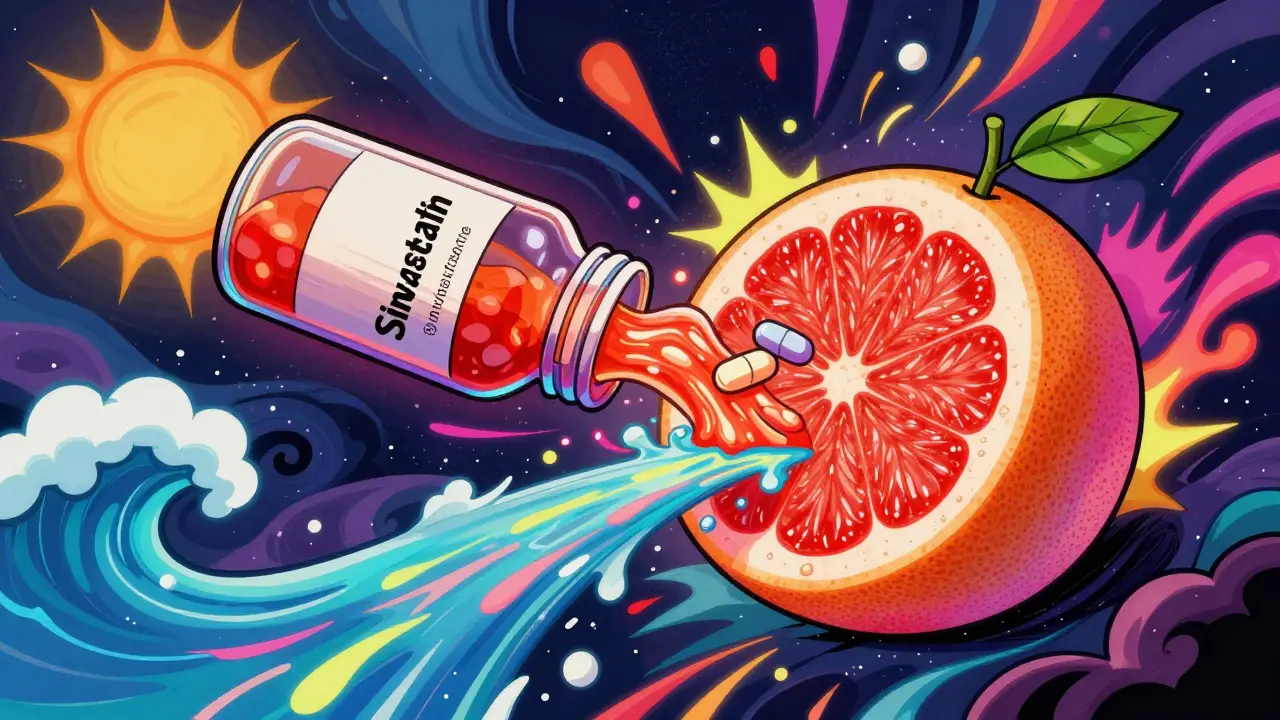
Not all statins are created equal when it comes to grapefruit. The problem lies in how your body breaks them down. Some statins rely heavily on an enzyme called CYP3A4, mostly found in your gut. Grapefruit contains chemicals called furanocoumarins-mainly bergamottin and DHB-that shut down this enzyme like flipping a switch. When that happens, the statin doesn’t get broken down as it should. Instead, it floods into your bloodstream, sometimes 3 to 8 times higher than normal.
The big three statins that react badly with grapefruit are:
- Simvastatin (Zocor, FloLipid)
- Atorvastatin (Lipitor)
- Lovastatin (Mevacor)
These are the ones you need to watch out for. If your prescription says one of these, grapefruit isn’t just a mild inconvenience-it’s a red flag.
On the other hand, these statins are safe to take with grapefruit:
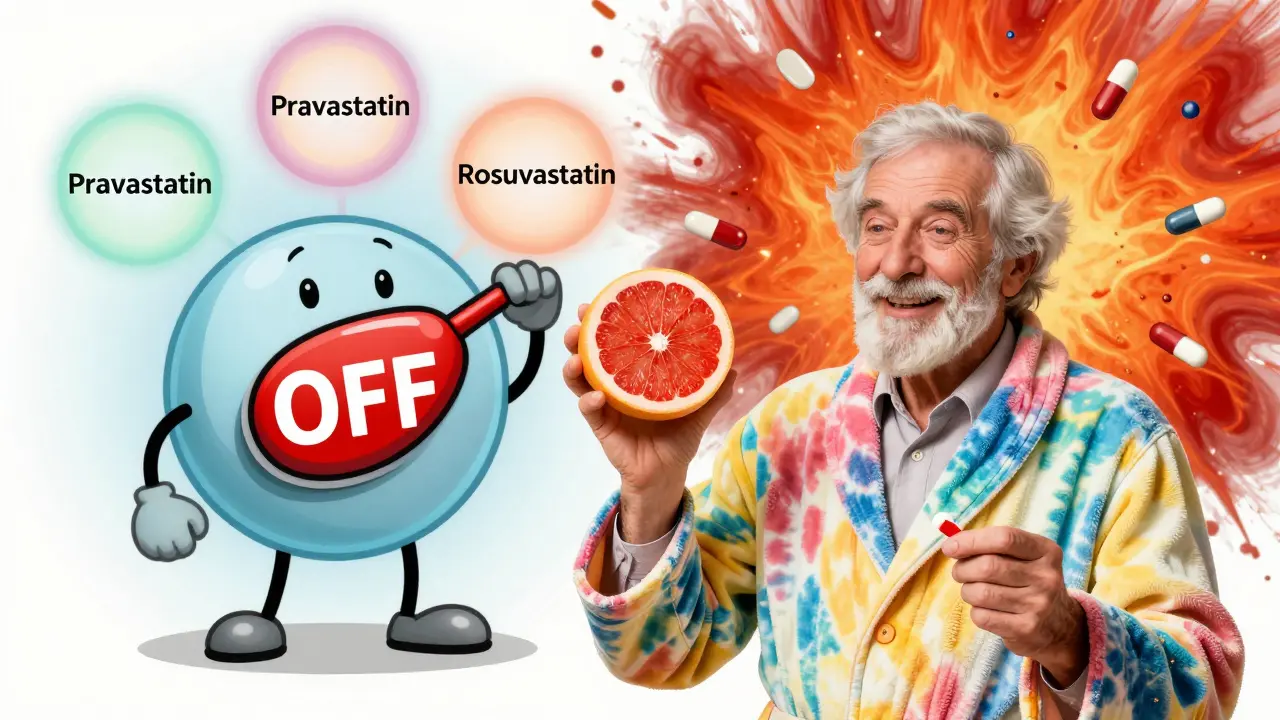
- Pravastatin (Pravachol)
- Rosuvastatin (Crestor)
- Fluvastatin (Lescol)
- Pitavastatin (Livalo, Zypitamag)
They use different metabolic pathways, so grapefruit doesn’t interfere. If you love grapefruit and are on a statin, switching to one of these is often the safest move.
How Much Grapefruit Is Too Much?
There’s no universal answer. One person might drink a full glass daily with no issues. Another might feel muscle pain after just half a grapefruit. Why? Genetics. Age. Other meds. Liver health. Your body’s CYP3A4 enzyme levels vary wildly.
But science has drawn a line. Based on clinical studies and FDA guidance, here’s what we know:
- 200-250 ml (8 oz) of grapefruit juice is the threshold where significant interaction begins. This is the amount that reliably increases simvastatin levels by 3 to 4 times.
- One glass per day can double the risk of muscle damage for people on simvastatin or atorvastatin.
- 1.2 liters per day (about five 8-oz glasses) is the official FDA definition of “excessive consumption”-a level that almost guarantees dangerous drug buildup.
Here’s the catch: even one glass daily can be risky if you’re on a high dose. For example, someone taking 80 mg of simvastatin should avoid grapefruit entirely. The combination can push drug levels into toxic territory.
But what if you only have grapefruit once a week? Or half a grapefruit instead of juice? That’s where things get more forgiving. Studies show that occasional, small amounts-like half a grapefruit or a single 8-oz glass-may not cause major issues for most people on standard doses. Still, it’s not zero risk. And if you’re over 65, have kidney problems, or take other meds like blood pressure pills or antibiotics, even small amounts can be dangerous.
What Happens When Grapefruit and Statins Mix?
The danger isn’t immediate. You won’t collapse after your first glass. But over time, the extra statin builds up in your muscles. That’s when things go wrong.
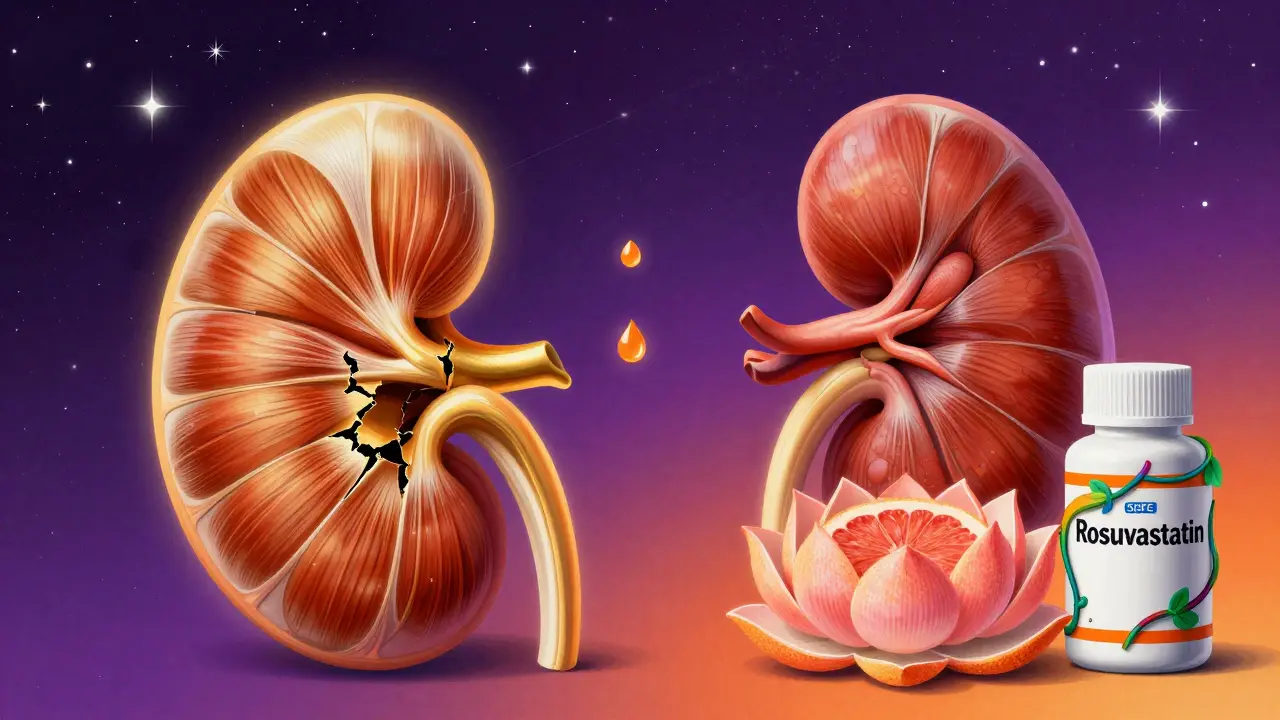
The most serious risk is rhabdomyolysis-a condition where muscle tissue breaks down and leaks into the bloodstream. This can clog your kidneys, cause kidney failure, and sometimes lead to death. Symptoms include:
- Unexplained muscle pain, tenderness, or weakness
- Dark, tea-colored urine
- Fatigue or nausea
If you notice any of these after starting grapefruit with your statin, stop both and see a doctor immediately.
Between 1990 and 2021, only 17 confirmed cases of rhabdomyolysis were linked to grapefruit-statin interactions in U.S. federal databases. That sounds rare. But rarity doesn’t mean safety. These cases are often preventable-and they’re not evenly spread. Most happen in older adults, people on high-dose statins, or those who drink grapefruit juice daily.
Can You Still Drink Grapefruit Juice?
Yes-but only under the right conditions.
If you’re on simvastatin, atorvastatin, or lovastatin:
- Avoid daily consumption. Even one glass a day increases risk.
- Don’t drink it at the same time as your statin. If you take your statin at night, have grapefruit in the morning. That gives your body time to clear some of the enzyme-blocking chemicals before the statin hits your system.
- Stick to half a grapefruit or one 8-oz glass. Don’t go beyond that. Juice is worse than fruit because it’s more concentrated and absorbed faster.
- Never drink grapefruit juice if you’re on 80 mg of simvastatin. That dose alone carries a high risk. Add grapefruit? It’s playing Russian roulette with your muscles.
Here’s a practical tip: if you’re unsure, switch statins. Rosuvastatin or pravastatin work just as well for most people-and they’re safe with grapefruit. Why risk it when you don’t have to?
What Do Experts Really Say?
Dr. Stanley Hazen from Cleveland Clinic says: “For grapefruit-loving people on a statin, a measured approach works.” He’s not saying it’s safe-he’s saying it’s manageable if you’re smart.
The American College of Cardiology’s 2023 guidelines don’t tell everyone to quit grapefruit. Instead, they say: “Consider switching to a non-interacting statin for patients who regularly consume grapefruit.” That’s the gold standard now. It’s not about fear. It’s about control.
Dr. David Bailey, who first discovered this interaction in 1991, puts it bluntly: “Individual responses vary from zero to eight times higher drug levels.” That means two people drinking the same amount could have completely different outcomes. One might be fine. The other could end up in the hospital.
The European Medicines Agency agrees. Their 2023 update says blanket bans aren’t helpful. What matters is personalized advice. Your doctor should ask: “Do you drink grapefruit juice? How much? What statin are you on?”
What Should You Do?
If you’re on a statin and like grapefruit, here’s your action plan:
- Check your statin name. Is it simvastatin, atorvastatin, or lovastatin? If yes, proceed with caution.
- Don’t assume it’s safe. Even if you’ve had grapefruit for years with no issues, your body changes. Age, new meds, or liver changes can suddenly make it dangerous.
- Ask your doctor or pharmacist. Say: “I drink grapefruit juice. Is my statin safe with it?” Don’t wait for them to ask.
- Consider switching. If you love grapefruit and take your statin daily, switching to rosuvastatin or pravastatin is the smartest long-term move.
- Watch for symptoms. Muscle pain, weakness, dark urine? Stop grapefruit and call your doctor. Don’t wait.
There’s no need to give up grapefruit forever. But if you’re on a high-risk statin, treating it like a weekend treat-not a daily habit-is the difference between staying healthy and ending up in the hospital.
What About Other Citrus Fruits?
Not all citrus is the same. Seville oranges (used in marmalade), pomelos, and tangelos also contain furanocoumarins and can cause the same interaction. So if you’re on simvastatin or atorvastatin, avoid those too.
Regular oranges, lemons, limes, and clementines? Safe. They don’t have the same chemicals. You can enjoy them without worry.
Bottom Line
Grapefruit isn’t the enemy. Statins aren’t the enemy. But together, they can be dangerous-if you don’t know the rules.
The threshold isn’t about how much you drink. It’s about what you’re taking, how often, and who you are. For most people on safe statins, grapefruit is fine. For those on simvastatin or atorvastatin, even one glass a day is a gamble. The safest choice? Switch to a statin that doesn’t care about grapefruit. Your muscles-and your kidneys-will thank you.
Kinnaird Lynsey
December 18, 2025 AT 00:34I used to drink grapefruit juice every morning with my Lipitor. Thought it was fine until I started getting muscle cramps at night. Switched to pravastatin and now I can have my juice without sweating it. No drama, no hospital visits. Just life.
Glen Arreglo
December 18, 2025 AT 13:03Look, I get it. People love their grapefruit. But if you're on simvastatin and you're still sipping juice like it's a morning ritual, you're not being healthy-you're being stubborn. I've seen guys in the ER because they thought 'it's just one glass' and then boom, rhabdo. Don't be that guy.
shivam seo
December 19, 2025 AT 04:35Why are we even talking about this like it's a mystery? The FDA said it 20 years ago. Grapefruit + statins = bad. If you're too lazy to read the pill bottle or ask your pharmacist, don't blame the system when your kidneys give out. Australia doesn't have this problem because we don't let people be this dumb.
benchidelle rivera
December 19, 2025 AT 08:16As a clinical pharmacist with over 15 years in cardiology, I cannot emphasize enough: the interaction between grapefruit and CYP3A4-metabolized statins is not theoretical, not anecdotal, and not negotiable. Patients who continue consumption despite warnings are at statistically significant risk for myopathy and renal failure. This is not a lifestyle choice-it is a pharmacological hazard. Please, consult your provider before making any dietary adjustments to your regimen.
Connie Zehner
December 21, 2025 AT 06:00They’re hiding the truth. Grapefruit is fine. It’s the pharmaceutical companies that want you to switch to pravastatin because it’s more expensive. They don’t want you to know that natural stuff works better. My cousin took Lipitor with grapefruit for 12 years and she’s still running marathons. They’re just trying to sell you a new drug. 😒
Vicki Belcher
December 22, 2025 AT 23:23OMG I just switched to Crestor last month and I’m SO happy I can still have my grapefruit!! 🍊💖 I used to feel guilty every morning but now I’m living my best life. My cholesterol’s down, my mood’s up, and I’m not giving up my juice. You’re welcome, future me. 😘
Alex Curran
December 24, 2025 AT 02:10Just to clarify the 8oz threshold is based on simvastatin studies but atorvastatin can be affected too especially at higher doses. Also the timing thing? It’s not really a fix. The enzyme inhibition lasts over 24 hours so drinking juice in the morning doesn’t help if you take your statin at night. Just switch statins. It’s easier.
Lynsey Tyson
December 24, 2025 AT 12:48My dad took simvastatin for 10 years and drank grapefruit juice every day. Never had a problem. He’s 82 and still rides his bike. So maybe it’s not as scary as they make it sound? I’m not saying ignore the warnings but maybe it’s not a death sentence for everyone?
Edington Renwick
December 25, 2025 AT 20:27They’re lying. This whole grapefruit thing is a distraction. The real danger is the statins themselves. They’re poisoning people and now they’re blaming the fruit. I’ve been reading forums-there are dozens of cases where people got sick after switching to ‘safe’ statins. They’re just trying to make you feel guilty so you’ll take more pills.
Laura Hamill
December 27, 2025 AT 20:14THEY KNOW. THEY ALL KNOW. Grapefruit is a natural blood thinner. The FDA and Big Pharma don’t want you to know you can fix your cholesterol with fruit and sunshine. They want you on pills forever. I stopped my statin and now I eat 3 grapefruits a day. My numbers are better. They’re scared of natural cures. 😡