Getting Enough Medication Before International Travel: A Practical Guide to Avoid Legal Trouble and Medical Emergencies
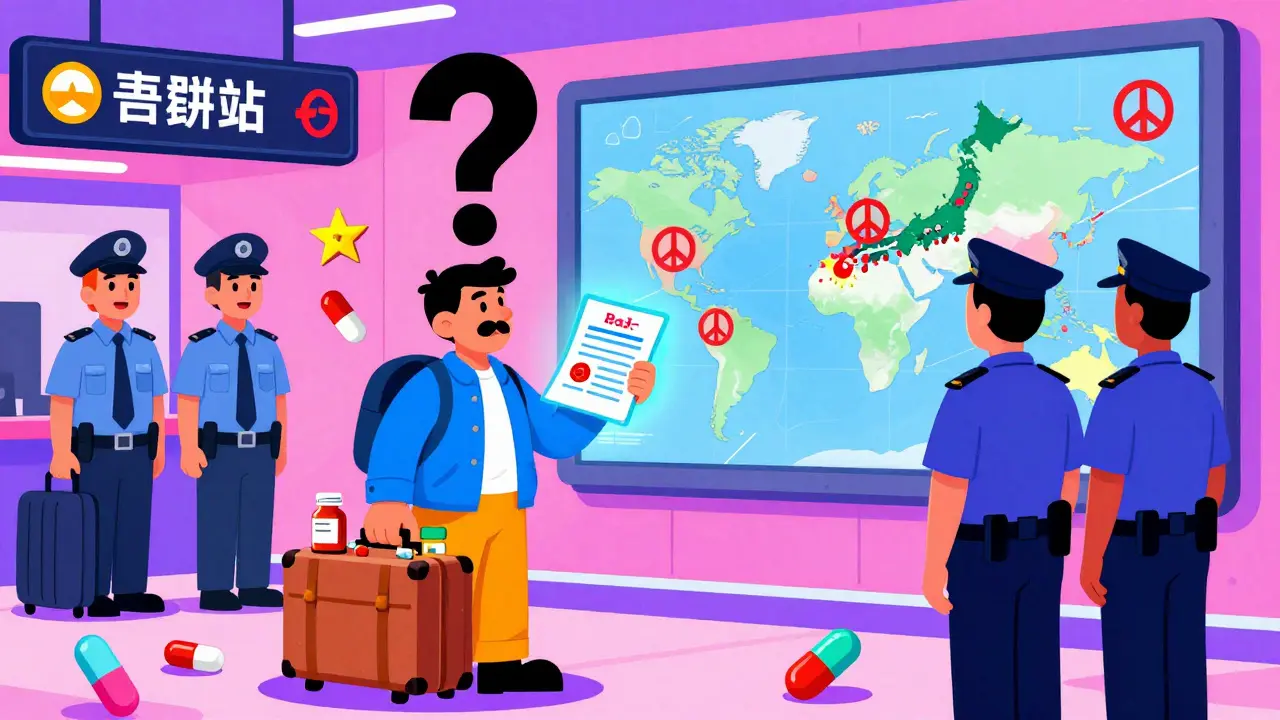
Imagine landing in Bangkok after a long flight, only to be pulled aside by customs because your anxiety pills aren’t in the right bottle. Or arriving in Dubai with a painkiller you’ve used for years - only to find out it’s illegal there, and you’re facing jail time. This isn’t a movie plot. It happens to thousands of travelers every year. The truth is, getting enough medication before international travel isn’t just about packing extra pills. It’s about understanding laws, avoiding traps, and making sure your health doesn’t become a border control issue.
Why This Isn’t Just a Packing List
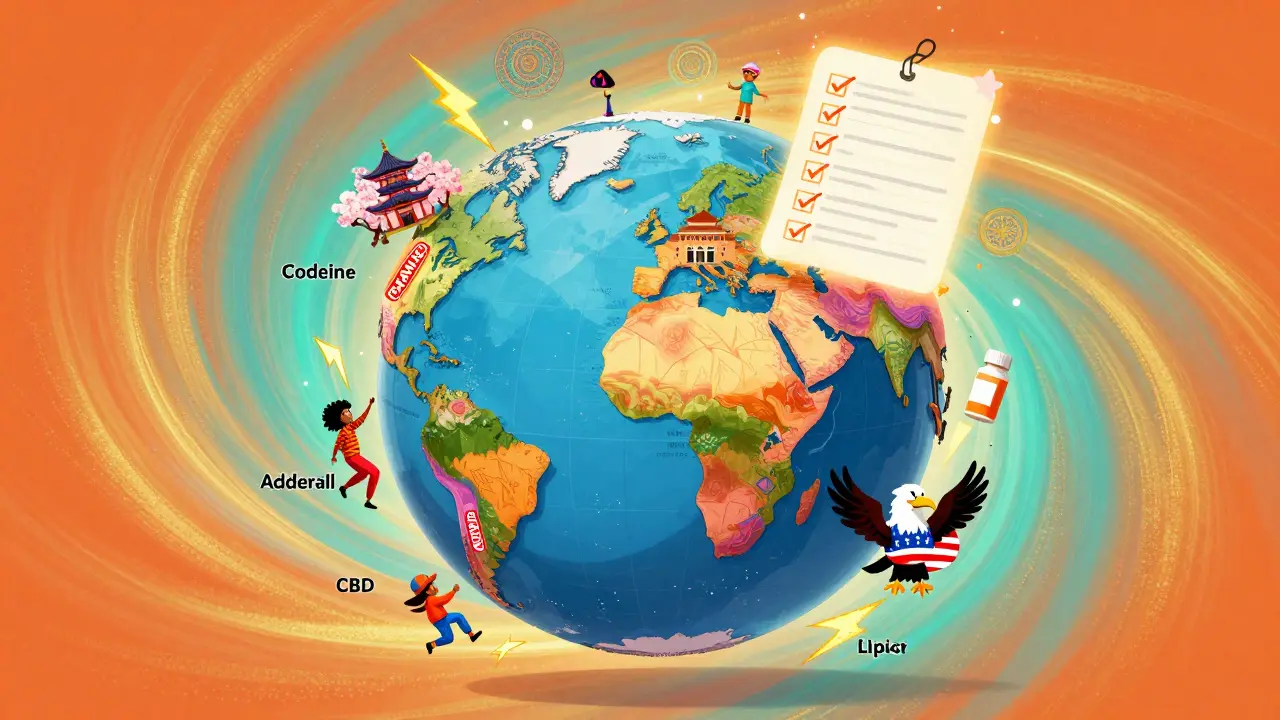
Most people think, "I’ll just bring my prescription in the original bottle and call it good." That’s not enough. Over 12% of international travelers run into medication problems, according to the CDC’s Yellow Book. These aren’t just inconveniences - they’re legal risks. In Thailand, carrying zolpidem (a common sleep aid) without a notarized doctor’s letter can get you detained for 72 hours. In Japan, ADHD meds like Adderall are outright banned. In the UAE, even codeine-based cough syrup can land you in prison for five years. The problem isn’t just the destination. It’s transit. If you’re flying through the U.S. with a prescription from another country, or connecting through multiple countries, each leg has its own rules. The TSA says prescription labels are "recommended but not required," but states like California and Texas legally require controlled substances to stay in original bottles. So if you’re flying from Australia to Germany with a layover in Atlanta, you’re juggling three sets of rules.Which Medications Are Most Likely to Cause Problems
Not all meds are created equal when it comes to crossing borders. Some are fine. Others are ticking time bombs. Here are the categories that trip people up most:- Narcotics: Hydrocodone, oxycodone, codeine - even in small doses. These are tightly controlled almost everywhere outside the U.S. and Canada.
- Sedatives and anti-anxiety meds: Alprazolam (Xanax), diazepam (Valium), clonazepam. Many countries treat these like illegal drugs.
- Sleep aids: Zolpidem (Ambien) is banned in Japan and restricted in Thailand and Singapore.
- ADHD medications: Amphetamine-based drugs like Adderall, Vyvanse, and Ritalin are illegal in Japan, South Korea, Sweden, and the UAE.
- Decongestants: Pseudoephedrine (Sudafed) is banned in Japan and restricted in several European countries.
- CBD and cannabis products: Even if legal in your state, CBD is banned in 19 countries including Malaysia, South Korea, and Saudi Arabia.
How Much Should You Bring?
You can’t just pack a month’s supply if you’re going for six weeks. The U.S. Customs and Border Protection (CBP) says you should bring no more than a 90-day supply - and that’s for U.S. citizens returning home. Many countries have stricter limits. Japan allows only a 30-day supply for personal use, and even that requires pre-approval. The smart rule: bring enough for your entire trip, plus at least seven extra days. Why? Flight delays happen. Lost luggage happens. Your hotel might be out of your favorite tea, and you’re not going to risk running out of your blood pressure med because of a missed connection. If you’re going to multiple countries, plan for the most restrictive one. If you’re flying to Japan, then France, then Spain - follow Japan’s rules. Don’t assume that because one country lets you bring it, the next one will too.Documentation: It’s Not Optional
A prescription bottle with your name on it? That’s the bare minimum. Most countries require more.- Doctor’s letter: This should be on letterhead, signed, and dated. It needs to list your name, the medication (both brand and generic), dosage, and reason for use. Some countries - like Thailand and Saudi Arabia - require it to be notarized.
- Original prescription: Bring the actual paper copy from your pharmacy, not just a photo on your phone. Some customs agents won’t accept digital copies.
- International Certificate for Medicinal Products (ICMP): This is a standardized form that 68% of U.S. pharmacies can provide. It costs $25-$40, but it’s worth it if you’re traveling to Japan, the UAE, or any country with strict controls. It’s recognized by the WHO and accepted in over 60 countries.
How to Check Your Medications Before You Go
You can’t guess. You can’t rely on what a friend said. You need facts. Start with the International Narcotics Control Board (INCB) Country Regulations Database. It’s updated in real time and includes over 180 countries. Type in your medication name, and it tells you if it’s banned, restricted, or allowed - and what documentation you need. Then, contact the embassy of every country you’re visiting - even if you’re just transiting. Don’t email. Call. Ask for the health or consular section. Say: "I’m a traveler with a prescription for [medication]. Is it allowed? Do I need a permit? What documentation is required?" Write down the name of the person you speak to, the date, and what they said. Don’t trust websites like Tripadvisor or Reddit for legal advice. People post anecdotes - "I got away with it!" - but that doesn’t mean it’s legal. One person’s luck isn’t your exemption.How to Pack It Right
Packing isn’t just about fitting things in your suitcase. It’s about safety and compliance.- Carry all meds in your carry-on. Checked luggage gets lost. If you need insulin, EpiPen, or heart meds, you can’t risk losing them.
- Keep everything in original containers. No pill organizers for controlled substances. Even if your pharmacy says it’s okay, customs might not.
- Liquids and needles: TSA allows medically necessary liquids over 3.4 oz, but you must declare them at security. Same for syringes - bring a doctor’s note explaining why you need them.
- Don’t mail meds. The U.S. Postal Service and FedEx don’t allow most prescription drugs to be shipped internationally. Even if you think it’s "just a few pills," it’s illegal in most countries and will be seized.
What If You’re Traveling to Multiple Countries?
This is where it gets messy. The EU has some harmonized rules - if you’re flying between Schengen countries, you’re mostly safe with your U.S. prescription. But step outside the EU - say, to Turkey or Morocco - and everything changes. The rule: Always follow the strictest country’s rules. If you’re going to Japan, then Italy, then Egypt - follow Japan’s rules for everything. That means no Adderall, no pseudoephedrine, no zolpidem. Even if Italy lets you bring it, Egypt doesn’t. And you’ll be flying through both. Use the INCB database to check each country. Print out the results. Keep them with your passport. If you’re asked, you can show proof you did your homework.
What About Refills While Traveling?
Don’t count on refilling prescriptions abroad. Even if a pharmacy has the same drug, it might be a different brand, dose, or formulation. A 500mg tablet in the U.S. might be 250mg in Europe. Your doctor might not know how to convert it. Some countries allow you to get a local prescription - but only if you have a doctor’s letter and original prescription. Even then, it’s not guaranteed. In Thailand, you need a local doctor to approve your U.S. script. In Japan, you can’t get most U.S. meds at all. The best strategy? Bring enough. No exceptions.Emerging Trends You Can’t Ignore
Regulations are tightening - not loosening. Since 2020, 63 countries have added new restrictions on traveler medications. Japan now bans 1,432 substances. The UAE blocks 876. Saudi Arabia has 742. CBD is a big one. Even if you’re using it legally in California, it’s banned in Malaysia, South Korea, and the UAE. And the U.S. government doesn’t help - they won’t tell you what’s legal abroad. The good news? The INCB launched a new version of their database in January 2025 with real-time embassy contacts and medication equivalency tools. The U.S. State Department is also testing a pilot program with Japan, UAE, and Thailand to create standardized forms. But that’s not live yet. Don’t wait for it.What to Do If You’re Denied Entry or Confiscated
If customs takes your meds, stay calm. Don’t argue. Ask for a written receipt. Contact your country’s embassy immediately. They can’t get your meds back, but they can help you find a local doctor or arrange emergency care. If you’re detained, don’t sign anything without legal advice. Call your embassy. Don’t rely on your airline. They’re not equipped to handle legal emergencies. And if you’re lucky enough to get through - don’t celebrate yet. Keep your meds with you. Don’t check them. Don’t leave them in the hotel safe. You’re not done until you’re home.Final Checklist Before You Leave
- ✅ Verified each medication’s status in every country using the INCB database
- ✅ Contacted every embassy (even transit points) at least 60 days in advance
- ✅ Got a signed, dated doctor’s letter on letterhead - notarized if required
- ✅ Obtained an ICMP certificate if traveling to Japan, UAE, or similar countries
- ✅ Packaged all meds in original containers with labels
- ✅ Brought at least 7 extra days’ supply
- ✅ Carried all meds in carry-on luggage
- ✅ Printed and saved copies of all documentation (digital isn’t enough)
- ✅ Know the emergency number for your country’s embassy in your destination
Can I bring my prescription meds in a pill organizer?
Only if they’re not controlled substances. For medications like opioids, benzodiazepines, or ADHD drugs, you must keep them in their original pharmacy bottles with your name and prescription label. Many countries require this by law. Even if you’re not carrying a controlled substance, having the original bottle reduces the chance of delays or questions at security.
What if my medication is banned in my destination country?
If your medication is banned, you cannot bring it. There are no exceptions. You’ll need to talk to your doctor about alternatives before you leave. Some countries allow similar drugs with a local prescription, but you can’t rely on getting one on arrival. Plan ahead - don’t wait until you’re overseas to find out.
Do I need a letter from my doctor if I’m just transiting through a country?
Yes. Even if you’re not leaving the airport, customs officers can inspect your bags. If you’re flying through Japan, the UAE, or Thailand, you’re still subject to their laws. A doctor’s letter and original packaging are your best protection. Don’t assume transit means exemption.
Can I get my medication refilled overseas?
It’s risky. Even if a pharmacy has the same drug, the brand, dosage, or formulation may differ. Some countries require you to see a local doctor first, which can take days. In Japan, many U.S. prescriptions aren’t recognized at all. Bring enough for your entire trip - plus extra.
Is it safe to mail my medication to myself overseas?
No. Mailing prescription drugs internationally is illegal in most countries. Even if you’re shipping from the U.S., customs will seize it. FedEx, UPS, and the postal service all prohibit this. You could also face legal trouble if the package is opened and flagged. Always carry your meds with you.
What should I do if I lose my meds while traveling?
Contact your country’s embassy immediately. They can help you find a local doctor who can assess your condition and potentially prescribe an alternative. Keep a list of your medications, dosages, and your doctor’s contact info saved on your phone and printed. Never wait until you’re out of pills to act.
If you’re traveling with chronic conditions - diabetes, heart disease, epilepsy, mental health issues - your meds aren’t optional. They’re your lifeline. Don’t let bureaucracy turn your vacation into a medical emergency. Do the work before you go. It takes time. It takes effort. But it’s the only way to make sure you come home healthy.
Emma Addison Thomas
January 8, 2026 AT 01:24I once got pulled aside in Singapore for carrying a small bottle of melatonin. No one warned me it was classified as a controlled substance there. I had to wait 48 hours while they verified my prescription. Now I always check the INCB database before I pack anything. It’s not paranoia-it’s just smarter than assuming everything’s fine.
Traveling with meds is like packing a parachute. You hope you never need it, but you’d be insane not to have it.
Christine Joy Chicano
January 8, 2026 AT 13:07Let’s be real-this post should be mandatory reading for every American who thinks ‘I’m just going to Europe’ means they can bring their Xanax in a Ziploc. The fact that Adderall is banned in Japan isn’t some obscure footnote-it’s a felony offense. And yet, I’ve seen people on Instagram posting selfies with their pill organizers in Tokyo airports like it’s a fashion statement.
And don’t even get me started on CBD. One woman I know flew from Colorado to Seoul with a tincture she bought at Whole Foods. Got detained. Lost her passport for three weeks. She now refers to it as ‘The Great CBD Debacle.’
Documentation isn’t paperwork. It’s your legal armor. Treat it like your passport-because in many countries, it’s just as vital.
Adam Gainski
January 10, 2026 AT 05:58I work in international pharmacy compliance, and I’ve seen this play out too many times. The biggest mistake? Assuming the original bottle is enough. In the UAE, you need a notarized letter AND an ICMP form. No exceptions. I had a client try to argue with customs in Dubai because ‘her doctor said it was fine.’ They didn’t care. She spent a night in a holding cell.
Also-never, ever mail meds. I once helped a guy whose FedEx package of insulin got seized in Nigeria. He was diabetic. Had to fly to Germany to get a new prescription. Took three weeks. His insurance didn’t cover it.
Bottom line: If it’s controlled, treat it like a firearm. Lock it, label it, document it. No shortcuts.
Anastasia Novak
January 11, 2026 AT 07:21Ugh. I can’t believe people still think this is ‘just common sense.’ Like, hello? We’re in 2025. The world doesn’t revolve around your American prescription. You think your doctor’s scribble means something in Saudi Arabia? Newsflash: it doesn’t.
I had a friend get arrested in Thailand for carrying 10 Valium pills she bought at CVS. She cried in the airport because ‘she needed them for her anxiety.’ Guess what? The Thai court didn’t care about your anxiety. They cared that you broke their law.
And now you’re telling me to bring ‘seven extra days’? That’s not preparation-that’s hoarding. But fine. Whatever. Just don’t expect me to feel bad when you get detained because you didn’t read the INCB database like a responsible adult.
Elen Pihlap
January 11, 2026 AT 16:44OMG I had this happen to me in Dubai!! I had a cough syrup with codeine and they took it and I cried and my husband had to call the embassy and it was so traumatic I swear I’ll never travel again 😭😭😭
Sai Ganesh
January 12, 2026 AT 06:02In India, we have strict rules too-but we don’t expect foreigners to know them. Still, if you’re coming here with ADHD meds, you need prior permission from the Narcotics Control Bureau. Many Americans don’t realize that. I’ve helped travelers at Delhi airport with paperwork before. It’s not hard. Just plan ahead.
Don’t treat international travel like a road trip to the next state. Laws change. Cultures change. Your meds aren’t sacred. The law is.
Paul Mason
January 12, 2026 AT 22:20Look, I’ve been flying for 30 years. I’ve been to every damn country. And let me tell you, if you’re bringing anything stronger than ibuprofen, you’re asking for trouble. I once saw a guy get dragged off in Frankfurt because he had a bottle of tramadol. No warning. No second chance.
My advice? Leave it home. If you need it, get it there. Simple. No drama. No paperwork. No jail.
And stop using those fancy pill organizers. Original bottles only. End of story.
Aparna karwande
January 14, 2026 AT 06:28Why do Americans think the world owes them their prescriptions? You bring your Adderall to Japan like it’s a right? You think your mental health is more important than our national laws? We don’t allow dangerous stimulants here because we care about our youth, not your convenience.
And CBD? In India, even hemp oil is illegal without a license. You think your California lifestyle is acceptable here? You’re lucky they don’t arrest you for cultural arrogance.
This isn’t about medication-it’s about respect. And you Americans have none.
Ayodeji Williams
January 15, 2026 AT 16:22bro i just brought my xanax in a tupperware to thailand and no one said anything 😎
u guys are overthinking this. i got 3 different meds in my bag and i didn’t even show my prescription. they just looked at me and waved me through. u need to chill.
if u get caught, u get caught. life goes on. 😂
Anthony Capunong
January 16, 2026 AT 06:12So what? You’re telling me I can’t bring my ADHD meds to Japan? That’s ridiculous. My doctor says I need them. Why should I be punished because some country is outdated? This is discrimination. My mental health is a human right.
I’m not changing my meds because some bureaucrat in Tokyo doesn’t understand neurodiversity. I’ll risk it. I’ve done it before. I’m not scared.
Andrew N
January 17, 2026 AT 11:33Interesting. The CDC says 12% of travelers have issues. But the INCB database only covers 180 countries. What about the ones it doesn’t? What about the countries that don’t report? What about the transit zones where rules are ambiguous? You’re giving people false confidence by making it seem like this is a solved problem.
Also, the ICMP form costs $40. Most people won’t pay that. So you’re basically telling them to break the law or suffer financially. That’s not advice. That’s a privilege.
Katrina Morris
January 17, 2026 AT 13:22thank you for this i was so nervous about my anxiety meds for my trip to dubai and this literally saved me 😭 i printed the icmp form and the doctor’s letter and even put them in a folder with my passport. i feel so much better now. i just wish more people knew this stuff
Jessie Ann Lambrecht
January 19, 2026 AT 12:02As a nurse who’s helped travelers in 17 countries, I can tell you this: the people who get in trouble aren’t the ones who overprepared-they’re the ones who thought they were ‘too healthy’ to need this info. You don’t need to be a medical expert. You just need to be a little bit humble.
One woman came to me in Bali with a suitcase full of pills-no labels, no prescriptions. She said, ‘I’ve been taking these for ten years, I know what they do.’ I had to call the embassy because she was on a controlled opioid cocktail. She didn’t even know half the names.
Don’t be that person. Do the work. Your future self will thank you.