ED Medications: The Dangers of Mixing Nitrates and Alpha-Blockers

ED Medication Safety Checker
Select your current medications and the ED treatment you are considering to evaluate potential interaction risks.
Imagine a scenario where a medication designed to help your sex life suddenly puts your heart at risk. It sounds like a plot from a medical drama, but for men taking certain heart or prostate medications, this is a real-life danger. The conflict arises when ED medications is a class of drugs known as phosphodiesterase type 5 (PDE5) inhibitors that increase blood flow to the penis by enhancing the effects of nitric oxide. While these pills are a lifeline for many, combining them with nitrates or alpha-blockers can trigger a catastrophic drop in blood pressure.
If you're managing chest pain or an enlarged prostate, you aren't just looking for a solution that works-you're looking for one that won't land you in the emergency room. Understanding the chemistry behind these interactions is the only way to ensure your treatment is safe.
The Essential Guide to PDE5 Inhibitors
To understand the risk, we first need to look at how these drugs actually work. Most common ED treatments, such as Sildenafil (Viagra), Tadalafil (Cialis), Vardenafil (Levitra), and Avanafil (Stendra), target an enzyme called PDE5. Normally, this enzyme breaks down a molecule called cGMP, which is responsible for relaxing the smooth muscles in your blood vessels. By blocking this enzyme, the medication lets cGMP build up, which opens up the arteries and allows more blood to flow.
The catch is that these drugs don't just target the penile arteries; they cause a mild systemic relaxation of blood vessels throughout the entire body. In a healthy person, this might only lower blood pressure by about 5 to 8 mmHg-hardly noticeable. But when you add another medication that does the same thing, that modest dip becomes a dangerous plunge.
| Medication | Common Brand | Duration of Action | Primary Use |
|---|---|---|---|
| Sildenafil | Viagra | 4-5 Hours | On-demand ED treatment |
| Tadalafil | Cialis | Up to 36 Hours | Daily or on-demand use |
| Vardenafil | Levitra | 4-5 Hours | On-demand ED treatment |
| Avanafil | Stendra | 6 Hours | Rapid-onset on-demand use |
The Red Zone: Nitrates and Life-Threatening Risks
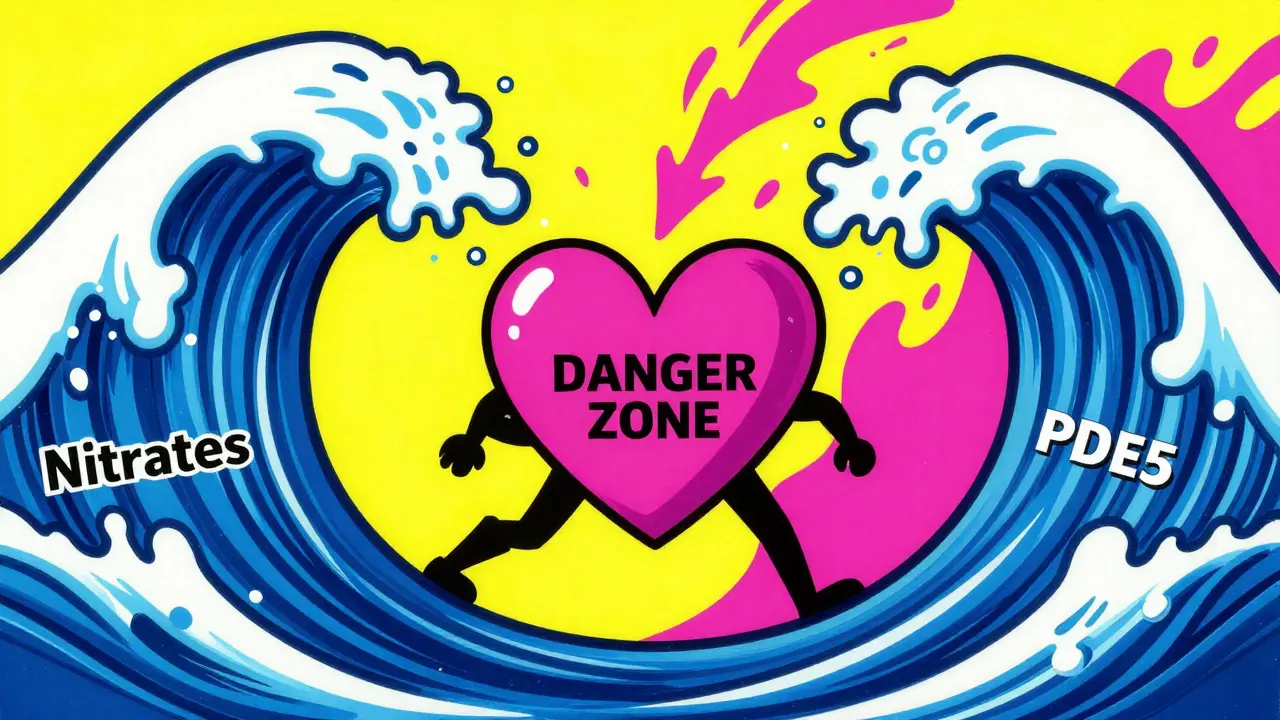
If you take Nitrates, you must avoid PDE5 inhibitors entirely. This isn't a suggestion; it's an absolute medical contraindication. Nitrates-used to treat angina (chest pain)-work through the same nitric oxide pathway as ED pills but are far more potent. When you combine them, they create a synergistic effect that can crash your blood pressure.
Clinical data shows that while an ED pill alone drops blood pressure slightly, combining it with an organic nitrate can cause a systolic pressure drop of 25 to 51 mmHg. This can lead to a hypotensive crisis, where your brain and heart aren't getting enough oxygen. In severe cases, this leads to syncope (fainting), myocardial infarction (heart attack), or a stroke.
It's important to realize that nitrates come in many forms. It's not just the pills you swallow. The danger includes:
- Sublingual nitroglycerin tablets or sprays for acute chest pain.
- Long-acting patches or tablets like Isosorbide mononitrate (Imdur) or Isosorbide dinitrate (Isordil).
- Amyl nitrite, often referred to as "poppers," used recreationally.
Real-world reports highlight the danger. For instance, a 62-year-old man reported on a heart failure forum that taking sildenafil while using nitroglycerin for angina caused his blood pressure to plummet to 70/40 mmHg, requiring immediate hospitalization. The FDA has documented nearly 90 deaths directly linked to these interactions over a four-year period.
Alpha-Blockers: The Hidden Danger for Prostate Patients
Many men who struggle with ED also deal with Benign Prostatic Hyperplasia (BPH), an enlarged prostate. To treat this, doctors often prescribe Alpha-Blockers. These drugs relax the muscles in the bladder neck and prostate to make urination easier.
The risk here is similar to nitrates but usually less severe-unless you aren't careful. Because alpha-blockers also lower blood pressure, taking them alongside a PDE5 inhibitor can cause symptomatic hypotension. You might feel a sudden wave of dizziness or vertigo, especially when standing up quickly. This is particularly risky with non-selective alpha-blockers like phenoxybenzamine.
If you are on an alpha-blocker, the strategy is "low and slow." Experts recommend starting with the lowest possible dose of an ED medication-such as sildenafil at 25mg or tadalafil at 5mg. Furthermore, you should be stable on your alpha-blocker therapy for a while before introducing an ED pill. Some guidelines even suggest leaving a 48-hour gap between doses to maximize safety.
Is Your Heart Ready for ED Medication?
Because erectile dysfunction is often one of the first "canaries in the coal mine" for cardiovascular disease, a prescription shouldn't be the first step. If you're over 45, or if you have diabetes or high blood pressure, a full cardiac evaluation is a must. The goal is to ensure your heart can handle the physical exertion of sexual activity, regardless of whether the medication itself is safe.
Doctors generally use a "METs" (metabolic equivalents) test to determine safety. If you can achieve 4 METs of activity-roughly the effort it takes to walk briskly or climb two flights of stairs-without chest pain or extreme shortness of breath, you're likely a candidate for these medications. However, if you've had a heart attack or stroke in the last six months, or if you have unstable angina, these medications are strictly off-limits.

Safe Alternatives and Future Directions
For men who cannot use PDE5 inhibitors due to heart conditions, the medical world is moving toward non-drug options. Shockwave therapy and acoustic wave treatments have seen a massive surge in popularity because they don't affect systemic blood pressure. They work by stimulating the growth of new blood vessels in the penis rather than relying on a chemical reaction in the bloodstream.
There is also hope for better drug delivery. New research into topical formulations of avanafil has shown that applying the medication as a gel can reduce the impact on systemic blood pressure by up to 87% compared to oral pills. By keeping the drug local, the risk of a heart-threatening blood pressure drop is virtually eliminated.
Can I take Viagra if I use a nitroglycerin spray for chest pain?
No. You should never take any PDE5 inhibitor, including sildenafil (Viagra), if you use any form of nitrates, including sprays. The combination can cause a sudden, life-threatening drop in blood pressure that can lead to a heart attack or stroke.
Do I need to stop taking alpha-blockers before using Cialis?
You don't necessarily need to stop, but you must consult your doctor. The safest approach is to be stable on your alpha-blocker first and then start the ED medication at the lowest possible dose. Some doctors recommend a 48-hour window between doses to avoid dizziness.
Are there ED pills that don't affect blood pressure?
All oral PDE5 inhibitors lower blood pressure to some extent. However, emerging topical formulations and non-pharmaceutical options like shockwave therapy do not cause systemic blood pressure drops and may be safer for heart patients.
What are the warning signs of a dangerous drug interaction?
Immediate red flags include severe dizziness, feeling like you might faint (syncope), a sudden racing heart, or extreme lightheadedness when standing. If these occur, seek emergency medical attention immediately.
Can low-dose Tadalafil actually help the heart?
Some recent research suggests that very low doses of Tadalafil (2.5mg daily) may improve endothelial function in men with stable coronary artery disease. However, this is only for stable patients who have been fully screened and cleared by a cardiologist.
What to Do Next
If you're currently taking any medication for your heart or prostate, your first move should be a medication audit. List every supplement and prescription you use and bring that list to your doctor. Don't rely on memory-bring the actual bottles.
If you've been using telemedicine services to get ED pills, be cautious. Ensure the provider has a full picture of your cardiac health and isn't just checking a box. If you're unsure about your heart health, ask for a stress test or a METs evaluation before taking your first dose. Your sex life is important, but your heart health is non-negotiable.
Betty Kawira
April 29, 2026 AT 06:07Just a heads up for anyone reading this, if you're using those online pharmacies that don't require a real doctor's visit, you're playing a dangerous game with your heart. Always double check your med list with a real pro before trying any of these pills.
Dale Kensok
April 29, 2026 AT 16:12The systemic hemodynamic collapse described here is a textbook example of synergistic pharmacological antagonism. One must consider the pharmacokinetic profile and the half-life of PDE5 inhibitors before attempting any concurrent administration of alpha-adrenergic antagonists to avoid orthostatic hypotension. It's quite elementary that the titration of such potent vasodilators requires a sophisticated understanding of vascular resistance and systemic perfusion indices to mitigate the risk of a cardiovascular event. Most layman interpretations of this risk fail to account for the precise molecular modulation of cGMP levels in the smooth muscle cells. The precipitous drop in systolic pressure isn't just a "plunge," it's a catastrophic failure of homeostatic autoregulation within the arterial network. We are talking about a profound disruption of the nitric oxide pathway that transcends simple drug interaction. The sheer audacity of some to ignore these contraindications is a testament to the cognitive decline of the general public. This is a critical failure of health literacy at a systemic level. Such pharmacological volatility demands a level of clinical precision that the current telemedicine landscape completely ignores. Truly, the lack of rigorous adherence to these guidelines is an affront to basic medical science.
Amber McCallum
April 30, 2026 AT 22:33People just want quick fixes for their broken spirits and bodies. You can't just pop a pill and expect the universe to align if your heart is literally failing. Just eat some greens and find peace.
Timothy Brown
May 1, 2026 AT 18:35Typical. Men think they can cheat death and aging with a blue pill and then act surprised when they pass out in the bedroom.
Kevin Taggart
May 3, 2026 AT 02:42i didnt know about the poppers thing... thnx for warnin us :)
Jean Robert
May 4, 2026 AT 06:26It is so important to remember that we are all just doing our best to navigate these health challenges and it's okay to feel a bit overwhelmed by the medical jargon. If you're feeling scared about these interactions, just know that your doctor is there to help you find a path that keeps you safe and healthy while still improving your quality of life. You've got this and staying proactive about your heart health is a wonderful way to show yourself some love and respect.
Thomas Jorquez
May 4, 2026 AT 08:04The caution regarding the METs test is very appropriate. One should not overlook the importence of physical readiness.
Darrin Oneto
May 4, 2026 AT 21:42Man, that blood pressure drop sounds like a total wipeout. Glad there's other ways to get things jumpin' without crashing your ticker.
Justin Crice
May 6, 2026 AT 08:14The efficacy of topical avanafil in minimizing systemic bioavailability is an intriguing development in pharmacokinetics.
lalit adesara
May 8, 2026 AT 07:09Western medicine is a joke. India has better natural ways. Pathetic.
Peter Minto
May 9, 2026 AT 16:41Who cares bout the rules? Just take the pill and deal with it. America needs more grit!
Jonathan Hall
May 11, 2026 AT 06:24While I understand the urgent need for safety, I think it is vital that we approach this conversation with an open heart and recognize that different cultures handle health and sexuality in various ways, although I must say that the reckless disregard for these chemical warnings is absolutely infuriating and dangerous to the point of being criminal.
Michael Yoste
May 11, 2026 AT 08:25I totally get where you're coming from, but honestly, if you're taking nitrates, you've already failed the basic health test. Just follow the rules, buddy!