Deprescribing Frameworks: How to Safely Reduce Medications and Cut Side Effects

Medication Risk Assessment Tool
Assess Your Medication Burden
Why This Matters
Key Insight: By age 65, nearly 40% of adults globally are taking five or more medications—a condition called polypharmacy. The more pills you take, the higher your chance of a bad reaction.
Deprescribing Benefits
- 65% of older adults felt relieved after reducing medications (better sleep, less stomach upset, less confusion)
- Studies show deprescribing reduces medication burden without increasing hospitalizations or deaths
- Deprescribing can improve quality of life without sacrificing health
Results
Your Risk Assessment
Potential Benefits
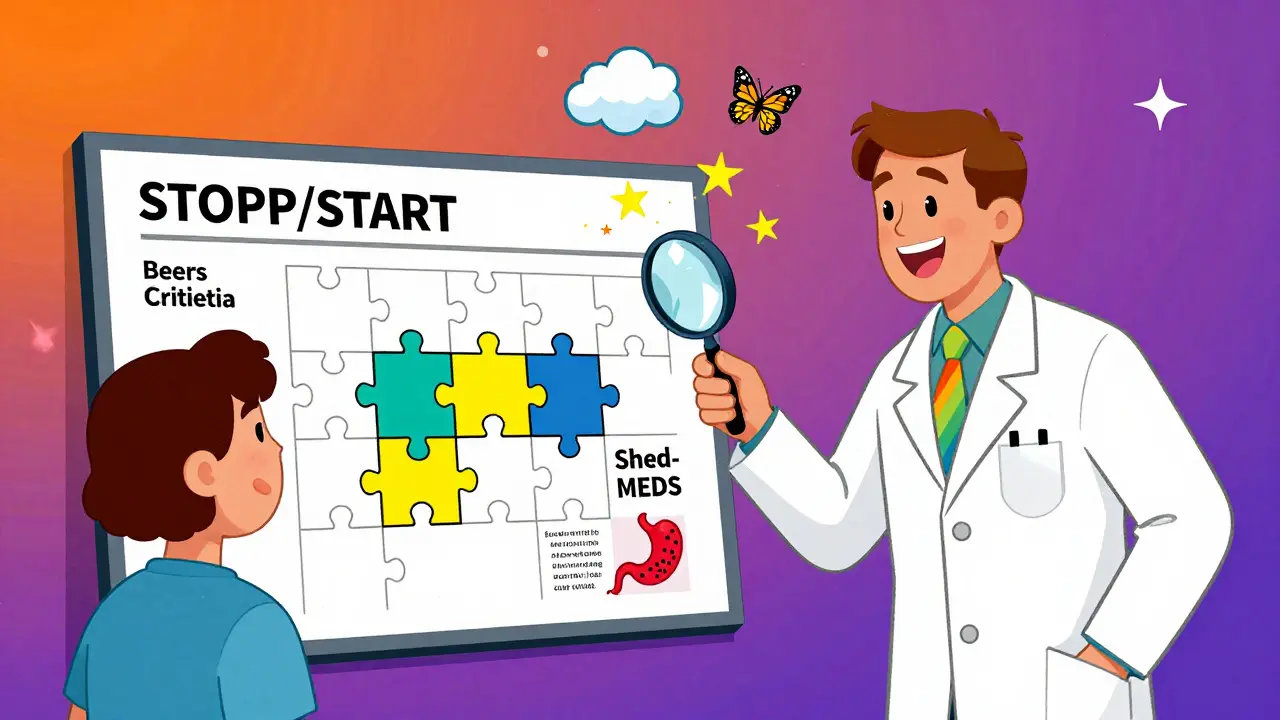
Next Step: Discuss these findings with your healthcare provider. Consider using tools like the Beers Criteria or STOPP/START guidelines to identify medications that might be candidates for safe reduction.
Every year, millions of older adults take more medications than they need. Some of these drugs were prescribed years ago for conditions that no longer exist. Others were meant to treat short-term problems but became long-term habits. And many are causing more harm than good-dizziness, confusion, falls, stomach bleeds, even hospital stays. The answer isn’t always to add another pill. Sometimes, it’s to stop one.
What Is Deprescribing, Really?
Deprescribing isn’t just quitting drugs. It’s a careful, step-by-step process of reviewing every medication a person takes and deciding which ones can be safely stopped. The goal? Reduce side effects, lower the risk of dangerous interactions, and improve quality of life-without sacrificing health.This approach became a formal clinical strategy around 2010, led by researchers in Canada who saw how often older patients were drowning in pills. Today, it’s backed by solid evidence: deprescribing reduces medication burden without increasing hospitalizations or deaths. In fact, studies show patients often feel better after stopping unnecessary drugs.
It’s not about cutting corners. It’s about being smarter. Just like you wouldn’t start a drug without a reason, you shouldn’t keep taking one without checking if it still makes sense.
Why So Many People Are Taking Too Many Medications
Most people don’t end up on 10 or 12 pills by accident. It happens slowly. A patient gets a prescription for acid reflux. Then a sleep aid. Then a painkiller. Then a cholesterol drug. Each one makes sense on its own. But together? They pile up.By age 65, nearly 40% of adults globally are taking five or more medications-a condition called polypharmacy. For those with chronic illnesses like diabetes, heart disease, or arthritis, it’s even higher. And here’s the problem: the more pills you take, the higher your chance of a bad reaction.
One major study found that inappropriate polypharmacy contributes to 30% of hospital admissions in people over 65. Many of those admissions could have been avoided if someone had looked back at the list and asked: “Do we still need this?”
Doctors aren’t ignoring the issue. They’re just overwhelmed. A typical primary care visit lasts 7 to 10 minutes. That’s not enough time to review 12 medications, check for interactions, talk to the patient about their goals, and decide what to stop.
The Five Key Medication Classes Targeted by Deprescribing
Not all drugs are equally risky. Deprescribing frameworks focus on five classes where the harm often outweighs the benefit, especially in older adults:- Proton-pump inhibitors (PPIs) - Used for heartburn, but many take them for years without a clear reason. Long-term use raises risk of bone fractures, kidney damage, and infections.
- Benzodiazepines and sleep aids - These can cause drowsiness, memory loss, and falls. Many older adults take them for insomnia, but non-drug options like sleep hygiene work better and safer.
- Antipsychotics - Sometimes prescribed for agitation in dementia, even though they increase stroke risk and don’t fix the root problem.
- Antihyperglycemics - Blood sugar drugs like sulfonylureas can cause dangerous low blood sugar in older adults, especially if their diabetes is well-controlled or they’re not eating much.
- Opioid painkillers - Often continued long after acute pain has healed, leading to dependence, constipation, and confusion.
Each of these has a clear, evidence-based deprescribing pathway. For example, the PPI guideline says: check if the original reason still exists, try reducing the dose gradually over 4 to 8 weeks, and monitor for rebound symptoms. No sudden stops. No guesswork.
How Deprescribing Works: The Shed-MEDS Framework
One of the most proven methods is called Shed-MEDS. It’s a simple four-step system used in hospitals and clinics:- Best Possible Medication History - Get the full list from the patient, family, pharmacy records, and past charts. Don’t trust memory.
- Evaluate - Use tools like STOPP/START criteria or the Beers Criteria to flag drugs that are risky or unnecessary.
- Deprescribing Recommendations - Decide which meds can be stopped, tapered, or switched. Prioritize the highest-risk ones first.
- Synthesis - Put it all together with the patient. Explain why you’re making these changes and what to watch for.
A 2023 clinical trial showed this method reduced the average number of medications per patient from 11.3 to 9.5 at discharge-and kept it low 90 days later. Crucially, there was no increase in bad outcomes. No more falls. No more ER visits. Just fewer pills and better function.
Who Should Lead Deprescribing? Pharmacists Are Key
Doctors can’t do it alone. The most successful deprescribing programs involve pharmacists-specifically those trained in medication therapy management (MTM). These pharmacists spend hours reviewing charts, talking to patients, and coordinating with prescribers.Studies show deprescribing success rates jump 35% to 40% when pharmacists are involved. Why? They have the time. They’re trained to spot hidden risks. They know how to taper safely.
But here’s the catch: only 28% of U.S. primary care practices have formal deprescribing protocols. In Canada, where a national program called DIGE has been running since 2018, the number is 63%. The difference? System support.
Successful programs don’t rely on one overworked doctor. They build teams: pharmacists, nurses, physicians, and patients working together. They use electronic health record alerts that flag high-risk meds. They train staff to ask: “When was this last reviewed?”
What Patients Say About Stopping Medications
Many patients are scared to stop pills they’ve taken for decades. “This is what my doctor told me to take,” they say. “What if I get sick without it?”A 2022 study found that 65% of older adults felt relieved after reducing their medications. They slept better, had less stomach upset, and felt less confused. But 22% felt anxious-especially about stopping sleep aids or heart meds.
The key? Communication. Don’t just hand someone a list of drugs to quit. Sit down. Explain why. Show them the evidence. Let them ask questions. Reassure them that stopping doesn’t mean giving up care-it means getting smarter care.
One pharmacist in Ohio reported tapering 18 out of 22 patients off benzodiazepines over six months. Only two had mild withdrawal symptoms-and those were managed quickly. “They thanked me afterward,” she said. “They said they finally felt like themselves again.”
Barriers to Getting It Done
Even with strong evidence, deprescribing is still rare in many clinics. Why?- Time - Most visits are too short for deep medication reviews.
- Tools - Only 32% of clinicians feel their EHR systems help them identify deprescribing opportunities.
- Guidelines - Out of 3,569 recommendations in major clinical guidelines, only 7% mention deprescribing. Most still focus on adding drugs, not removing them.
- Training - Medical schools barely teach deprescribing. Most doctors learned to prescribe, not to stop.
There’s also fear. Some worry stopping a drug will cause harm. But the data says otherwise. In the same trial that showed medication reductions, the rate of adverse events was nearly identical between those who deprescribed and those who didn’t.
Dr. Amy Gravely put it best: “Deprescribing is not simply stopping medications-it’s a structured clinical process that requires the same rigor as initiating therapy.”
What’s Changing in 2025 and Beyond
The tide is turning. In June 2024, the American Medical Association issued its first policy urging physicians to routinely review all medications. Starting in 2026, Medicare will start measuring deprescribing as part of provider performance ratings.The FDA has funded over $8 million in deprescribing research since 2020. The European Union now lists it as a top priority. And researchers are working on AI tools that scan EHRs and flag drugs that should be reconsidered.
By 2030, experts predict deprescribing assessments will be as routine as checking blood pressure. The goal? A 40% drop in medication-related hospitalizations among older adults.
But there’s still a gap. Of the 500+ common medication combinations used in older adults, less than half have clear deprescribing guidance. That’s where the next wave of research is headed.
Where to Start: Free Tools for Clinicians and Patients
You don’t need fancy software to begin deprescribing. These free, evidence-based resources are ready to use today:- deprescribing.org - Offers step-by-step algorithms for PPIs, benzodiazepines, antipsychotics, and more. Downloadable, printable, and easy to follow.
- STOPP/START Criteria (Version 3, 2021) - A checklist to identify potentially inappropriate prescriptions and missed opportunities for needed drugs.
- Beers Criteria (2023 Update) - Lists 34 medications to avoid or use with caution in older adults. Updated every two years by the American Geriatrics Society.
These aren’t just guidelines. They’re safety nets. Use them to start conversations-not to dictate decisions, but to guide them.
Final Thought: Less Is Sometimes More
Medicine has gotten really good at adding treatments. Now it’s time to get good at removing them. Deprescribing isn’t about cutting corners. It’s about cutting clutter.For older adults, fewer pills often mean more energy, fewer falls, clearer thinking, and better days. It’s not about living longer. It’s about living better.
Ask yourself: Is this medication still helping? Or is it just another thing to manage? Sometimes, the most powerful prescription is the one you don’t take.
Ian Long
January 10, 2026 AT 10:09Man, I’ve seen this play out with my dad. He was on 14 meds at 78. Got him down to 6. He started sleeping through the night, stopped stumbling in the hallway, and actually remembered his own birthday. No magic pill-just someone who asked, ‘Do we still need this?’
Patty Walters
January 11, 2026 AT 03:32my dr never even asked if i still took my acid reflux pill. i stopped it on my own after 5 years and my stomach stopped acting up. turns out i was just eating too late. who knew? 🤷♀️
Phil Kemling
January 12, 2026 AT 04:12There’s a deeper philosophical question here: if medicine is meant to restore balance, why do we treat the body like a machine that only needs more parts? Deprescribing isn’t just clinical-it’s a reclamation of autonomy. We’ve been taught that more intervention equals better care. But sometimes, the body knows how to heal itself if we just stop interfering.
The real tragedy isn’t polypharmacy-it’s the erosion of trust in our own physiology. We’ve outsourced our health to prescriptions, and now we’re afraid to be without them. What if the answer isn’t another drug… but silence?
tali murah
January 12, 2026 AT 20:59Oh, so now we’re going to ‘deprescribe’ because doctors are too lazy to manage medications properly? Let me guess-the next thing you’ll say is that we should stop brushing our teeth because ‘it’s just a habit.’ This isn’t innovation. It’s negligence dressed up as wisdom. People die from stopping meds without supervision. This is dangerous pseudoscience.
Jenci Spradlin
January 13, 2026 AT 21:02just read this and went through my mom’s pill organizer. found 3 things she hasn’t taken in 3 years. one was for a UTI she had in 2019. another was for anxiety that got resolved with therapy. the third? i have no idea. she just kept taking it. we tossed them all. she’s been more alert since. thanks for the reminder.
Heather Wilson
January 15, 2026 AT 03:37Let’s be honest: this entire ‘deprescribing’ movement is a cost-cutting scheme disguised as patient care. Insurance companies don’t want to pay for expensive drugs, so they’re pushing doctors to pull prescriptions. And now we’re supposed to applaud this as ‘smart medicine’? The fact that 30% of hospitalizations are due to polypharmacy doesn’t mean we should stop treating people-it means we need better monitoring, not fewer drugs. This is dangerous reductionism.
And don’t even get me started on pharmacists leading this. They’re not doctors. They don’t have the training to make clinical decisions about complex chronic conditions. This is a slippery slope toward pharmacy-driven medicine, and it’s terrifying.
Also, who approved this article? The tone is so sanctimonious. ‘Less is more’? That’s not medicine-that’s a self-help slogan. Real medicine is messy. It’s complicated. And it requires constant adjustment, not blanket reductions based on some checklist.
And for the love of God, stop telling patients to ‘feel better’ after stopping meds. What if they get worse? Who’s liable? You? The pharmacist? The internet blogger who wrote this? This isn’t empowerment. It’s malpractice waiting to happen.
Micheal Murdoch
January 16, 2026 AT 23:06I’ve been working with geriatric patients for 22 years, and I’ve seen the quiet revolutions happen-not in hospitals, but in living rooms. An elderly woman stops her nighttime benzos and starts reading before bed. A man with diabetes stops his sulfonylurea and eats dinner with his grandkids again without fear of passing out. These aren’t just clinical wins-they’re human ones.
Deprescribing isn’t about taking away. It’s about returning. Returning energy. Returning clarity. Returning dignity. The pills weren’t the cure-they were the cage. And we’ve been so focused on adding more locks, we forgot to ask if the door was even locked in the first place.
It’s not about being lazy. It’s about being thoughtful. And if your doctor hasn’t asked you about your meds in over a year? That’s the real red flag.
Chris Kauwe
January 17, 2026 AT 21:40Deprescribing? Sounds like another liberal, technocratic overreach designed to neuter American healthcare. We used to trust our doctors. Now we’re being told to question them because some ‘framework’ says so? This isn’t science-it’s ideology masquerading as evidence. The FDA funds this? The EU endorses it? What’s next-banning aspirin because ‘it’s overprescribed’? We’re sliding into a dystopia where the state decides what your body can handle. And it’s not about health-it’s about control.
And don’t give me that ‘fewer pills, better life’ nonsense. My grandfather took 11 meds. He lived to 94. He was sharp until the end. You want to cut meds? Fine. But don’t pretend you know better than decades of clinical experience. This is dangerous, un-American, and frankly, arrogant.
RAJAT KD
January 19, 2026 AT 12:36My uncle in Delhi was on 8 meds. We stopped 3 after a pharmacist reviewed them. He stopped feeling dizzy. Started walking again. No drama. Just logic. This isn’t new. It’s basic.
Pooja Kumari
January 20, 2026 AT 00:00Oh my god, I just realized my mom has been taking that sleep pill for 12 years. She says she can’t sleep without it. But she also says she’s always tired. And she’s always forgetting where she put her keys. And she cries at commercials. I think… I think we’ve been poisoning her with kindness. I’m calling her pharmacist tomorrow. I’m so mad at myself for not seeing this sooner. I love her so much. I just didn’t know.
Jacob Paterson
January 20, 2026 AT 11:14Oh wow. So now we’re supposed to trust a pharmacist over a doctor? That’s the new gospel? Next thing you know, we’ll be letting nurses prescribe opioids and pharmacists write insulin scripts. This is how medicine becomes a Walmart pharmacy aisle. You think ‘STOPP/START’ is a clinical tool? It’s a checklist for liability avoidance. Real medicine requires judgment. Not algorithmic reductionism. And if you’re telling older adults to ‘feel like themselves again’ after stopping meds, you’re not helping-you’re gaslighting them.
Elisha Muwanga
January 22, 2026 AT 05:55Let’s be clear: this is a direct attack on the American healthcare industrial complex. Why do you think Big Pharma funds 80% of clinical guidelines? Because they profit from perpetual prescriptions. Deprescribing threatens their $1.3 trillion market. So they smear it as ‘risky’ or ‘unscientific.’ But the data doesn’t lie. Stopping unnecessary meds saves lives. It saves money. And it restores autonomy. This isn’t radical. It’s overdue. The real danger is continuing business as usual.
And yes, pharmacists should lead this. They’re the only ones who have the time, training, and incentive to do it right. Doctors are overworked. Nurses are stretched thin. But pharmacists? They’re the only ones who sit down, open the chart, and ask: ‘Why are you taking this?’
Stop calling it ‘cutting corners.’ Call it what it is: reclaiming the soul of medicine.
Alicia Hasö
January 23, 2026 AT 02:24My grandma took her last pill last week. She’s 89. She’s been off her statin, her PPI, her sleep aid, and her ‘for your heart’ aspirin. She says she feels ‘lighter.’ Like she’s not carrying a backpack full of pills. She’s gardening again. Laughing more. She told me, ‘I didn’t know I was tired because of the medicine.’
This isn’t about taking away. It’s about giving back. The time. The energy. The peace. We’ve been so obsessed with fixing, we forgot to let people just be.
Thank you for writing this. I’m printing it out and handing it to my dad’s doctor tomorrow. No more blind obedience. We’re taking back control.
Ashley Kronenwetter
January 24, 2026 AT 23:26While the intent behind deprescribing is commendable, the implementation requires rigorous adherence to evidence-based protocols and individualized risk-benefit analysis. Without standardized decision support tools integrated into electronic health records, the potential for adverse outcomes increases significantly. Furthermore, patient autonomy must be balanced with clinical oversight to prevent premature discontinuation of medications that may still provide therapeutic benefit. The proposed frameworks, while useful, should be applied within a multidisciplinary context to ensure patient safety remains paramount.
Ian Long
January 24, 2026 AT 23:54Heather, you’re right-this isn’t a checklist. It’s a conversation. But you’re also ignoring the data. In the 2023 trial, the group that deprescribed had fewer ER visits than the control group. No one’s suggesting we pull meds overnight. We’re suggesting we ask: ‘Is this still serving you?’ That’s not negligence. That’s accountability.