CoQ10 for Statin Muscle Pain: What the Research Actually Says
CoQ10 Supplementation Planner for Statin Users
Personalized Protocol Generator: Answer a few questions about your current situation to receive a tailored CoQ10 supplementation plan based on clinical research findings.
What are you currently taking?
Describe your symptoms
Personal factors
Your Personalized CoQ10 Protocol
Recommended Approach:
- Start with 200mg Ubiquinol daily
- Take with a meal containing healthy fats
- Expect improvements in 4-8 weeks
- Track your symptoms weekly
Key Tips for Success:
⚠️ Important Reminders:
- Don't stop your statin without consulting your doctor
- Monitor for any changes in symptoms
- Consider getting CK levels checked if symptoms worsen
Statins are the gold standard for lowering cholesterol and preventing heart attacks. But for millions of people, they come with a painful price tag: muscle aches, weakness, and cramps. If you’ve been told to "just push through" the pain or switch to another drug that might cause the same issue, you’re not alone. This is known as Statin-Associated Muscle Symptoms (SAMS), and it affects up to 20% of users. Many turn to Coenzyme Q10, also known as ubiquinone, hoping it will fix the problem without stopping their life-saving medication. But does it actually work? The answer isn’t a simple yes or no-it’s complicated by conflicting studies, different supplement forms, and individual biology.
The Theory: Why Statins Might Drain Your Energy
To understand why CoQ10 is suggested, we have to look at how statins work. Statins block an enzyme called HMG-CoA reductase to stop your liver from making cholesterol. The problem? That same pathway is used by your body to produce Coenzyme Q10 naturally. Think of CoQ10 as the spark plug in your cells’ engines (mitochondria). It helps convert food into energy. When statins lower your CoQ10 levels-some studies show a drop of 16% to 54% in blood circulation-your muscles may struggle to get the fuel they need, leading to fatigue and pain.
This biological link makes perfect sense on paper. However, science often hits roadblocks when moving from theory to practice. While blood levels of CoQ10 definitely drop with statin use, some research shows that CoQ10 levels inside the actual muscle tissue don’t always decrease. In fact, two studies reported increases in intramuscular CoQ10 despite statin therapy. This disconnect between blood tests and muscle reality is a major reason why clinical trials have produced mixed results.
What the Clinical Trials Say
If you read medical journals, you’ll find a battle of headlines. Some studies claim CoQ10 is a miracle cure for SAMS; others say it’s useless. Let’s break down the data without the hype.
| Study / Source | Participants | Dosage & Duration | Outcome |
|---|---|---|---|
| JAHA Meta-Analysis (2018) | 575 patients | Varied (up to 600mg/day) | Significant reduction in pain, weakness, and tiredness scores. |
| Caso et al. (2007) | Small trial | 100 mg/day for 30 days | Significant pain reduction compared to placebo. |
| Fedacko Study (PMC4226312) | Unspecified | 50 mg twice daily for 30 days | 33% reduction in pain intensity vs. 0.4% in placebo group. |
| Young et al. (2007) | Pilot study | 200 mg/day for 12 weeks | No improvement in statin tolerance despite higher blood CoQ10 levels. |
| NLA Position (2013/Updated) | Review of evidence | N/A | Evidence remains inconclusive due to small sample sizes and varied methods. |
The 2018 meta-analysis published in the Journal of the American Heart Association is one of the most cited pieces of evidence supporting CoQ10. It analyzed 12 randomized controlled trials and found that patients taking CoQ10 had significantly lower scores for muscle pain, weakness, and tiredness than those on a placebo. Specifically, muscle pain scores dropped by an average of 1.6 points on standardized scales.
However, skeptics point out flaws. Many of these trials were small, often involving fewer than 100 people. They also used different ways to measure "pain," making it hard to compare results directly. Furthermore, while pain scores improved, there was no significant change in creatine kinase (CK) levels-a blood marker for muscle damage. This suggests CoQ10 might help with the *sensation* of pain rather than repairing actual muscle injury.

Real-World Experiences vs. Medical Data
There is often a gap between what doctors see in controlled trials and what patients experience in their living rooms. Online communities paint a picture that leans positive, though not universal.
- Reddit Surveys: In a 2023 thread on r/Supplements, 78% of respondents who tried CoQ10 for statin-related pain reported some relief. One user noted that 200mg daily eliminated leg cramps within three weeks.
- Patient Forums: Data from Inspire.com’s Statin Support Community showed that while 58% of members tried CoQ10, only 32% described "significant improvement." The rest saw minor changes or none at all.
- Product Reviews: Amazon reviews for top CoQ10 brands frequently mention "statin muscle pain" in positive feedback, with many users rating the supplement 4.2 out of 5 stars specifically for this purpose.
Why the difference? It could be the placebo effect, which is powerful in pain management. Or it could be that real-world users give themselves more time to adjust, whereas clinical trials have strict timelines. Regardless, if 70-80% of anecdotal reports are positive, it’s worth considering for those suffering from mild to moderate symptoms.
How to Try CoQ10 Safely and Effectively
If you decide to test whether CoQ10 helps your statin-induced muscle pain, you need to do it right. Taking a cheap pill once a week won’t cut it. Here is a practical guide based on expert recommendations and successful trial protocols.
- Choose the Right Form: There are two main forms: Ubiquinone (oxidized) and Ubiquinol (reduced). Ubiquinol is the active antioxidant form and is absorbed much better by the body, especially in adults over 40. Look for "Ubiquinol" on the label. Some brands claim it is 3-8 times more bioavailable than standard Ubiquinone.
- Dosing Matters: Most successful studies used doses between 100 mg and 200 mg per day. Some went up to 600 mg, but higher doses don’t always mean better results. Start with 100-200 mg daily.
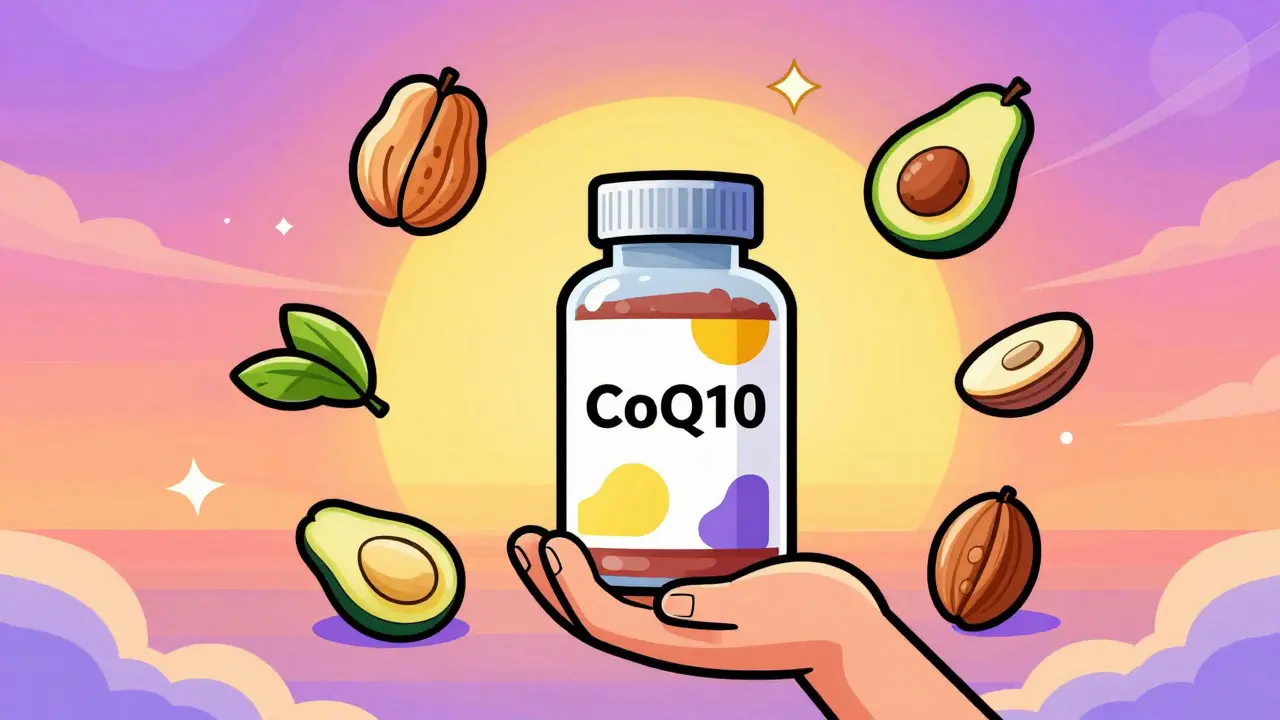
- Take It With Fat: CoQ10 is fat-soluble. If you take it with black coffee on an empty stomach, you’re wasting money. Take it with a meal containing healthy fats (like avocado, nuts, or olive oil) to boost absorption.
- Be Patient: This isn’t Tylenol. You won’t feel better in an hour. Clinical trials typically required 4 to 12 weeks to see significant improvements. Give it at least 3 months before deciding it doesn’t work.
- Check Interactions: CoQ10 is generally safe, but it can interact with blood thinners like Warfarin. Always tell your doctor before adding any new supplement to your regimen.
Cost and Accessibility
One advantage of CoQ10 is its affordability compared to other solutions. Switching to a different statin or trying non-statin cholesterol medications can cost hundreds of dollars a month depending on your insurance. A quality Ubiquinol supplement typically costs between $15 and $40 per month. Given the safety profile-with no serious adverse events reported in decades of use-it’s a low-risk experiment for many patients.
However, quality varies wildly. The FDA does not regulate supplements as strictly as drugs. Look for third-party testing seals from organizations like USP, NSF, or ConsumerLab to ensure the bottle contains what it claims. Cheap, untested brands may contain little to no active ingredient.
When CoQ10 Isn't Enough
CoQ10 works best for mild-to-moderate muscle aches. If you are experiencing severe weakness, dark urine (a sign of rhabdomyolysis), or intense pain that limits your daily activities, CoQ10 alone is unlikely to solve the problem. In these cases, you need immediate medical attention.
Your doctor might suggest:
- Lowering your statin dose.
- Switching to a different statin (e.g., from simvastatin to rosuvastatin).
- Taking the statin every other day instead of daily.
- Adding ezetimibe or PCSK9 inhibitors if cholesterol control is critical.
Don’t stop your statin abruptly without consulting your cardiologist. The risk of a heart attack or stroke usually outweighs the discomfort of muscle pain, provided the pain is manageable.
How long does it take for CoQ10 to relieve statin muscle pain?
Most clinical trials and patient reports suggest it takes between 4 to 12 weeks to notice a significant difference. Some people report slight improvements within 2-3 weeks, but giving it a full 3-month trial is recommended before concluding it is ineffective.
Is Ubiquinol better than Ubiquinone for statin users?
Yes, Ubiquinol is generally considered superior for older adults and those with absorption issues. It is the reduced, active form of CoQ10 and has significantly higher bioavailability. Since statins already stress the body's production systems, starting with the easier-to-absorb form is a logical choice.
Can CoQ10 raise my cholesterol levels?
No. Current research indicates that CoQ10 supplementation does not interfere with the cholesterol-lowering effects of statins. It works on mitochondrial energy production, not lipid metabolism, so your LDL numbers should remain stable while potentially reducing side effects.
Are there any side effects of taking high-dose CoQ10?
CoQ10 is very well-tolerated. Mild side effects can include insomnia (if taken too late in the day), upset stomach, or nausea. Serious side effects are rare. However, because it may affect blood clotting, caution is advised if you are taking anticoagulants like Warfarin.
Should I stop taking my statin if I start CoQ10?
Absolutely not. CoQ10 is intended to be taken with your statin to mitigate side effects, not replace it. Stopping statins without medical supervision can rapidly increase your cardiovascular risk. Always coordinate supplement changes with your healthcare provider.