Carbamazepine Generics: Understanding Enzyme Induction and Drug Interactions
Dealing with seizures often feels like a balancing act. When you're finally stable on a medication, the last thing you want is a surprise change in how your body processes that drug. For people taking Carbamazepine is an antiepileptic drug used to treat focal and generalized tonic-clonic seizures , the switch to a generic version can sometimes trigger a chain reaction in the body. This isn't just about the brand name; it's about how this specific molecule interacts with your liver and other medications.
If you've noticed breakthrough seizures or new side effects after your pharmacy switched your pills, you aren't imagining it. Because Carbamazepine is a narrow therapeutic index drug, even a tiny shift in how much is in your blood can be the difference between a seizure-free month and a medical emergency. Let's break down why this happens and what you need to watch for.
The Engine Room: How Enzyme Induction Works
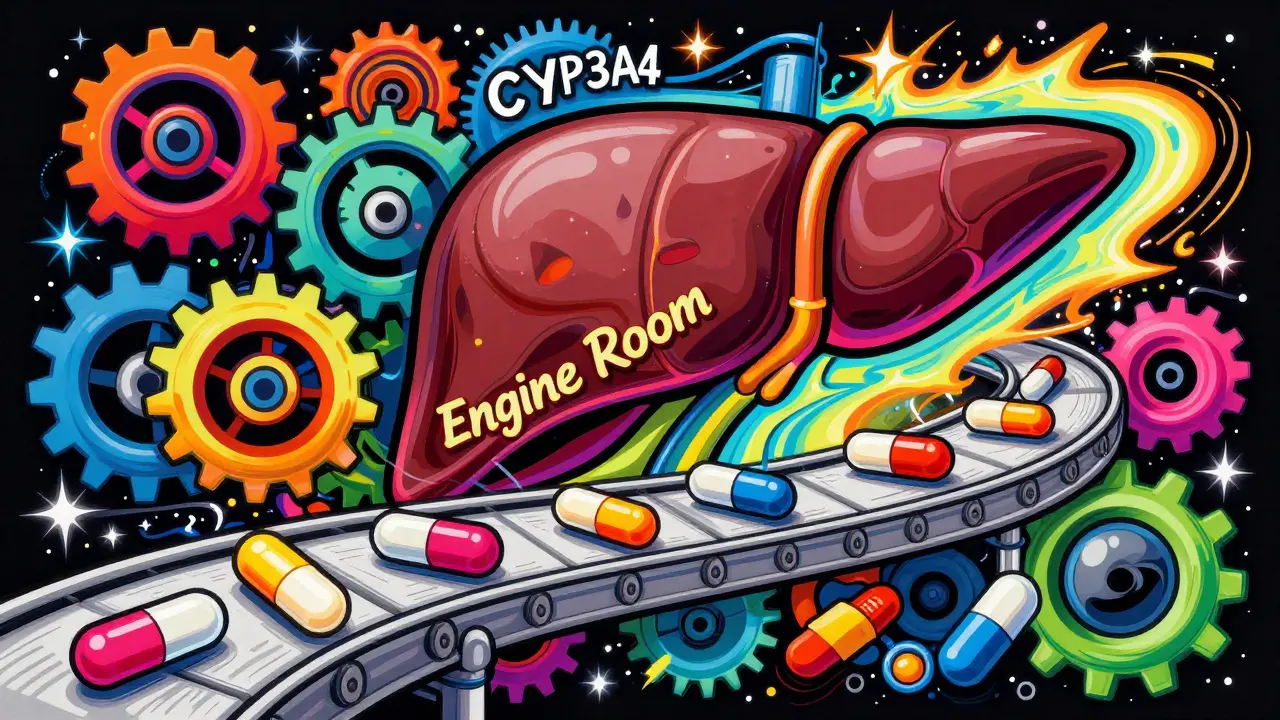
To understand why Carbamazepine is so tricky, you have to look at the liver. Most drugs are broken down by enzymes. Carbamazepine doesn't just get broken down; it actually tells your liver to produce more enzymes to destroy it. This process is called autoinduction.
The main player here is CYP3A4 is a critical cytochrome P450 enzyme responsible for metabolizing about 50% of all marketed medications . When you start Carbamazepine, it ramps up the activity of CYP3A4. This typically starts within 48 to 72 hours and hits full speed after about two to three weeks. Here is the catch: because CYP3A4 handles so many other drugs, Carbamazepine essentially "speeds up" the metabolism of other medications you might be taking, making them less effective.
It doesn't stop there. It also affects UDP-glucuronosyltransferase is an enzyme group involved in the conjugation of drugs to make them easier for the body to excrete and P-glycoprotein transporters. Essentially, your body becomes a high-speed disposal unit for a wide variety of chemicals.
Dangerous Pairings: Common Drug Interactions
Because of this enzyme induction, Carbamazepine can "cancel out" other vital treatments. If your liver is working overtime to clear out drugs, the levels of those meds in your blood drop below the therapeutic window. This can be dangerous depending on what else you're taking.
| Drug Class | Examples | Typical Effect |
|---|---|---|
| Anticoagulants | Warfarin | Reduced blood-thinning effect |
| Immunosuppressants | Cyclosporine, Tacrolimus | Increased risk of organ transplant rejection |
| HIV Medications | Protease Inhibitors | Reduced viral suppression |
| Cardiovascular Drugs | Amlodipine, Felodipine | Lower blood pressure control |
| Other Anticonvulsants | Valproic acid, Topiramate | Lower drug levels, higher seizure risk |
The Generic Gamble: Why One "Same" Pill Isn't Always the Same
You might wonder why your doctor cares if you use Generic A or Generic B if the FDA says they are "bioequivalent." In the world of Narrow Therapeutic Index (NTI) is a classification for drugs where small differences in dose or blood concentration can lead to serious therapeutic failure or toxicity drugs, a 10% difference in absorption isn't just a statistic-it's a clinical problem.
The therapeutic range for Carbamazepine is quite tight, usually between 4 and 12 mcg/mL. If a generic version absorbs slightly slower or faster, or if the "beads" in an extended-release capsule dissolve differently in your gut, your blood levels can dip. For example, a patient might drop from 7.2 to 4.8 mcg/mL simply by switching manufacturers, even if the dose on the label remains 200 mg. This can lead to breakthrough seizures.
Research shows that about 12% of patients experience therapeutic failure or adverse events when switching generics. This is particularly risky for women of childbearing age, as hormonal changes can already influence CYP3A4 metabolism, making them more sensitive to these fluctuations.
Who is Most at Risk?
Not everyone reacts to generics the same way. Certain biological markers and health conditions make these switches more dangerous:
- Asian Populations: There is a critical need to screen for the HLA-B*1502 allele is a genetic marker that significantly increases the risk of severe skin reactions to carbamazepine . People with this marker have a 10-fold higher risk of developing Stevens-Johnson Syndrome (SJS) is a rare, serious disorder of the skin and mucous membranes .
- Patients with Gastroparesis: If your stomach empties slowly, the different bead sizes in various generic extended-release capsules can change how the drug is released, leading to unpredictable levels.
- Polypharmacy Patients: If you are taking multiple antiepileptic drugs, the variability in how your body handles Carbamazepine increases from 25% to 45%, amplifying any small difference between generic brands.

How to Manage a Generic Switch Safely
If you must switch generics-perhaps due to insurance changes or pharmacy stock-don't do it blindly. The gold standard for safety is Therapeutic Drug Monitoring (TDM) is the clinical practice of measuring drug levels in the blood to maintain a therapeutic concentration .
Here is the recommended safety protocol for a transition:
- Baseline Test: Get your blood levels checked right before the switch.
- The 7-14 Day Check: Test your levels again one to two weeks after starting the new generic. This is when the initial absorption difference is most apparent.
- The 4-Week Stabilization: Test again after a month to ensure the levels are steady.
- The 15% Rule: If your blood concentration changes by more than 15%, your doctor should adjust your dose immediately.
To prevent these issues entirely, some neurologists use the "Dispense as Written" (DAW) code on prescriptions. This tells the pharmacist not to substitute the specific manufacturer the doctor chose, keeping your blood levels stable.
Is every generic carbamazepine the same as the brand name?
While the FDA requires generics to be bioequivalent (meaning they have similar absorption rates), the "narrow therapeutic index" of carbamazepine means that even small, legally acceptable differences in how the drug is absorbed can lead to breakthrough seizures or side effects in sensitive patients.
How long does it take for carbamazepine to start affecting other drugs?
The enzyme induction effect usually begins within 48 to 72 hours of starting the medication and typically reaches its maximum strength after 2 to 3 weeks. This means other medications you take may become less effective over the first month of treatment.
Why do some people get a rash with carbamazepine?
While mild rashes can occur, some people have a genetic predisposition (specifically the HLA-B*1502 allele, common in certain Asian populations) that puts them at a high risk for Stevens-Johnson Syndrome, a severe and potentially life-threatening skin reaction.
What should I do if my pharmacy switches my generic brand?
Notify your neurologist immediately. Request a blood test (Therapeutic Drug Monitoring) within 7 to 14 days of the switch to ensure your levels haven't dropped, and ask your doctor about using a "Dispense as Written" instruction to keep the manufacturer consistent.
Does the extended-release version work differently than the immediate-release?
Yes. Extended-release formulations generally show 15-20% less fluctuation in plasma concentrations. This can lead to steadier levels in the blood and potentially fewer side effects, though the risk of generic substitution issues remains.
Next Steps and Troubleshooting
If you are currently stable on a specific version of Carbamazepine, the best move is to stay with that manufacturer. If you notice a change in your seizure frequency or feel "off" after a pharmacy change, don't wait for your next scheduled appointment. Contact your provider and request a serum concentration test.
For those who have experienced instability with generics, ask your doctor about precision dosing. Newer research into genetic polymorphisms (like the CYP3A4*22 variant) is allowing doctors to tailor doses more accurately, reducing the "guesswork" and lowering the risk of adverse events by up to 40%.
David Snyder
April 11, 2026 AT 21:04This is such a helpful breakdown for anyone feeling a bit lost with their meds. It's great to see the science explained so simply so we can all feel more empowered when talking to our doctors!
Mary Johnson
April 13, 2026 AT 11:47Of course they call it "bioequivalent" while they swap your meds behind your back!! It's just another way for Big Pharma to play with our brains and keep us dependent on the system. They don't care if you have a breakthrough seizure as long as the profit margins stay high for the generic manufacturers. It's all a game and we're just the lab rats in their twisted experiment. Wake up people, these "small differences" are intentional to keep us off-balance!!
Sam Dyer
April 14, 2026 AT 01:54Imagine thinking a little swap in a pill makes a difference when American medicine is the gold standard globally 🇺🇸. The FDA doesn't just "guess" on these things, you amateurs. If you can't handle a generic, maybe you're just not cut out for the high-performance lifestyle. Total joke 🤡.
john chiong
April 14, 2026 AT 02:33absolutely disgusting that companies gamble with human lives just to shave a few cents off a pill cost... it is a moral failure of the highest order to treat NTI drugs like candy
Scott Lofquist
April 15, 2026 AT 11:20Actually, the 15% rule is way too lenient for some people 🙄. I've seen cases where a 5% shift caused a total meltdown. You're just following the standard textbook guidelines but real-world application is way more chaotic 💅. Most doctors just ignore this anyway because they're lazy 🤷♂️.
Mark Dueben
April 15, 2026 AT 22:52I think it's important to remember that everyone's journey with medication is different. If you're feeling overwhelmed by these changes, just know you aren't alone and there are always ways to work with your provider to find a stable path.
Randy Ryder
April 16, 2026 AT 02:31The pharmacokinetic variability here is fascinating, especially regarding the CYP3A4 autoinduction. It creates a complex feedback loop where the drug essentially modulates its own clearance rate, which naturally complicates the steady-state concentration when you introduce variations in the excipients or the release matrix of a generic formulation. The interaction with P-glycoprotein transporters further adds a layer of efflux variability that can drastically alter the bioavailability in the blood-brain barrier region.
Kenzie Evans
April 17, 2026 AT 23:12Wow, this is just basic stuff. Anyone with half a brain knows about SJS and HLA-B*1502. Why are we pretending this is new information? The whole "Generic Gamble" section is just fluff to make the article seem more dramatic than it is. I've seen better explanations in a pharmacy pamphlet from 1995.
Milo Tolley
April 19, 2026 AT 07:48The sheer audacity of the pharmacodynamic instability here is simply... UNACCEPTABLE!!! I can't even wrap my head around the catastrophic failure of the therapeutic window!!! This is a medical melodrama of the highest order!!! The metabolic flux is absolutely chaotic!!!
Becca Suttmiller
April 19, 2026 AT 11:06I'll just stick to requesting a specific manufacturer and keeping my records organized. It's the safest way to avoid the stress.