Caloric Deficit and Weight Loss: What Actually Works for Fat Loss
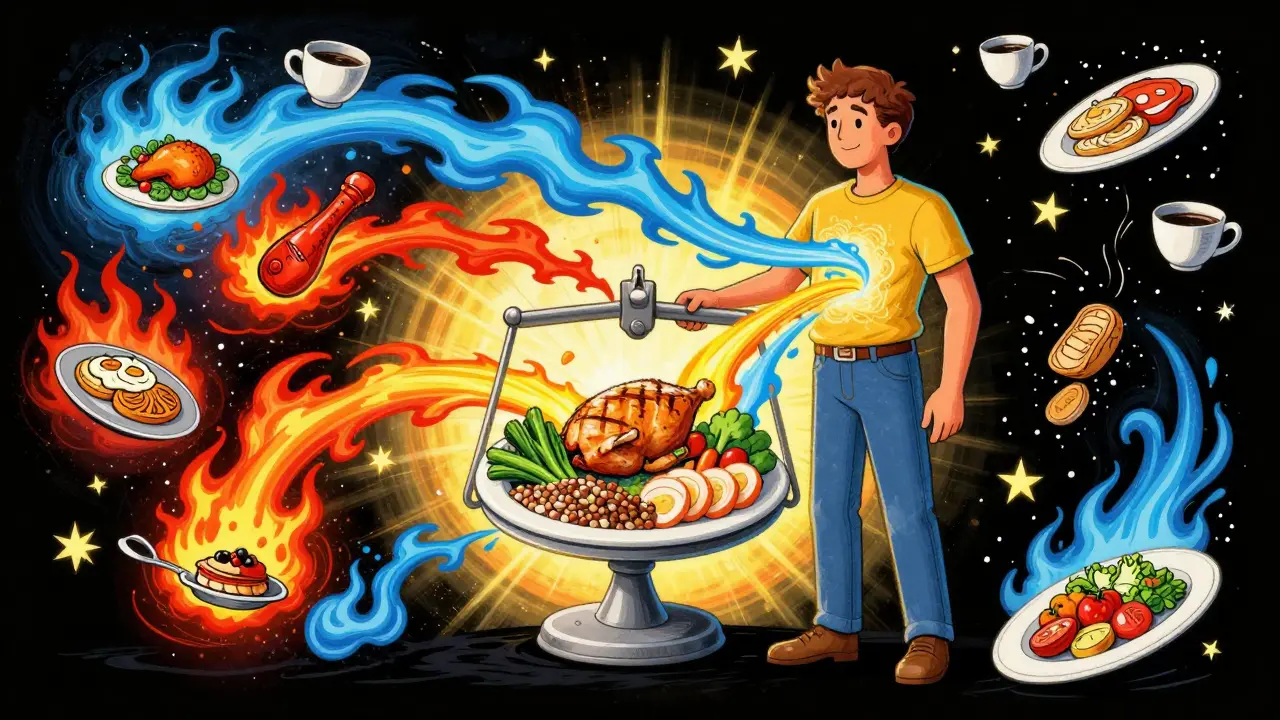
When you hear "caloric deficit," you might think it’s just about eating less. But if that were true, everyone who cut calories would lose weight easily-and stay off it. The truth? It’s way more complicated than that. In Perth, where coffee runs and weekend brunches are part of the rhythm, understanding caloric deficit isn’t about deprivation. It’s about working with your body, not against it.
What a Caloric Deficit Really Means
A caloric deficit happens when you burn more energy than you take in. Simple, right? But here’s what most people miss: your body doesn’t just sit there and let you burn fat. It fights back. Every time you eat fewer calories, your metabolism adjusts. It slows down. Hormones shift. You get hungrier. This isn’t weakness-it’s biology. The idea isn’t new. Back in the 1890s, German scientist Max Rubner figured out that energy balance governs weight. Fast forward to today, and research from the National Institutes of Health confirms it: you can’t lose fat without a deficit. But the old rule-"3,500 calories equals one pound of fat"-is outdated. That math assumes your body stays the same. It doesn’t.Why Weight Loss Slows Down (Even When You’re Doing Everything Right)
Let’s say you start with a 500-calorie daily deficit. You might lose about a pound a week at first. Great. But after a few weeks, the scale stops moving. You’re eating the same, working out, and still no change. What’s going on? Your body drops its energy use by more than you’d expect. Studies show that after losing 10% of your body weight, your resting metabolism slows down by about 15% more than just the weight loss alone. That’s not a myth. It’s measured. In one trial, people burned 55 extra calories per day less than predicted-just because they’d lost weight. Why? Your muscles shrink a bit. Your kidneys shrink too. Your thyroid slows. Leptin, the hormone that tells your brain you’re full, crashes by 50-70%. Ghrelin, the hunger hormone, spikes. You’re not lazy. You’re not failing. Your body is protecting you.What Happens When You Cut Too Much
Some people think: "If 500 calories works, then 1,000 must be twice as good." Not even close. Cutting more than 1,000 calories a day triggers a survival mode. Your body starts breaking down muscle for energy. Your energy plummets. You feel tired, irritable, cold. And the worse part? When you go back to normal eating, you gain back more fat than you lost. The Cleveland Clinic recommends starting with a 250-500 calorie deficit. That’s it. Enough to lose about 0.5-1 pound per week. Slow, steady, sustainable. Bigger cuts don’t mean faster results-they mean more muscle loss, more hunger, and a higher chance of quitting.
It’s Not Just About Calories
You can eat 1,200 calories of candy and still be in a deficit. But you’ll feel awful. Your blood sugar will spike and crash. You’ll crave more. Your body will hold onto fat because it’s stressed. The quality of your calories matters. Protein is key. Aim for 1.6-2.2 grams per kilogram of body weight. That means if you weigh 70 kg, you need 112-154 grams of protein a day. It keeps your muscles intact, keeps you full, and helps your metabolism stay stable. Fiber-rich foods like vegetables, beans, and whole grains add volume without many calories. A big salad with grilled chicken fills you up more than a small bag of chips-even if they have the same calories. And here’s something surprising: low-carb diets might give you a slight metabolic edge. One study found people on low-carb diets burned about 57 extra calories a day compared to low-fat diets after weight loss. But that advantage fades over time. The real win? Eating a way you can stick with.How to Beat the Plateau
Plateaus aren’t failures. They’re signals. Your body has adapted. To reset it, try a diet break. Eat at your maintenance calories for 1-2 weeks. No restriction. Just normal eating. Then go back to your deficit. Studies show this reduces metabolic slowdown and helps you lose more fat long-term. Another trick? Move more-but not just cardio. Strength training preserves muscle. Muscle burns more calories at rest than fat. Lifting weights three times a week can make a huge difference in how your body responds to a deficit. And track your food-not for perfection, but for awareness. Most people underestimate their intake by 20-30%. Weigh your food for two weeks. Use an app. Get honest. You’ll be shocked at how much hidden sugar and oil is in "healthy" meals.What Actually Works for Long-Term Success
The National Weight Control Registry tracks over 10,000 people who’ve lost at least 13 kg and kept it off for over a year. What do they all do? They eat around 1,800 calories a day and burn 2,700 through activity. That’s a 900-calorie deficit-but it’s spread out across food and movement. They don’t count every gram. They don’t starve. They eat protein-rich meals, stay active, and avoid extreme diets. They accept that weight loss isn’t linear. They celebrate non-scale wins: better sleep, more energy, clothes fitting looser. And here’s the hard truth: only 20% of people keep off 10% of their weight after a year. Why? Because after weight loss, your body still acts like it’s starving. Hormones stay off-kilter for years. That’s why maintenance isn’t just about willpower-it’s about strategy.
What to Do Instead of Counting Calories Forever
Forget the idea that you need to count calories for life. That’s not sustainable. Instead, learn energy balance. Know your maintenance level. Eat enough protein. Move regularly. Sleep well. Manage stress. These habits keep your metabolism stable. Use apps like MyFitnessPal or Cronometer to check your intake for a few weeks-not forever. Then, switch to intuitive cues: hunger, fullness, energy levels. If you’re consistently losing 0.3-0.5 kg a week, you’re on track. If you’re not, adjust slightly. The goal isn’t to be perfect. It’s to be consistent. One good week isn’t enough. One bad week doesn’t ruin everything. Progress is made over months, not days.Why Most Diets Fail (And How to Avoid It)
The weight loss industry makes $261 billion a year selling quick fixes. But the science is clear: no magic pill, no cleanse, no juice detox works without a caloric deficit. The real difference? How you stick to it. People who succeed don’t follow trends. They build habits. They eat meals they enjoy. They don’t cut out carbs entirely-they just eat them with protein and fiber. They walk daily. They lift weights. They sleep 7-8 hours. They don’t punish themselves for a slice of cake. The biggest mistake? Thinking weight loss is a short-term project. It’s not. It’s a lifestyle shift. And the only way to make it last is to make it feel like life-not a punishment.How many calories should I cut to lose weight safely?
A safe and sustainable deficit is 15-25% below your maintenance calories. For most people, that’s 250-500 calories per day. This leads to about 0.5-1 kg of weight loss per week. Larger deficits increase muscle loss and trigger stronger metabolic slowdown, making long-term success harder.
Why am I not losing weight even though I’m in a deficit?
Your body adapts. After a few weeks, your metabolism slows down more than expected, and hunger hormones rise. You might also be underestimating your intake. Try weighing food for two weeks to get accurate numbers. Also, check your sleep, stress, and activity levels-these all affect weight loss.
Do I need to count calories forever?
No. Use tracking for 2-4 weeks to learn portion sizes and hidden calories. After that, switch to mindful eating: listen to hunger cues, prioritize protein and fiber, and stay active. You don’t need to log every meal to stay lean.
Can I lose weight without exercise?
Yes, but it’s harder. Exercise, especially strength training, helps preserve muscle, boosts metabolism, and improves insulin sensitivity. Without it, you’ll lose more muscle than fat, making it easier to regain weight later. Movement isn’t optional for long-term results.
What’s the best diet for a caloric deficit?
The best diet is the one you can stick to. High-protein, high-fiber diets with whole foods work best for most people. Whether it’s low-carb, Mediterranean, or plant-based, the key is consistency. Avoid extreme restrictions-they lead to rebound hunger and metabolic slowdown.
How long does metabolic adaptation last after weight loss?
Studies show metabolic slowdown and hormonal changes can last years after weight loss. The famous "Biggest Loser" study found participants’ metabolisms stayed suppressed even six years later. That’s why maintenance requires ongoing effort-eating enough protein, staying active, and managing stress.
Yuri Hyuga
January 20, 2026 AT 18:32Okay but let’s be real-caloric deficit is the baseline, not the whole story. 🌱 I’ve seen people drop 20lbs on junk food and then gain it all back because they didn’t rebuild their relationship with food. It’s not about willpower. It’s about wisdom. Your body isn’t a calculator. It’s a living, breathing, hormone-swinging masterpiece that just wants to survive. So yes, deficit? Essential. But also: sleep, stress management, protein, and joy. If you hate your meals, you won’t stick with them. And if you’re miserable, you’re not losing weight-you’re just surviving. 💪❤️
MARILYN ONEILL
January 21, 2026 AT 15:18Ugh. I tried this. Ate salad every day. Lost 5 lbs. Then gained 10. Turns out my body just hates me. Now I eat pizza. And I’m happy. Why do people make this so hard? It’s just calories. Stop overthinking.
Coral Bosley
January 23, 2026 AT 10:24I used to think I was failing because I couldn’t stick to a 1,200-calorie diet. Then I realized I was starving myself and crying into my oatmeal every night. My body wasn’t broken-it was screaming. I started eating more protein, lifting weights, and letting myself have chocolate. Not because I ‘deserved it’-because I’m human. And guess what? I lost 18 lbs in 6 months without feeling like a prisoner. This isn’t punishment. It’s self-respect.
Steve Hesketh
January 25, 2026 AT 09:58Brother, I’m from Lagos and we don’t have fancy apps or scales here-but we know food. We eat yam with palm oil, beans with pepper, and we move. We walk everywhere. We don’t count calories. We listen. If you’re hungry, eat. If you’re full, stop. If your energy is low, rest. The body knows. The West overcomplicates everything with graphs and apps. The truth? Eat real food. Move your body. Sleep. Repeat. No magic. Just rhythm. And yes, your metabolism will adapt-but so will you, if you’re gentle with yourself. You got this. 🙌
MAHENDRA MEGHWAL
January 25, 2026 AT 18:30It is of paramount importance to recognize that the thermodynamic principle underpinning energy balance remains empirically valid. However, the physiological compensatory mechanisms induced by prolonged caloric restriction-particularly the downregulation of resting metabolic rate and the dysregulation of leptin and ghrelin-are well-documented in peer-reviewed literature. A deficit of 250–500 kcal/day is optimal for minimizing lean mass attrition and sustaining adherence. Furthermore, protein intake should be maintained at 1.6–2.2 g/kg of body weight to preserve nitrogen balance. This is not opinion-it is evidence-based physiology.
Dee Monroe
January 26, 2026 AT 04:45What no one tells you is that after you lose weight, your brain still thinks you’re starving. It’s like your body has a ghost of the old you haunting it-always whispering, ‘More food. More food.’ That’s why maintenance feels like a full-time job. I used to think I was weak for craving carbs after losing 30 lbs. Then I learned: it’s not weakness. It’s biology. And the only way to win is to stop fighting it. I eat like I’m still losing-just a little more. I lift. I sleep. I walk. I don’t track. I just know. And some days, I eat the whole pizza. And the next day, I eat the salad. Not because I’m good or bad. Because I’m human. And that’s okay. The goal isn’t to be perfect. It’s to be alive. And alive people eat pizza sometimes. And that’s beautiful.
Barbara Mahone
January 27, 2026 AT 22:04Interesting how the post conflates metabolic adaptation with failure. The data is clear: metabolic slowdown is a predictable physiological response, not a personal shortcoming. The National Weight Control Registry findings reinforce that long-term success correlates with consistent physical activity and dietary pattern stability-not rigid calorie counting. Furthermore, the 57-calorie daily advantage observed in low-carb diets is statistically insignificant over time and likely confounded by protein intake and satiety. The emphasis should remain on behavioral sustainability over metabolic manipulation.
Ashok Sakra
January 28, 2026 AT 09:41So you’re telling me I can’t just starve and be done with it? I tried that. I lost 15 lbs in 2 weeks. Felt like death. Then I gained 25. Now I’m back to square one. Why does everyone make this so complicated? I just want to be skinny. Why do I have to eat protein? Why do I have to lift? Why can’t I just not eat? You people make it sound like a religion. It’s just food. Just eat less. That’s it.