Calcium and Iron Mineral Interactions: How to Time Your Medications

You might think that taking a daily vitamin or mineral supplement is always a healthy move, but when paired with prescription drugs, those "healthy" pills can actually stop your medicine from working. Imagine taking a strong antibiotic for a stubborn infection, only to find out the calcium tablet you took for your bones effectively blocked the drug from entering your bloodstream. This isn't a rare glitch; it's a common chemical reaction called chelation.
The core problem is that certain minerals-specifically Calcium is an essential mineral found in dairy and supplements, often used to treat or prevent osteoporosis and Iron is a critical mineral used to treat anemia and maintain hemoglobin levels-act like magnets. They bind to medication molecules in your gut, creating a large, insoluble complex that your body simply cannot absorb. When this happens, the drug stays in your digestive tract and is eventually flushed out, leaving you untreated.
The Hidden Danger of Calcium-Drug Bindings
Calcium is one of the most common supplements globally, with research showing that roughly 67% of women and 25% of men take it regularly. However, its ability to bind with specific drugs can be a serious issue. The most notable targets are Tetracyclines (like doxycycline) and Fluoroquinolones (like ciprofloxacin). These are potent antibiotics used for everything from acne to severe respiratory infections.
If you take calcium carbonate-a common form found in many antacids and supplements-your body might absorb up to 40% less of a drug like ciprofloxacin. That's nearly half the medicine gone. In a real-world scenario, this means a bacterial infection that should have been cleared up in a week might persist or even worsen because the dose was effectively cut in half.
It's not just antibiotics. If you take Levothyroxine for an underactive thyroid, calcium can interfere with its bioavailability. Because thyroid hormones are calibrated to a very precise level in your blood, even a slight drop in absorption can lead to fatigue, weight gain, and brain fog.
Iron Supplements and the Acid Balance
Iron presents a different set of challenges. Like calcium, iron can bind to tetracycline antibiotics, making them significantly less effective. But iron has an additional quirk: it is highly dependent on the pH level of your stomach to be absorbed. It needs an acidic environment to "unlock" and enter your system.
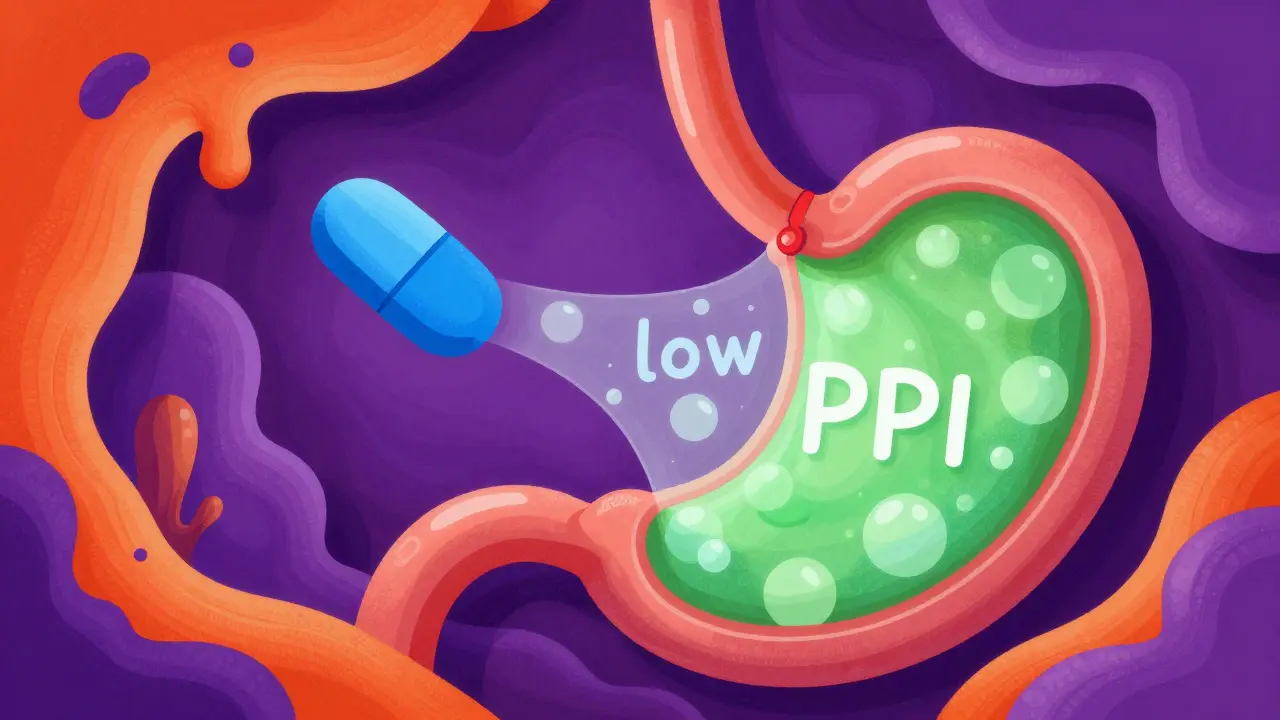
This is where heartburn medications come into play. Proton Pump Inhibitors (PPIs) (such as omeprazole or pantoprazole) and H2 blockers (like famotidine) work by reducing stomach acid. By making your stomach less acidic, these drugs inadvertently make it much harder for your body to absorb iron supplements like Ferrous Fumarate. If you are treating anemia while managing chronic acid reflux, you might find that your iron levels aren't budging despite taking your supplements daily.
| Mineral | Commonly Affected Drugs | Primary Mechanism | Typical Spacing Need |
|---|---|---|---|
| Calcium | Fluoroquinolones, Tetracyclines, Levothyroxine | Chelation (Binding) | 2 to 6 hours |
| Iron | Tetracyclines, PPIs, H2 Blockers | Binding & pH Interference | 2 to 4 hours |
Mastering the Timing: How to Space Your Doses
The only real way to prevent these interactions is through a strict timing strategy. You can't simply take a pill and a supplement at the same time and hope for the best. You need to create a "buffer zone" in your digestive tract so the medication can be absorbed before the mineral arrives, or vice versa.
For those on thyroid medication, the rule is strict: leave at least four hours between your levothyroxine dose and your calcium supplement. This ensures the hormone reaches your bloodstream without interference. For antibiotics, the general guideline is to take the medication at least 2 hours before or 4 hours after taking an iron supplement.
When dealing with iron and acid reducers, the strategy is about maximizing acid. Experts recommend taking your iron supplement up to 2 hours before you take your heartburn medication. This gives the iron a window of time to absorb while the stomach environment is still naturally acidic.
Practical Tips for Better Absorption
Beyond just timing, what you drink with your supplements matters. Many people instinctively reach for a glass of milk to wash down a pill, but if that pill is an iron supplement for anemia, milk is a bad choice. The calcium in milk binds to the iron, preventing it from being absorbed.
Instead, try these relatable hacks to ensure you get the most out of your nutrients:
- The Citrus Trick: Take iron supplements with a glass of orange juice. The mild acidity of the juice helps break down the iron and enhances absorption.
- The Morning/Evening Split: If you take a thyroid pill first thing in the morning, schedule your calcium supplement for the evening. This creates a natural 10-hour gap, far exceeding the minimum 4-hour requirement.
- The Supplement Audit: Check your multivitamins. Many contain both calcium and iron in the same tablet. While convenient, this can sometimes limit the absorption of both. If you have a clinical deficiency, separate supplements are often better.

Navigating the Complexity of Polypharmacy
As we age or deal with chronic conditions, we often end up with "polypharmacy"-taking multiple medications at once. This makes the scheduling puzzle even harder. Parents often struggle with this when a child has anemia (requiring iron) but also needs an antibiotic for acne (tetracycline). In these cases, a simple calendar or alarm system on your phone is essential.
It is also worth noting that these interactions aren't just about supplements. Many "over-the-counter" antacids are packed with calcium carbonate. If you're popping a Tums for occasional heartburn while on a course of ciprofloxacin, you're potentially compromising your treatment. Always treat your antacids as if they were prescription-strength supplements when it comes to timing.
Can I take my calcium supplement and antibiotic at the same time?
Generally, no. For antibiotics like tetracyclines and fluoroquinolones, calcium can bind to the drug and prevent it from being absorbed. You should usually separate them by at least 2 to 6 hours, or avoid the supplement entirely during the short course of the antibiotic.
Why does orange juice help with iron absorption?
Iron absorption is pH-dependent and requires an acidic environment. The ascorbic acid (Vitamin C) and citric acid in orange juice lower the pH in the stomach, making it easier for the iron to be absorbed into the bloodstream.
Does milk block iron absorption?
Yes, milk contains calcium which can bind with iron, forming an insoluble complex. This significantly reduces the amount of iron your body can absorb, which is why it's recommended to avoid dairy products when taking iron supplements.
How long should I wait between taking Levothyroxine and Calcium?
Clinical evidence suggests a gap of at least four hours is necessary. Calcium decreases the bioavailability of thyroid hormones, and a shorter window could lead to suboptimal thyroid levels.
Do PPIs like Omeprazole affect iron levels?
Yes. Proton Pump Inhibitors reduce the production of gastric acid. Since iron needs that acid to be absorbed, long-term use of PPIs can lead to decreased iron absorption and potentially contribute to anemia.
Next Steps for Your Health Routine
If you are currently taking a combination of minerals and prescriptions, don't panic, but do take action. Start by listing every supplement you take, including multivitamins and antacids. Compare this list against your prescriptions.
If you spot a potential overlap-especially with antibiotics or thyroid meds-talk to your pharmacist. They can provide a precise dosing schedule tailored to your specific medications. In the meantime, consider shifting your supplement intake to a different time of day to ensure you're getting the full benefit of your medical treatment.
Divine Manna
April 5, 2026 AT 16:40It is profoundly characteristic of the modern medical consumer to ignore the basic stoichiometry of chelation until a curated list is presented to them. Most individuals simply lack the intellectual discipline to read a pharmacy insert, preferring instead to treat their bodies like a random chemistry experiment. One must realize that the biological system is not a series of isolated compartments, but a complex equilibrium where the introduction of a divalent cation like calcium can catastrophically disrupt the pharmacokinetics of a fluoroquinolone. It is a simple matter of chemical affinity, yet the general public treats it as some arcane mystery. Proper timing is not merely a suggestion; it is the only logical way to ensure therapeutic efficacy. If one cannot manage a basic schedule, one has no business attempting self-directed supplementation.
Brian Shiroma
April 7, 2026 AT 07:14Yeah, because we all know how great it is to spend our mornings doing a complex math equation just to take a pill without accidentally neutralizing it. Truly a peak healthcare experience.
Goodwin Colangelo
April 8, 2026 AT 00:07Definitely a good call to double-check those multivitamin labels. A lot of people don't realize that taking a 'one-a-day' might actually be counterproductive if you're fighting a specific deficiency or taking a prescription. If you're feeling off, just hit up your pharmacist-they're usually way more accessible than the doctor and know this timing stuff inside out.
Rachelle Z
April 9, 2026 AT 23:32OMG!!! I literally did this for years and wondered why my meds weren't working!!! 😱 Total facepalm moment right here!!! Thanks for the heads up!!! ✨
Branden Prunica
April 11, 2026 AT 18:05I can't even deal with this. I'm staring at my supplement cabinet and I feel like my entire health routine has been a total lie! My thyroid levels have been all over the place and now I find out my morning calcium was basically sabotaging me this whole time! Absolute tragedy!
Rob Newton
April 11, 2026 AT 20:51Overblown. Most people absorb enough regardless.
Ace Kalagui
April 13, 2026 AT 04:58I really appreciate how this post breaks everything down so simply because it's so easy to get overwhelmed when you're managing a few different things at once, and I think it's just so important for us to support one another by sharing these kinds of practical tips that can actually change our quality of life in a huge way. For anyone struggling with the schedule, maybe try setting a series of alarms on your phone with labels like 'Iron Time' or 'Calcium Gap' so you don't have to stress about the clock and can just focus on getting better!
Beth LeCours
April 13, 2026 AT 19:42too long. just don't take them together.
Sakshi Mahant
April 15, 2026 AT 06:17This is very helpful information. In many cultures, we rely heavily on dietary sources of these minerals, so understanding how they interact with modern medicine is quite important for a balanced approach to health.
HARSH GUSANI
April 16, 2026 AT 02:46Who cares about these pills 🙄 My country has better natural ways to fix anemia anyway! These Western meds are just a scam to make money 🇮🇳💪
angel sharma
April 16, 2026 AT 04:20This is exactly the kind of knowledge we need to actually take control of our wellness journeys and stop guessing with our health because when you realize that a simple glass of orange juice can be the key to unlocking your iron absorption it just shows how powerful small changes are! Keep pushing for better health and keep educating yourselves because the more we know the stronger we become both physically and mentally!